Brazil Plumbing Components Market Size, Share & Growth Rate
The Brazil Plumbing Components Market was estimated at USD 190 Million in 2025 and is projected to reach USD 225 Million by 2032, growing at a CAGR of 2.4% from 2026 to 2032. This growth trajectory is primarily fueled by the robust construction and real estate sectors in Brazil, which are driving an increased demand for high-quality plumbing components across residential, commercial, and industrial applications. Furthermore, the rise of innovative water conservation technologies and the ongoing implementation of advanced plumbing systems are pivotal in reinforcing this markets expansion.
Brazil Plumbing Components Market Year-wise Growth Rate and Key Drivers
This graph highlights how the Brazil Plumbing Components Market has steadily grown over the years, supported by major growth factors.
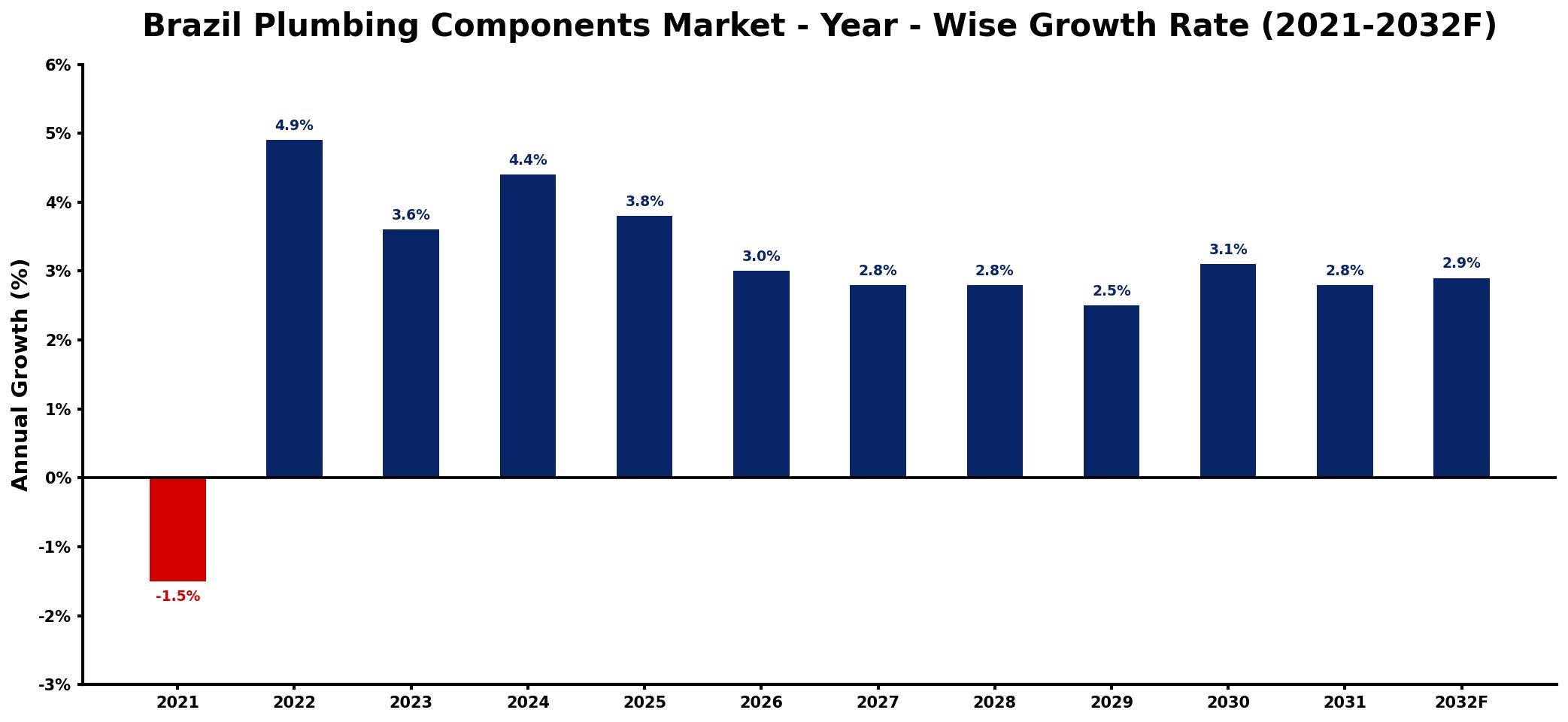
The table below presents the year‑wise growth rates along with the key drivers influencing the market
| Year | Growth Rate | Major Drivers |
| 2021 | -1.5% | construction activity faced setbacks |
| 2022 | 4.9% | residential sector saw resurgence |
| 2023 | 3.6% | infrastructure projects gained momentum |
| 2024 | 4.4% | commercial investments increased significantly |
| 2025 | 3.8% | housing market experienced growth |
| 2026 | 3.0% | sustainability initiatives drove demand |
| 2027 | 2.8% | renovation projects expanded rapidly |
| 2028 | 2.8% | technological advancements attracted investments |
| 2029 | 2.5% | government incentives spurred activity |
| 2030 | 3.1% | urbanization trends fueled expansion |
| 2031 | 2.8% | eco-friendly solutions gained popularity |
| 2032 | 2.9% | global supply chains improved efficiency |
Note: Market size estimations and growth projections presented in this report are based on 6Wresearch's proprietary forecasting methodology, utilizing the latest available industry data, government publications, and primary research inputs.
Brazil Plumbing Components Market Synopsis
The strongest force currently shaping the Brazil Plumbing Components Market is the government's focus on sustainable water usage and infrastructure development. Stricter regulations and standards for plumbing materials and fixtures are compelling manufacturers and suppliers to innovate continuously, ensuring compliance while catering to evolving consumer expectations.
Moreover, the surge in urbanization and the need for improved sanitation systems present additional momentum for this market. As the construction sector seeks to adapt to modern practices, the demand for water-efficient plumbing solutions continues to rise, driving industry growth.
Brazil Plumbing Components Market Key Takeaways
- Government regulations are enhancing standards for plumbing materials, emphasizing water conservation.
- The booming construction sector is increasing demand for high-quality plumbing components.
- Innovation in water-saving technologies is critical for market participants to maintain competitiveness.
- Urbanization drives the necessity for upgraded plumbing systems in both existing and new infrastructures.
- Compliance with evolving building codes presents ongoing challenges for the industry.
Evaluation of Restraints in Brazil Plumbing Components Market
Despite its growth potential, the Brazil Plumbing Components Market faces several restraints. The need to adapt to rapidly changing construction practices and materials poses significant challenges for manufacturers. As building codes evolve to prioritize sustainability and water conservation, companies must invest in research and development to stay compliant and competitive. Economic fluctuations also affect construction activity, leading to variable demand for plumbing components. Moreover, competition from alternative materials and technologies necessitates continuous innovation, further stretching industry resources.
Brazil Plumbing Components Market Trends
Several key trends are currently shaping the Brazil Plumbing Components Market. First, the push for smart technology integration in plumbing systems is transforming traditional approaches, leading to enhanced efficiency and performance. Second, theres a noticeable shift toward sustainable materials as manufacturers align with environmental standards and consumer expectations for eco-friendly products. Lastly, the increasing focus on water conservation is encouraging innovations in design and functionality, further expanding market opportunities.
Brazil Plumbing Components Market Opportunities
The Brazil Plumbing Components Market holds numerous growth and investment opportunities. With government incentives promoting water-saving technologies, businesses that innovate in this area can gain a significant competitive edge. Additionally, expanding urban areas provide fertile ground for new construction projects, necessitating advanced plumbing solutions. The retrofitting of existing structures with modern plumbing systems also represents a substantial market opportunity as older infrastructures require upgrades to meet current standards.
Government Initiatives in the Brazil Plumbing Components Market
The Brazilian government is actively shaping the plumbing components market through various initiatives aimed at improving water and sanitation systems across the country. Policies focusing on quality standards for plumbing materials and fixtures are essential for ensuring public health and environmental sustainability. Additionally, government programs designed to incentivize the adoption of water-saving technologies encourage innovation within the sector, aligning economic growth with responsible water usage practices.
Future Insights of the Brazil Plumbing Components Market
Looking ahead to 2026-2032, the Brazil Plumbing Components Market is poised for steady growth, driven by ongoing urbanization and the necessity for improved infrastructure. Innovations in plumbing technology will likely play a pivotal role in shaping market dynamics, especially as companies respond to both regulatory changes and consumer preferences. The emphasis on sustainability and efficient water use is expected to continue influencing product development and industry practices, paving the way for a resilient and adaptive market landscape.
Brazil Plumbing Components Market Latest Developments (2025 - 2026)
In recent months, the Brazil Plumbing Components Market has witnessed a surge in advancements centered around sustainable practices and water efficiency. There is an increasing collaboration between governmental bodies and industry stakeholders to enhance compliance with new regulations. Companies are also investing in cutting-edge technologies that facilitate better water management, aligning their offerings with the latest market demands. This direction indicates a robust commitment to not only meeting current standards but also anticipating future requirements.
Brazil Plumbing Components Market - Key Attractiveness of the Report
- 10 Years of Market Numbers
- Historical Data Starting from 2022 to 2025
- Base Year: 2025
- Forecast Data until 2032
- Key Performance Indicators Impacting the Market
- Major Upcoming Developments and Projects
Key Highlights of the Report:
- Brazil Plumbing Components Market Outlook
- Market Size of Brazil Plumbing Components Market, 2025
- Forecast of Brazil Plumbing Components Market, 2032
- Historical Data and Forecast of Brazil Plumbing Components Revenues & Volume for the Period 2022-2032F
- Brazil Plumbing Components Market Trend Evolution
- Brazil Plumbing Components Market Drivers and Challenges
- Brazil Plumbing Components Price Trends
- Brazil Plumbing Components Porter's Five Forces
- Brazil Plumbing Components Industry Life Cycle
- Historical Data and Forecast of Brazil Plumbing Components Market Revenues & Volume By Product for the Period 2022-2032F
- Historical Data and Forecast of Brazil Plumbing Components Market Revenues & Volume By Fittings for the Period 2022-2032F
- Historical Data and Forecast of Brazil Plumbing Components Market Revenues & Volume By Manifolds for the Period 2022-2032F
- Historical Data and Forecast of Brazil Plumbing Components Market Revenues & Volume By Pipes for the Period 2022-2032F
- Historical Data and Forecast of Brazil Plumbing Components Market Revenues & Volume By Valves for the Period 2022-2032F
- Historical Data and Forecast of Brazil Plumbing Components Market Revenues & Volume By End User for the Period 2022-2032F
- Historical Data and Forecast of Brazil Plumbing Components Market Revenues & Volume By Residential for the Period 2022-2032F
- Historical Data and Forecast of Brazil Plumbing Components Market Revenues & Volume By Non-residential for the Period 2022-2032F
- Historical Data and Forecast of Brazil Plumbing Components Market Revenues & Volume By Application for the Period 2022-2032F
- Historical Data and Forecast of Brazil Plumbing Components Market Revenues & Volume By Bathtubs for the Period 2022-2032F
- Historical Data and Forecast of Brazil Plumbing Components Market Revenues & Volume By Showerheads for the Period 2022-2032F
- Historical Data and Forecast of Brazil Plumbing Components Market Revenues & Volume By Faucets for the Period 2022-2032F
- Historical Data and Forecast of Brazil Plumbing Components Market Revenues & Volume By Others for the Period 2022-2032F
- Brazil Plumbing Components Import Export Trade Statistics
- Market Opportunity Assessment By Product
- Market Opportunity Assessment By End User
- Market Opportunity Assessment By Application
- Brazil Plumbing Components Top Companies Market Share
- Brazil Plumbing Components Competitive Benchmarking By Technical and Operational Parameters
- Brazil Plumbing Components Company Profiles
- Brazil Plumbing Components Key Strategic Recommendations






































