Brazil Polypropylene Market Growth Rate Analysis (2021-2031)
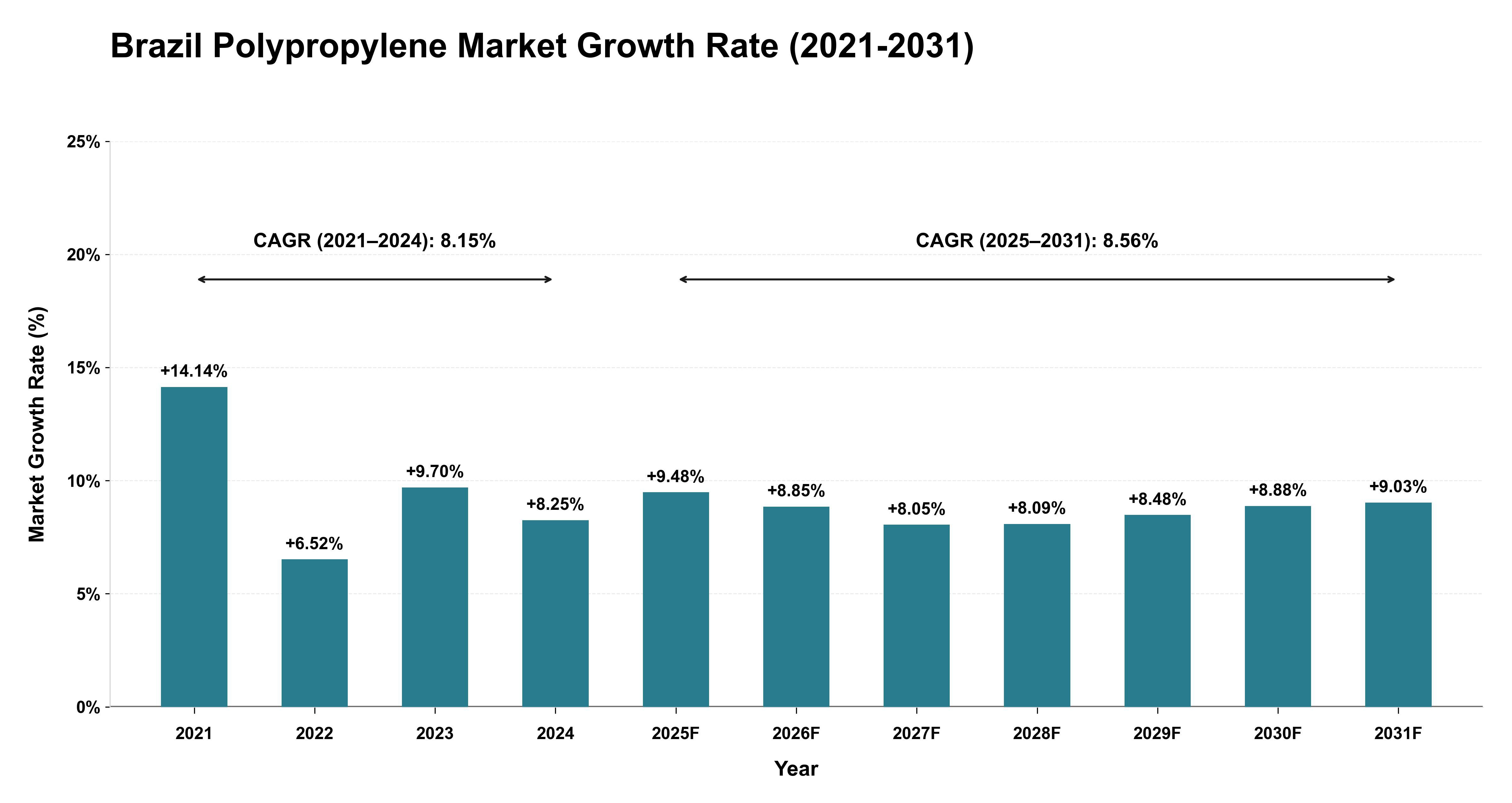
The Brazil Polypropylene Market experienced robust growth from 2021 to 2024, with a CAGR of 8.15%, driven by increased manufacturing output and infrastructure development. Despite a slight slowdown in 2022 due to temporary demand adjustments, the market rebounded in subsequent years. Looking towards 2031, the market is projected to maintain a steady growth trajectory with a CAGR of 8.56%, indicating stabilization post-pandemic surge, supported by ongoing investments in infrastructure projects and capital expenditures. The market is expected to continue expanding, benefiting from a favorable economic environment and industrial activities boosting demand for polypropylene products.
Brazil Polypropylene Market Overview
In Brazil, the Polypropylene market has established itself as a crucial segment within the polymer industry. Polypropylene`s versatility and cost-effectiveness have driven its adoption in packaging, automotive components, and consumer goods. The market`s dynamism is evident in the continuous innovation and development of polypropylene-based products, meeting the evolving demands of various end-use sectors.
Drivers of the market
The Brazil Polypropylene market is experiencing robust growth, propelled by the versatile applications of polypropylene in diverse industries. As a thermoplastic polymer, polypropylene is widely used in packaging, automotive, construction, and consumer goods due to its lightweight nature, excellent chemical resistance, and low cost. The market is further driven by innovations such as the development of high-performance grades of polypropylene, expanding its application scope and meeting the evolving demands of end-users.
Challenges of the market
The Brazil Polypropylene market grapples with challenges such as market saturation and intense competition. Oversupply situations can lead to price volatility, impacting the profitability of market players. Moreover, the need for technological advancements and product innovation is crucial to differentiate polypropylene products in a crowded market.
Government Policy of the market
In the Polypropylene Market, the Brazil government has implemented policies to support domestic production, encourage innovation, and ensure product standards. These measures aim to bolster the Polypropylene industry`s growth and strengthen its role in the national economy.
Key Highlights of the Report:
- Brazil Polypropylene Market Outlook
- Market Size of Brazil Polypropylene Market, 2024
- Forecast of Brazil Polypropylene Market, 2031
- Historical Data and Forecast of Brazil Polypropylene Revenues & Volume for the Period 2018 - 2031
- Brazil Polypropylene Market Trend Evolution
- Brazil Polypropylene Market Drivers and Challenges
- Brazil Polypropylene Price Trends
- Brazil Polypropylene Porter's Five Forces
- Brazil Polypropylene Industry Life Cycle
- Historical Data and Forecast of Brazil Polypropylene Market Revenues & Volume By Type for the Period 2018 - 2031
- Historical Data and Forecast of Brazil Polypropylene Market Revenues & Volume By Homopolymer for the Period 2018 - 2031
- Historical Data and Forecast of Brazil Polypropylene Market Revenues & Volume By Copolymer for the Period 2018 - 2031
- Historical Data and Forecast of Brazil Polypropylene Market Revenues & Volume By Application for the Period 2018 - 2031
- Historical Data and Forecast of Brazil Polypropylene Market Revenues & Volume By Injection Molding for the Period 2018 - 2031
- Historical Data and Forecast of Brazil Polypropylene Market Revenues & Volume By Fiber & Raffia for the Period 2018 - 2031
- Historical Data and Forecast of Brazil Polypropylene Market Revenues & Volume By Film & Sheet for the Period 2018 - 2031
- Historical Data and Forecast of Brazil Polypropylene Market Revenues & Volume By Blow Molding for the Period 2018 - 2031
- Historical Data and Forecast of Brazil Polypropylene Market Revenues & Volume By End-use Industry for the Period 2018 - 2031
- Historical Data and Forecast of Brazil Polypropylene Market Revenues & Volume By Packaging for the Period 2018 - 2031
- Historical Data and Forecast of Brazil Polypropylene Market Revenues & Volume By Automotive for the Period 2018 - 2031
- Historical Data and Forecast of Brazil Polypropylene Market Revenues & Volume By Building & Construction for the Period 2018 - 2031
- Historical Data and Forecast of Brazil Polypropylene Market Revenues & Volume By Electrical & Electronics for the Period 2018 - 2031
- Historical Data and Forecast of Brazil Polypropylene Market Revenues & Volume By Medical for the Period 2018 - 2031
- Brazil Polypropylene Import Export Trade Statistics
- Market Opportunity Assessment By Type
- Market Opportunity Assessment By Application
- Market Opportunity Assessment By End-use Industry
- Brazil Polypropylene Top Companies Market Share
- Brazil Polypropylene Competitive Benchmarking By Technical and Operational Parameters
- Brazil Polypropylene Company Profiles
- Brazil Polypropylene Key Strategic Recommendations






































