Brazil Radio Broadcast Receivers Market Size, Share & Growth Rate
The Brazil Radio Broadcast Receivers Market was estimated at USD 174 Million in 2025 and is projected to reach USD 207 Million by 2032, growing at a CAGR of 2.5% from 2026 to 2032. This growth trajectory is fueled by the enduring popularity of radio as a medium, characterized by its affordability and widespread accessibility across diverse demographics. Moreover, the integration of advanced technologies, such as digital and internet radio capabilities, is capturing the interest of consumers looking for innovative broadcasting solutions.
Brazil Radio Broadcast Receivers Market Year-wise Growth Rate and Key Drivers
This graph highlights how the Brazil Radio Broadcast Receivers Market has steadily grown over the years, supported by major growth factors.
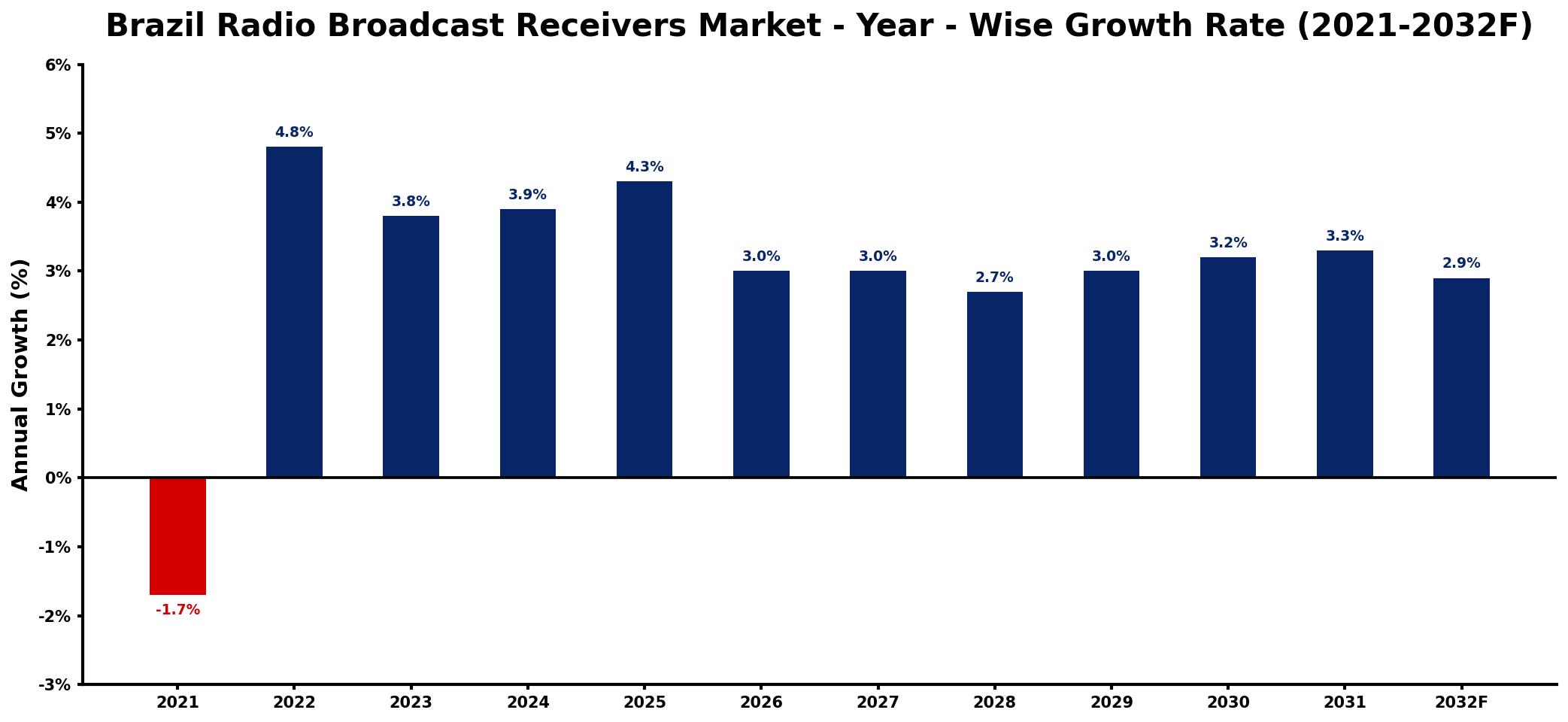
The table below presents the year‑wise growth rates along with the key drivers influencing the market
| Year | Growth Rate | Major Drivers |
| 2021 | -1.7% | Consumer preferences shifted towards digital |
| 2022 | 4.8% | Increased demand for portable devices |
| 2023 | 3.8% | Technological advancements in sound quality |
| 2024 | 3.9% | Growth in outdoor recreational activities |
| 2025 | 4.3% | improved processing technologies adoption |
| 2026 | 3.0% | Expansion of streaming services availability |
| 2027 | 3.0% | Higher investments in entertainment technology |
| 2028 | 2.7% | Increased advertising spending in media |
| 2029 | 3.0% | Surge in urban commuting trends |
| 2030 | 3.2% | enhanced product quality standards |
| 2031 | 3.3% | increased pharmaceutical industry usage |
| 2032 | 2.9% | Increased focus on sustainable materials |
Note: Market size estimations and growth projections presented in this report are based on 6Wresearch's proprietary forecasting methodology, utilizing the latest available industry data, government publications, and primary research inputs.
Brazil Radio Broadcast Receivers Market Synopsis
While the Brazil Radio Broadcast Receivers Market has maintained stable momentum due to traditional listening habits, the landscape is evolving. The increasing adoption of digital technologies is reshaping consumer expectations and driving demand for more advanced receivers that offer enhanced features.
Looking ahead, this market is poised to embrace significant changes, particularly as new forms of media become more prevalent. However, radio's unique ability to deliver localized content and foster community engagement ensures its relevance in the Brazilian media ecosystem, promoting sustained consumer interest and market growth.
Brazil Radio Broadcast Receivers Market Key Takeaways
- The market is expected to grow steadily, driven by a combination of traditional radio's popularity and technological advancements.
- Modern features such as digital connectivity are increasingly appealing to consumers, enhancing the functionality of radio receivers.
- Local content and community-driven programming remain key drivers of radio's enduring success in Brazil.
- Government policies supporting the broadcasting sector positively influence market dynamics and growth potential.
- Challenges from digital platforms exist, but radio retains a strong listener base, particularly in regional markets.
Evaluation of Restraints in Brazil Radio Broadcast Receivers Market
Despite its robust position, the Brazil Radio Broadcast Receivers Market faces several significant restraints. The emergence of digital media and streaming services is reshaping consumer habits, pulling attention away from traditional radio. This shift not only affects listener engagement but also poses challenges for advertising revenues that have historically supported the sector. Furthermore, regulatory barriers, including licensing and spectrum allocation, can create hurdles for market players, complicating efforts to innovate and expand. Companies must navigate these complexities while striving for profitability in a rapidly changing media landscape.
Brazil Radio Broadcast Receivers Market Trends
Several trends are currently shaping the Brazil Radio Broadcast Receivers Market. The shift toward digitalization is paramount, with more consumers seeking devices that offer digital radio capabilities and internet connectivity. Additionally, the rise of podcasts and on-demand audio content is influencing radio programming strategies, pushing broadcasters to diversify their content offerings. Enhanced interactivity through smart technologies is also making radio experiences more engaging, appealing to a tech-savvy audience.
Brazil Radio Broadcast Receivers Market Opportunities
The evolving landscape presents multiple avenues for growth and investment within the Brazil Radio Broadcast Receivers Market. Opportunities lie in upgrading existing receiver technology to include smart features, thereby enhancing the overall user experience. Furthermore, targeting niche markets through localized content can foster greater listener loyalty and engagement. Companies can also leverage partnerships with streaming platforms to offer hybrid solutions, appealing to consumers who seek both traditional radio and digital content.
Government Initiatives in the Brazil Radio Broadcast Receivers Market
Government initiatives play a pivotal role in shaping the Brazil Radio Broadcast Receivers Market. Policies aimed at promoting the broadcasting industry ensure effective spectrum allocation and streamline licensing requirements, fostering a favorable environment for market growth. Furthermore, regulatory frameworks that govern content standards and advertising practices create a structured landscape, encouraging companies to innovate while adhering to national guidelines. The government's support for digitalization initiatives also enhances the potential for convergence between radio broadcasting and emerging technologies.
Future Insights of the Brazil Radio Broadcast Receivers Market
The future of the Brazil Radio Broadcast Receivers Market from 2026 to 2032 appears optimistic, driven by the continued evolution of consumer preferences. As the digital transformation of media progresses, radio is likely to adopt more integrated approaches, merging traditional broadcasts with digital and online content delivery. The focus will increasingly shift to enhancing user experience, incorporating features that allow for interactivity and personalization. Given its deep-rooted presence in Brazilian culture, radio is expected to maintain its relevance, adapting to the changing dynamics of media consumption while exploring new growth avenues.
Brazil Radio Broadcast Receivers Market Latest Developments (2025 - 2026)
Recent developments within the Brazil Radio Broadcast Receivers Market indicate a marked shift towards digital integration. Companies are actively investing in research and development to innovate product offerings that align with consumer demands for connectivity and advanced features. Additionally, collaborations between radio stations and tech firms are increasing, paving the way for hybrid platforms that combine traditional broadcasting with modern digital solutions. Regulatory updates aimed at facilitating the transition to digital broadcasting are also shaping industry trends, underscoring a proactive approach to future challenges.
Brazil Radio Broadcast Receivers Market - Key Attractiveness of the Report
- 10 Years of Market Numbers
- Historical Data Starting from 2022 to 2025
- Base Year: 2025
- Forecast Data until 2032
- Key Performance Indicators Impacting the Market
- Major Upcoming Developments and Projects
Key Highlights of the Report:
- Brazil Radio Broadcast Receivers Market Outlook
- Market Size of Brazil Radio Broadcast Receivers Market, 2025
- Forecast of Brazil Radio Broadcast Receivers Market, 2032
- Historical Data and Forecast of Brazil Radio Broadcast Receivers Revenues & Volume for the Period 2022-2032F
- Brazil Radio Broadcast Receivers Market Trend Evolution
- Brazil Radio Broadcast Receivers Market Drivers and Challenges
- Brazil Radio Broadcast Receivers Price Trends
- Brazil Radio Broadcast Receivers Porter's Five Forces
- Brazil Radio Broadcast Receivers Industry Life Cycle
- Historical Data and Forecast of Brazil Radio Broadcast Receivers Market Revenues & Volume By Equipment for the Period 2022-2032F
- Historical Data and Forecast of Brazil Radio Broadcast Receivers Market Revenues & Volume By Modulators for the Period 2022-2032F
- Historical Data and Forecast of Brazil Radio Broadcast Receivers Market Revenues & Volume By Transmitters And Receivers for the Period 2022-2032F
- Historical Data and Forecast of Brazil Radio Broadcast Receivers Market Revenues & Volume By Encoders for the Period 2022-2032F
- Historical Data and Forecast of Brazil Radio Broadcast Receivers Market Revenues & Volume By Switches for the Period 2022-2032F
- Historical Data and Forecast of Brazil Radio Broadcast Receivers Market Revenues & Volume By Filters for the Period 2022-2032F
- Historical Data and Forecast of Brazil Radio Broadcast Receivers Market Revenues & Volume By Amplifiers for the Period 2022-2032F
- Historical Data and Forecast of Brazil Radio Broadcast Receivers Market Revenues & Volume By Frequency for the Period 2022-2032F
- Historical Data and Forecast of Brazil Radio Broadcast Receivers Market Revenues & Volume By Low Frequency for the Period 2022-2032F
- Historical Data and Forecast of Brazil Radio Broadcast Receivers Market Revenues & Volume By Medium Frequency for the Period 2022-2032F
- Historical Data and Forecast of Brazil Radio Broadcast Receivers Market Revenues & Volume By High Frequency for the Period 2022-2032F
- Brazil Radio Broadcast Receivers Import Export Trade Statistics
- Market Opportunity Assessment By Equipment
- Market Opportunity Assessment By Frequency
- Brazil Radio Broadcast Receivers Top Companies Market Share
- Brazil Radio Broadcast Receivers Competitive Benchmarking By Technical and Operational Parameters
- Brazil Radio Broadcast Receivers Company Profiles
- Brazil Radio Broadcast Receivers Key Strategic Recommendations






































