Brazil Radio Receivers Market Summary
The brazil radio receivers market was estimated at USD 200 Million in 2025 and is projected to reach USD 238 Million by 2032, growing at a CAGR of 2.5% from 2026 to 2032.
Brazil Radio Receivers Market Year-wise Growth Rate and Key Drivers
This graph highlights how the Brazil Radio Receivers Market has steadily grown over the past five years, supported by major growth factors.
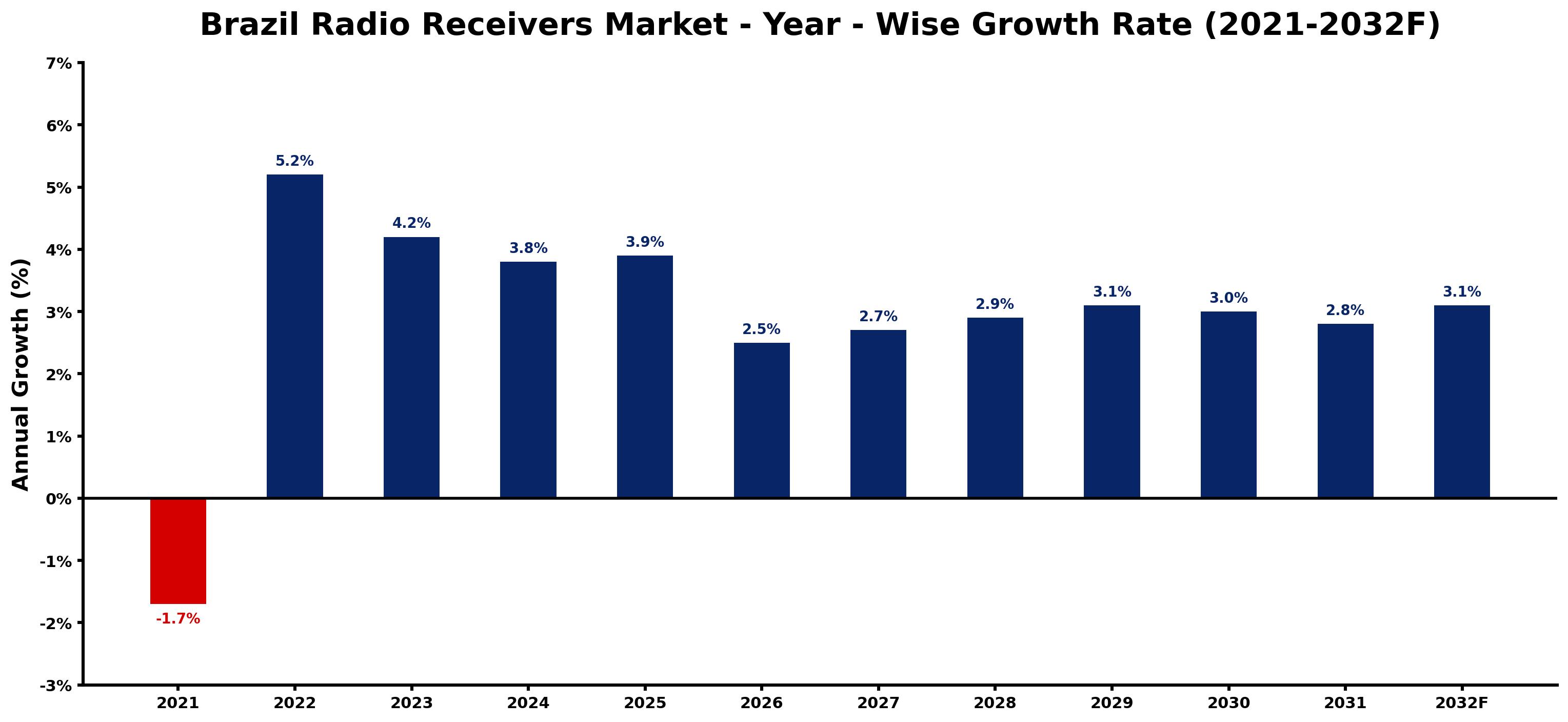
The table below presents the year wise growth rates along with the key drivers influencing the market
| Year | Growth Rate | Major Drivers |
| 2021 | -1.7% | Increased smartphone penetration led to diminished interest in traditional radio receivers among Brazilian consumers. |
| 2022 | 5.2% | Technological upgrades in radio broadcasting enhance sound quality, attracting new listeners. |
| 2023 | 4.2% | Emerging trends in digital radio platforms foster competition among existing manufacturers. |
| 2024 | 3.8% | Audio content diversification captures younger audiences, shifting traditional listening patterns. |
| 2025 | 3.9% | Urbanization trends drive demand for portable and car radio receivers in metropolitan areas. |
| 2026 | 2.5% | Localized content creation becomes essential, appealing to regional preferences and dialects. |
| 2027 | 2.7% | Partnerships between manufacturers and streaming services expand radio receiver functionalities. |
| 2028 | 2.9% | Sustainability concerns prompt a shift towards eco-friendly materials in radio manufacturing. |
| 2029 | 3.1% | Smart technology integration enables voice-activated features, enhancing user engagement. |
| 2030 | 3.0% | Consumer electronics' growth fuels innovation in multi-functional radio receiver designs. |
| 2031 | 2.8% | Niche markets for vintage radio receivers cultivate passionate collector communities. |
| 2032 | 3.1% | A robust infrastructure for FM broadcasting solidifies radio's position in media consumption. |
Note - Market size estimations and growth projections presented in this report are based on 6Wresearch's advanced forecasting approach, validated with industry datasets as of June 2026.
Brazil Radio Receivers Market Synopsis
The Brazil Radio Receivers Market is projected to reach 2.5% and witness significant growth during the forecast period (2026-2032). Despite the rise of digital streaming platforms, traditional radio receivers continue to maintain relevance, particularly in automotive and portable sectors. The increasing integration of advanced technologies, including digital radio capabilities and enhanced connectivity options, supports the adaptation of this market to contemporary consumer preferences and technological innovations.
Brazil Radio Receivers Market Growth Drivers
Several factors contribute to the growth of the Brazil Radio Receivers Market. The enduring appeal of radio as a source of entertainment and information remains a significant driver, encouraging manufacturers to innovate their offerings. Key growth drivers include:
- Widespread popularity of radio broadcasting, which remains a trusted medium for news and entertainment, particularly in rural areas.
- Technological advancements that enable the integration of digital radio and internet connectivity into radio devices, enhancing usability.
- Increased demand for automotive radio receivers as consumers seek enhanced audio experiences during travel.
- Growing use of portable radio receivers among outdoor enthusiasts, especially in events such as sports, festivals, and camping activities.
- Consumer interest in multi-functional devices that combine radio capabilities with other forms of media consumption.
Brazil Radio Receivers Market Challenges and Restraints
While the Brazil Radio Receivers Market is poised for growth, it also faces challenges that could hinder progress. Notable challenges include:
- The digital shift in broadcasting, which leads to changing consumer habits and preferences for online streaming services over traditional radio.
- Adaptation to new digital broadcasting standards that require significant investment and research from manufacturers.
- Issues related to signal quality and coverage, particularly in remote areas where connectivity may be limited.
- The need for manufacturers to innovate and incorporate internet radio features to maintain relevance in a competitive environment.
- Regulatory challenges concerning licensing and spectrum management that may impose additional constraints on market operations.
Brazil Radio Receivers Market Trends and Opportunities
As the landscape of media consumption evolves, the Brazil Radio Receivers Market presents a range of trends and opportunities for development. Emerging trends include:
- The integration of smart technologies in radio devices, enabling compatibility with smartphones and other digital platforms to enhance user experience.
- Increased focus on sustainability and eco-friendly manufacturing practices, reflecting a growing consumer preference for environmentally conscious products.
- Expansion of digital ecosystems that allow for seamless transitions between traditional radio and online streaming, fostering a hybrid consumption model.
- Investment in research and development to explore new functionalities and features that address evolving consumer needs.
- Collaborations between radio manufacturers and technology companies to leverage innovative solutions in product design and functionality.
Brazil Radio Receivers Market Government Investment and Initiatives
The Brazilian government plays a pivotal role in shaping the radio receivers market through several policies and initiatives aimed at fostering industry growth. Government investment often focuses on:
- Establishing regulatory frameworks that ensure compliance with broadcasting standards and electromagnetic compatibility, vital for maintaining market integrity.
- Promoting consumer protection laws that safeguard users against substandard devices and ensure fair practices within the market.
- Investing in infrastructure development to improve signal quality and coverage, particularly in underserved regions, thereby extending the reach of radio broadcasting.
- Implementing incentives for research and development initiatives that aim to modernize radio technology and encourage innovation.
- Fostering public awareness campaigns to promote the advantages of radio as an essential information and entertainment medium.
Brazil Radio Receivers Market Latest Developments (May 2025 - June 2026)
Recent developments in the Brazil Radio Receivers Market from May 2025 to June 2026 illustrate the industry's progressive trajectory. During this period:
- There has been an increase in the adoption of digital radio technologies, reflecting changing consumer preferences and an emphasis on modernizing traditional radio receivers.
- Manufacturers have begun to introduce hybrid devices that seamlessly integrate internet streaming capabilities with conventional radio functions.
- Collaborative efforts between government and industry stakeholders focused on improving regulations surrounding broadcasting standards and consumer protection.
- There has been a notable rise in consumer interest in multifunctional devices, indicating a shift toward more versatile audio solutions that include radio features.
- Market players have initiated initiatives aimed at enhancing signal quality and coverage, particularly in rural and mountainous regions of Brazil.
Brazil Radio Receivers Market - Key Attractiveness of the Report
- 10 Years of Market Numbers
- Historical Data Starting from 2022 to 2025
- Base Year: 2025
- Forecast Data until 2032
- Key Performance Indicators Impacting the Market
- Major Upcoming Developments and Projects
Key Highlights of the Report:
- Brazil Radio Receivers Market Outlook
- Market Size of Brazil Radio Receivers Market, 2025
- Forecast of Brazil Radio Receivers Market, 2032
- Historical Data and Forecast of Brazil Radio Receivers Revenues & Volume for the Period 2022-2032F
- Brazil Radio Receivers Market Trend Evolution
- Brazil Radio Receivers Market Drivers and Challenges
- Brazil Radio Receivers Price Trends
- Brazil Radio Receivers Porter's Five Forces
- Brazil Radio Receivers Industry Life Cycle
- Historical Data and Forecast of Brazil Radio Receivers Market Revenues & Volume By Product for the Period 2022-2032F
- Historical Data and Forecast of Brazil Radio Receivers Market Revenues & Volume By Power Amplifier for the Period 2022-2032F
- Historical Data and Forecast of Brazil Radio Receivers Market Revenues & Volume By Filters for the Period 2022-2032F
- Historical Data and Forecast of Brazil Radio Receivers Market Revenues & Volume By Antenna Switches for the Period 2022-2032F
- Historical Data and Forecast of Brazil Radio Receivers Market Revenues & Volume By Modulators and Demodulators for the Period 2022-2032F
- Historical Data and Forecast of Brazil Radio Receivers Market Revenues & Volume By Duplexer for the Period 2022-2032F
- Historical Data and Forecast of Brazil Radio Receivers Market Revenues & Volume By Others for the Period 2022-2032F
- Historical Data and Forecast of Brazil Radio Receivers Market Revenues & Volume By Application for the Period 2022-2032F
- Historical Data and Forecast of Brazil Radio Receivers Market Revenues & Volume By Consumer Electronics for the Period 2022-2032F
- Historical Data and Forecast of Brazil Radio Receivers Market Revenues & Volume By Automotive for the Period 2022-2032F
- Historical Data and Forecast of Brazil Radio Receivers Market Revenues & Volume By Military for the Period 2022-2032F
- Historical Data and Forecast of Brazil Radio Receivers Market Revenues & Volume By Others for the Period 2022-2032F
- Brazil Radio Receivers Import Export Trade Statistics
- Market Opportunity Assessment By Product
- Market Opportunity Assessment By Application
- Brazil Radio Receivers Top Companies Market Share
- Brazil Radio Receivers Competitive Benchmarking By Technical and Operational Parameters
- Brazil Radio Receivers Company Profiles
- Brazil Radio Receivers Key Strategic Recommendations






































