Brazil Raw Cane Sugar Market Size, Share & Growth Rate
The Brazil Raw Cane Sugar Market was estimated at USD 212 Million in 2025 and is projected to reach USD 252 Million by 2032, growing at a CAGR of 2.5% from 2026 to 2032. This steady growth trajectory is primarily supported by robust domestic consumption driven by the food and beverage industry, alongside increasing international demand for sugar products. Furthermore, Brazil's vast sugarcane cultivation and established supply chain capabilities continue to position the country as a formidable player in the global sugar market.
Brazil Raw Cane Sugar Market Year-wise Growth Rate and Key Drivers
This graph highlights how the Brazil Raw Cane Sugar Market has steadily grown over the years, supported by major growth factors.
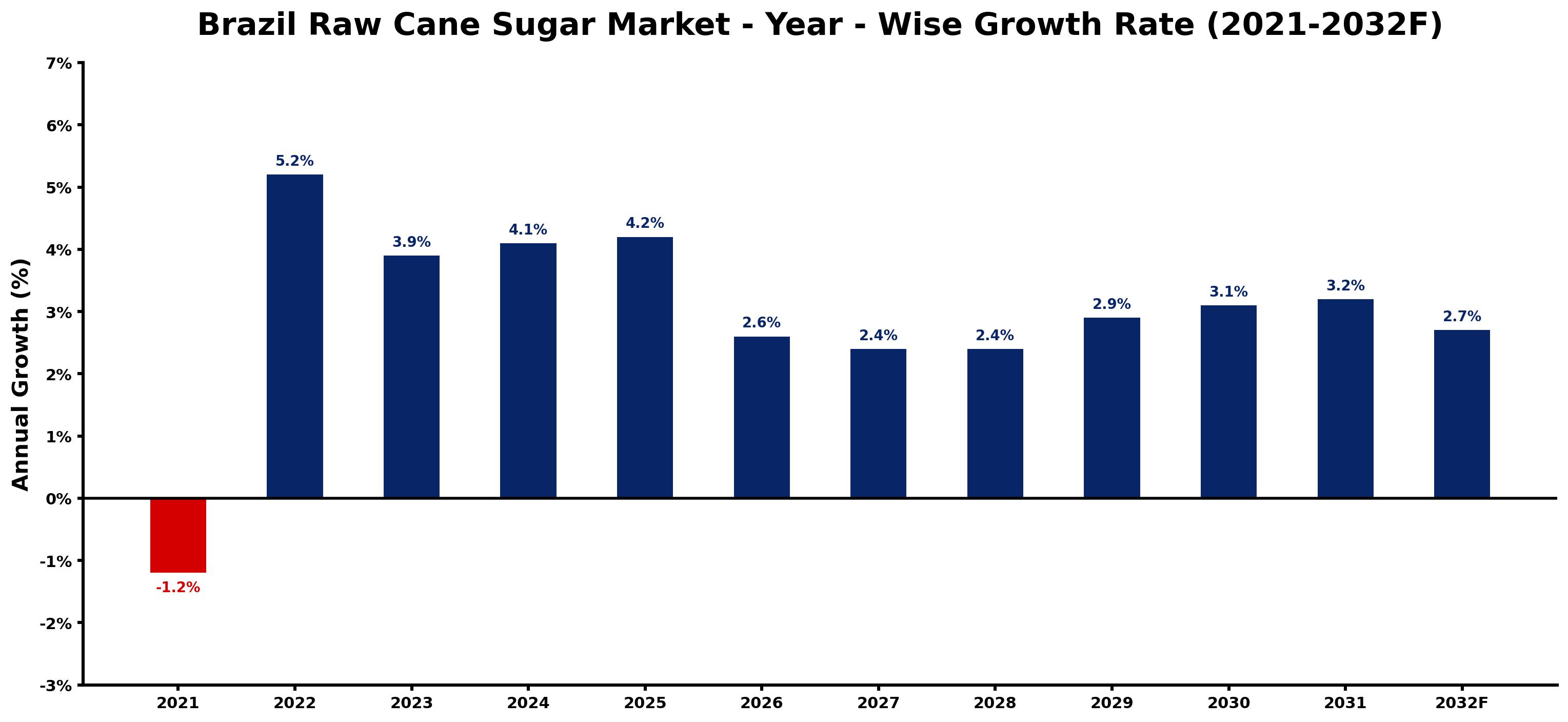
The table below presents the year‑wise growth rates along with the key drivers influencing the market
| Year | Growth Rate | Major Drivers |
| 2021 | -1.2% | Growing urbanization and commercial development |
| 2022 | 5.2% | Expansion of manufacturing activities |
| 2023 | 3.9% | Expansion of commercial construction activities |
| 2024 | 4.1% | Increasing industrial automation investments |
| 2025 | 4.2% | Expansion of commercial construction activities |
| 2026 | 2.6% | Expansion of commercial construction activities |
| 2027 | 2.4% | Expansion of commercial construction activities |
| 2028 | 2.4% | Expansion of manufacturing activities |
| 2029 | 2.9% | Increasing adoption of advanced technologies |
| 2030 | 3.1% | Rapid growth in telecom and data center sectors |
| 2031 | 3.2% | Increasing industrial infrastructure investments |
| 2032 | 2.7% | Expansion of transportation and logistics networks |
Note - Market size estimations and growth projections presented in this report are based on 6Wresearch's advanced forecasting approach, validated with industry datasets as of June 2026.
Brazil Raw Cane Sugar Market Synopsis
In recent years, Brazil has solidified its status as a leading hub for raw cane sugar, taking advantage of its rich agricultural resources and favorable climate for sugarcane production. The country's strategic location, with access to both domestic and international markets, enhances its export capabilities, making raw cane sugar a critical agricultural commodity.
The demand for raw cane sugar in Brazil is being further amplified by evolving consumer preferences towards natural sweeteners and the rising popularity of organic products. As manufacturers increasingly seek sustainable sources for their ingredients, the Brazilian sugar sector is adapting to meet these changing expectations.
Brazil Raw Cane Sugar Market Key Takeaways
- Brazil stands as a major global producer and exporter of raw cane sugar, influenced by both domestic consumption and international market dynamics.
- The market is supported by robust infrastructure for sugarcane processing and transportation, enhancing Brazil's competitiveness.
- Consumer demand for sustainably sourced sugar is shaping production practices and driving certifications like Fair Trade.
- Government initiatives are in place to support quality control, industry growth, and export promotion.
- Challenges remain with global price volatility and supply chain logistics that necessitate ongoing investment and improvements.
Evaluation of Restraints in Brazil Raw Cane Sugar Market
Despite its strong position, the Brazil raw cane sugar market faces significant restraints that could hinder growth. Global price volatility is a pressing concern, affecting the profitability of producers and exporters. Fluctuations in currency and trade policies also add layers of complexity, often leading to uncertainty in investment decisions. Additionally, the reliance on efficient transportation networks can pose challenges; any inadequacies in infrastructure may lead to disruptions in supply chains, consequently impacting market competitiveness. Addressing these restraints requires focused strategies and improvements across the sector.
Brazil Raw Cane Sugar Market Trends
Emerging trends within the Brazil raw cane sugar market indicate a growing inclination towards organic and fair-trade sugar products. As consumers become increasingly conscious of their purchasing decisions, manufacturers are responding by sourcing sugar from certified, sustainable farms. Additionally, technological advancements in sugar production and processing are gaining traction, aimed at enhancing efficiency and product quality. This evolution in practices reflects a broader shift towards sustainable and ethically produced goods.
Brazil Raw Cane Sugar Market Opportunities
The potential for growth in the Brazil raw cane sugar market lies in several key areas. The increasing global appetite for healthier, natural sweetening alternatives presents an opportunity for Brazilian sugar producers to capitalize on this shift. Furthermore, investments in infrastructure improvements are essential, offering prospects for enhanced logistics and supply chain management. As consumer preferences continue to evolve, there is also an avenue for producers to diversify their product offerings, tapping into new markets that prioritize sustainability.
Government Initiatives in the Brazil Raw Cane Sugar Market
The Brazilian government has been active in promoting the raw cane sugar industry through various policies aimed at improving production standards and ensuring product safety. These initiatives often include regulatory measures focused on sugar quality and grading, designed to maintain Brazil's reputation in the global market. Financial incentives and subsidies are also provided to support modern processing technologies and sustainable agricultural practices, reinforcing the industry's long-term growth and competitiveness.
Future Insights of the Brazil Raw Cane Sugar Market
Looking forward to the period between 2026 and 2032, the Brazil raw cane sugar market is poised for sustained growth. The combination of increasing domestic demand, favorable climate conditions for sugarcane cultivation, and advancements in production technology will likely propel the market forward. Additionally, as global consumers seek out ethical and sustainable products, Brazilian producers have the opportunity to enhance their market positioning through improved transparency and responsible sourcing practices.
Brazil Raw Cane Sugar Market Latest Developments (May 2025 - June 2026)
In the recent months leading up to June 2026, the Brazilian raw cane sugar market has seen a noticeable shift towards greater investment in sustainable practices. Industry stakeholders are increasingly prioritizing certifications that ensure environmentally friendly production methods. Furthermore, there have been ongoing discussions within the government about enhancing export support frameworks to bolster international competitiveness. These developments reflect a growing recognition of the importance of sustainability in securing the future of the market.
Brazil Raw Cane Sugar Market - Key Attractiveness of the Report
- 10 Years of Market Numbers
- Historical Data Starting from 2022 to 2025
- Base Year: 2025
- Forecast Data until 2032
- Key Performance Indicators Impacting the Market
- Major Upcoming Developments and Projects
Key Highlights of the Report:
- Brazil Raw Cane Sugar Market Outlook
- Market Size of Brazil Raw Cane Sugar Market, 2025
- Forecast of Brazil Raw Cane Sugar Market, 2032
- Historical Data and Forecast of Brazil Raw Cane Sugar Revenues & Volume for the Period 2022-2032F
- Brazil Raw Cane Sugar Market Trend Evolution
- Brazil Raw Cane Sugar Market Drivers and Challenges
- Brazil Raw Cane Sugar Price Trends
- Brazil Raw Cane Sugar Porter's Five Forces
- Brazil Raw Cane Sugar Industry Life Cycle
- Historical Data and Forecast of Brazil Raw Cane Sugar Market Revenues & Volume By Product Type for the Period 2022-2032F
- Historical Data and Forecast of Brazil Raw Cane Sugar Market Revenues & Volume By Demerara-style Sugar for the Period 2022-2032F
- Historical Data and Forecast of Brazil Raw Cane Sugar Market Revenues & Volume By Organic Sugar for the Period 2022-2032F
- Historical Data and Forecast of Brazil Raw Cane Sugar Market Revenues & Volume By End User for the Period 2022-2032F
- Historical Data and Forecast of Brazil Raw Cane Sugar Market Revenues & Volume By Food Processors for the Period 2022-2032F
- Historical Data and Forecast of Brazil Raw Cane Sugar Market Revenues & Volume By Livestock Feed for the Period 2022-2032F
- Historical Data and Forecast of Brazil Raw Cane Sugar Market Revenues & Volume By Retailers for the Period 2022-2032F
- Historical Data and Forecast of Brazil Raw Cane Sugar Market Revenues & Volume By Industrial Uses for the Period 2022-2032F
- Brazil Raw Cane Sugar Import Export Trade Statistics
- Market Opportunity Assessment By Product Type
- Market Opportunity Assessment By End User
- Brazil Raw Cane Sugar Top Companies Market Share
- Brazil Raw Cane Sugar Competitive Benchmarking By Technical and Operational Parameters
- Brazil Raw Cane Sugar Company Profiles
- Brazil Raw Cane Sugar Key Strategic Recommendations






































