Brazil Recycled Textiles Market Size, Share & Growth Rate
The Brazil Recycled Textiles Market was estimated at USD 344 Million in 2025 and is projected to reach USD 412 Million by 2032, growing at a CAGR of 2.6% from 2026 to 2032. This growth trajectory is primarily driven by an increase in consumer awareness surrounding environmental issues and a corresponding shift towards sustainable fashion. Government initiatives aimed at promoting eco-friendly practices further bolster the demand for recycled textiles, establishing a robust framework for market expansion.
Brazil Recycled Textiles Market Year-wise Growth Rate and Key Drivers
This graph highlights how the Brazil Recycled Textiles Market has steadily grown over the years, supported by major growth factors.
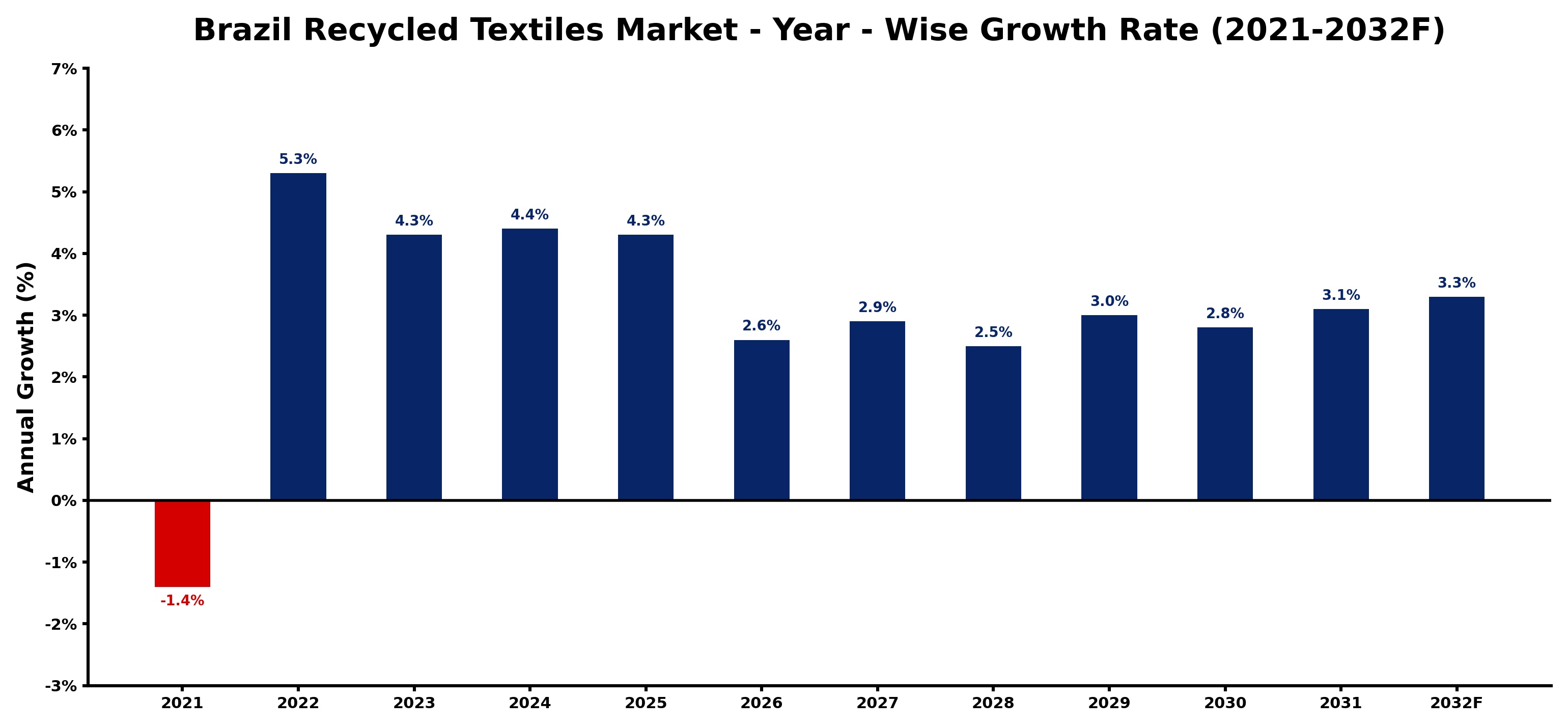
The table below presents the year‑wise growth rates along with the key drivers influencing the market
| Year | Growth Rate | Major Drivers |
| 2021 | -1.4% | Consumer demand for sustainability declined |
| 2022 | 5.3% | Increased awareness of recycling benefits |
| 2023 | 4.3% | Government incentives for recycling programs |
| 2024 | 4.4% | Fashion industry embracing recycled materials |
| 2025 | 4.3% | Technological advancements improved processing |
| 2026 | 2.6% | Collaboration with eco-friendly brands expanded |
| 2027 | 2.9% | Growing consumer preference for eco-products |
| 2028 | 2.5% | Investment in recycling infrastructure increased |
| 2029 | 3.0% | Partnerships with NGOs enhanced outreach |
| 2030 | 2.8% | Educational campaigns raised recycling awareness |
| 2031 | 3.1% | Corporate responsibility initiatives gained momentum |
| 2032 | 3.3% | Global trends favoring sustainable textiles |
Note - Market size estimations and growth projections presented in this report are based on 6Wresearch's advanced forecasting approach, validated with industry datasets as of June 2026.
Brazil Recycled Textiles Market Synopsis
Consumer awareness is the strongest force currently shaping the Brazil Recycled Textiles Market. As Brazilian consumers become more conscious of their ecological footprint, they are gravitating towards products that align with their sustainability values, thereby increasing the demand for recycled textile options.
Moreover, government support plays a critical role in shaping the market landscape. By implementing various initiatives that promote sustainable manufacturing and encourage investment in recycling technologies, authorities are actively facilitating a transition towards a circular economy within the textile sector.
Brazil Recycled Textiles Market Key Takeaways
- The market is witnessing significant growth driven by increasing consumer demand for sustainable clothing options.
- Government incentives are fostering innovation in recycling technologies, enhancing processing capacities.
- Challenges such as inadequate infrastructure are currently limiting the full potential of the recycled textiles market.
- The shift in consumer behavior towards eco-friendliness is reshaping product offerings in the textile industry.
- Investment opportunities are emerging, particularly in technology development and consumer education initiatives.
Evaluation of Restraints in Brazil Recycled Textiles Market
The Brazil Recycled Textiles Market faces several restraints that impede its growth potential. A significant issue is the lack of advanced infrastructure and technology required for effective textile recycling, which results in low collection rates and inadequate processing capabilities. This scenario leads to a considerable amount of textile waste being directed to landfills, heightening environmental concerns and resource depletion. Furthermore, the absence of robust regulatory frameworks and adequate incentives for recycling initiatives has deterred private sector investments. Consumer preferences for affordable fast fashion also reinforce a linear consumption model, limiting the appetite for recycled products.
Brazil Recycled Textiles Market Trends
Current trends in the Brazil Recycled Textiles Market highlight a growing integration of sustainable materials in mainstream fashion. Brands are increasingly adopting transparency in their supply chains, aligning with consumers' demands for accountability. Additionally, technological advancements in recycling processes are emerging, such as chemical recycling techniques that enhance the quality of recycled textiles. The concept of a circular economy is gaining traction, compelling manufacturers to rethink their production strategies.
Brazil Recycled Textiles Market Opportunities
Real growth and investment opportunities are emerging within the Brazil Recycled Textiles Market. With rising consumer demand for sustainable products, companies can benefit from developing innovative recycling technologies and expanding their product lines to include recycled materials. Collaborations between private enterprises and governmental bodies present an avenue for funding and resource sharing, fostering a more sustainable industry landscape. Furthermore, as awareness of sustainability grows, there is ample scope for educational initiatives that promote the benefits of recycled textiles to consumers.
Government Initiatives in the Brazil Recycled Textiles Market
The Brazilian government is actively involved in promoting the recycled textiles market through various initiatives. Policies encouraging eco-friendly manufacturing processes, alongside incentives for investment in sustainable technologies, are aimed at boosting local recycling capacities. Furthermore, consumer awareness campaigns are being rolled out to educate the public on sustainable fashion choices and the importance of recycling in mitigating environmental impacts.
Future Insights of the Brazil Recycled Textiles Market
Looking ahead to the period between 2026 and 2032, the Brazil Recycled Textiles Market is anticipated to evolve significantly. Factors such as increasing consumer demand for sustainable products and enhanced regulatory support are expected to drive market growth. Companies that invest in innovative recycling technologies and sustainable practices will likely gain a competitive edge, capitalizing on the broader trend towards environmental stewardship. The market is poised for a transformation as it aligns with global sustainability goals and the circular economy paradigm.
Brazil Recycled Textiles Market Latest Developments (May 2025 - June 2026)
In the recent months leading up to mid-2026, the Brazil Recycled Textiles Market has witnessed a surge in initiatives focused on sustainability. Key developments include the launch of new recycling technologies that promise to improve the quality of recycled fibers significantly. Additionally, several consumer brands have begun to adopt more stringent sustainability policies, encouraging more responsible sourcing practices. Collaborative projects between industries and government entities aim to boost recycling infrastructure, emphasizing the collective commitment to a greener future.
Brazil Recycled Textiles Market - Key Attractiveness of the Report
- 10 Years of Market Numbers
- Historical Data Starting from 2022 to 2025
- Base Year: 2025
- Forecast Data until 2032
- Key Performance Indicators Impacting the Market
- Major Upcoming Developments and Projects
Key Highlights of the Report:
- Brazil Recycled Textiles Market Outlook
- Market Size of Brazil Recycled Textiles Market, 2025
- Forecast of Brazil Recycled Textiles Market, 2032
- Historical Data and Forecast of Brazil Recycled Textiles Revenues & Volume for the Period 2022-2032F
- Brazil Recycled Textiles Market Trend Evolution
- Brazil Recycled Textiles Market Drivers and Challenges
- Brazil Recycled Textiles Price Trends
- Brazil Recycled Textiles Porter's Five Forces
- Brazil Recycled Textiles Industry Life Cycle
- Historical Data and Forecast of Brazil Recycled Textiles Market Revenues & Volume By Type for the Period 2022-2032F
- Historical Data and Forecast of Brazil Recycled Textiles Market Revenues & Volume By Recycled Cotton for the Period 2022-2032F
- Historical Data and Forecast of Brazil Recycled Textiles Market Revenues & Volume By Recycled Wool for the Period 2022-2032F
- Historical Data and Forecast of Brazil Recycled Textiles Market Revenues & Volume By Recycled Polyester for the Period 2022-2032F
- Historical Data and Forecast of Brazil Recycled Textiles Market Revenues & Volume By Recycled Nylon for the Period 2022-2032F
- Historical Data and Forecast of Brazil Recycled Textiles Market Revenues & Volume By Others for the Period 2022-2032F
- Historical Data and Forecast of Brazil Recycled Textiles Market Revenues & Volume By End-use Industry for the Period 2022-2032F
- Historical Data and Forecast of Brazil Recycled Textiles Market Revenues & Volume By Automotive for the Period 2022-2032F
- Historical Data and Forecast of Brazil Recycled Textiles Market Revenues & Volume By Retail for the Period 2022-2032F
- Historical Data and Forecast of Brazil Recycled Textiles Market Revenues & Volume By Mining for the Period 2022-2032F
- Historical Data and Forecast of Brazil Recycled Textiles Market Revenues & Volume By Building & Construction for the Period 2022-2032F
- Historical Data and Forecast of Brazil Recycled Textiles Market Revenues & Volume By Others for the Period 2022-2032F
- Brazil Recycled Textiles Import Export Trade Statistics
- Market Opportunity Assessment By Type
- Market Opportunity Assessment By End-use Industry
- Brazil Recycled Textiles Top Companies Market Share
- Brazil Recycled Textiles Competitive Benchmarking By Technical and Operational Parameters
- Brazil Recycled Textiles Company Profiles
- Brazil Recycled Textiles Key Strategic Recommendations






































