Brazil Residential Boiler Market Size, Share & Growth Rate
The Brazil Residential Boiler Market was estimated at USD 105 Million in 2025 and is projected to reach USD 125 Million by 2032, growing at a CAGR of 2.5% from 2026 to 2032. This growth trajectory is driven by the increasing focus on energy efficiency and sustainability within the residential sector, spurred by both consumer demand and regulatory frameworks. As urbanization expands, more households are seeking reliable and efficient heating solutions, contributing to the markets competitive landscape.
Brazil Residential Boiler Market Year-wise Growth Rate and Key Drivers
This graph highlights how the Brazil Residential Boiler Market has steadily grown over the years, supported by major growth factors.
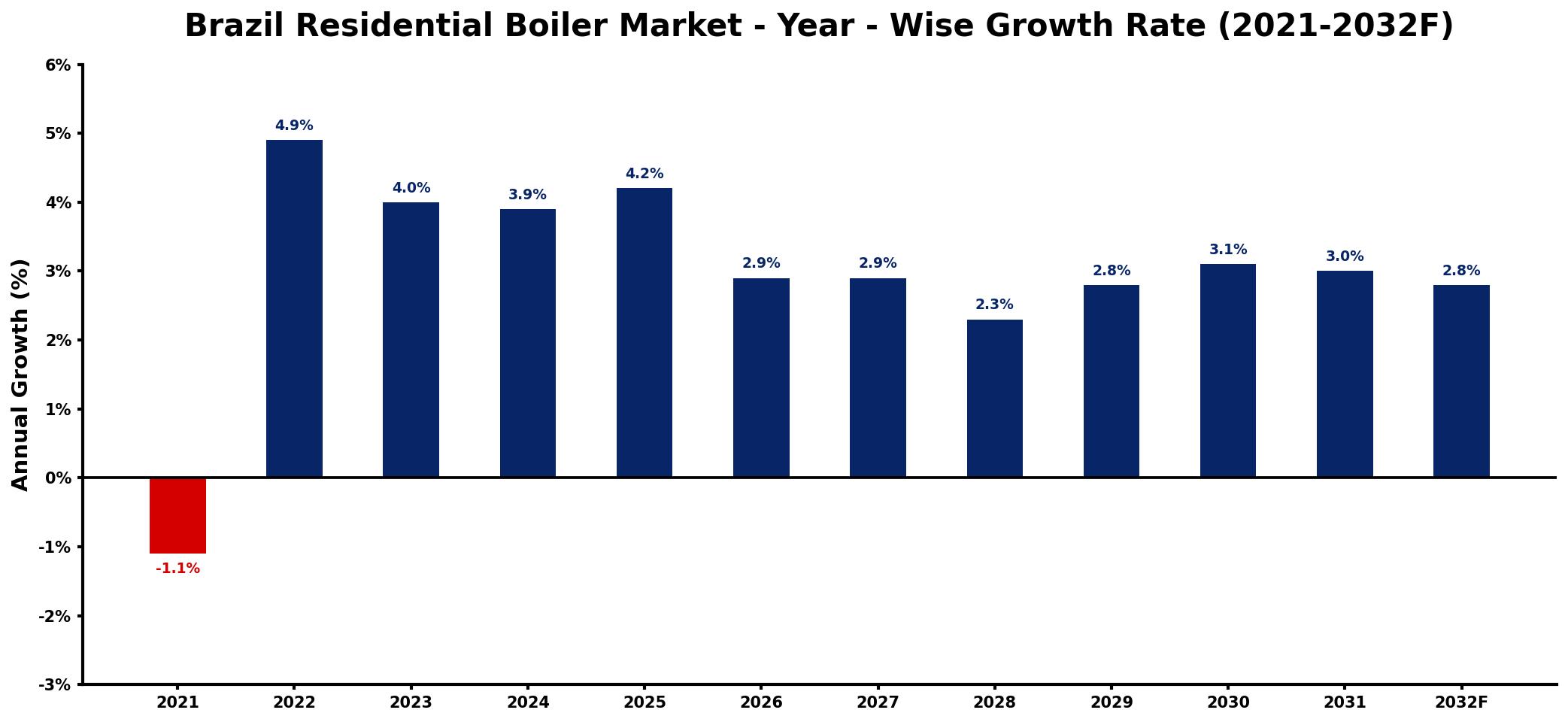
The table below presents the year‑wise growth rates along with the key drivers influencing the market
| Year | Growth Rate | Major Drivers |
| 2021 | -1.1% | decreased consumer spending trends |
| 2022 | 4.9% | increased energy efficiency awareness |
| 2023 | 4.0% | growing renewable energy investments |
| 2024 | 3.9% | expansion of green technology initiatives |
| 2025 | 4.2% | rising urbanization and infrastructure |
| 2026 | 2.9% | enhanced government energy policies |
| 2027 | 2.9% | increased construction activity levels |
| 2028 | 2.3% | growing focus on sustainability efforts |
| 2029 | 2.8% | rising disposable income rates |
| 2030 | 3.1% | increased interest in home upgrades |
| 2031 | 3.0% | improved raw material availability |
| 2032 | 2.8% | growing demand for smart solutions |
Note: Market size estimations and growth projections presented in this report are based on 6Wresearch's proprietary forecasting methodology, utilizing the latest available industry data, government publications, and primary research inputs.
Brazil Residential Boiler Market Synopsis
In Brazil, the residential boiler market is characterized by a growing inclination towards energy-efficient heating options, propelled by rising energy costs and environmental awareness. With diverse housing configurations across urban and rural areas, manufacturers are innovating to cater to the specific needs of different demographic segments.
Moreover, government incentives aimed at promoting sustainable heating solutions have further stimulated market demand. Consumer education campaigns highlight the benefits of modern boilers, driving a transition from traditional heating methods to more advanced, eco-friendly technologies.
Brazil Residential Boiler Market Key Takeaways
- Steady growth in market size, influenced by urbanization and enhanced consumer preferences.
- Government policies favoring energy-efficient solutions are crucial for market dynamics.
- Strong competition driven by innovation in boiler technology and sustainability practices.
- Challenges from alternative heating solutions like solar and electric options persist.
- Economic variables play a significant role in shaping demand and market strategies.
Evaluation of Restraints in Brazil Residential Boiler Market
Despite its potential, the Brazil Residential Boiler Market faces significant restraints that could inhibit growth. A notable challenge is the increasing consumer preference for alternative heating solutions, particularly solar and electric technologies, which are perceived as more sustainable. Additionally, fluctuations in the housing market, influenced by economic factors such as disposable income levels, can also dampen demand for residential boilers. Regulatory standards mandating energy efficiency can complicate product development, necessitating significant investment in R&D for compliance.
Brazil Residential Boiler Market Trends
The market is currently experiencing a shift towards the integration of smart technologies within residential boilers. These innovations enhance user control and efficiency, aligning with the growing trend of home automation. Furthermore, as climate awareness continues to rise, consumers are increasingly prioritizing systems that utilize renewable energy sources, thereby fostering demand for hybrid boiler solutions. Additionally, sustainability is becoming a core component of brand differentiation, compelling manufacturers to adopt eco-friendly production practices.
Brazil Residential Boiler Market Opportunities
There are substantial opportunities for growth within the Brazil Residential Boiler Market, particularly in regions experiencing rapid urbanization and infrastructural development. Investment in energy-efficient technologies presents a lucrative area, as consumers increasingly seek sustainable heating options. Partnerships with government initiatives promoting renewable energy can also create pathways for manufacturers to expand their market presence. Moreover, as economic conditions stabilize, a resurgence in residential construction is likely to bolster boiler demand.
Government Initiatives in the Brazil Residential Boiler Market
The Brazilian government has been proactive in fostering a market environment conducive to energy efficiency. Policies are in place that prioritize the adoption of residential boilers with high energy efficiency ratings, including subsidies and tax incentives for energy-efficient products. Public campaigns aimed at educating consumers about the benefits of modern heating solutions further support market growth, promoting a transition away from traditional systems toward sustainable alternatives.
Future Insights of the Brazil Residential Boiler Market
Looking ahead to 2026-2032, the Brazil Residential Boiler Market is set to evolve significantly. With continuous advancements in technology and increased governmental support for sustainable energy, the market will likely see further diversification in product offerings. As eco-consciousness becomes a norm among Brazilian consumers, manufacturers will need to align with these values, focusing on innovation and efficiency to maintain competitiveness. The push towards automation in heating solutions is also expected to create new avenues for growth and user engagement.
Brazil Residential Boiler Market Latest Developments (2025 - 2026)
In recent months, the Brazil Residential Boiler Market has witnessed a heightened focus on sustainable practices, with several manufacturers launching new product lines that emphasize energy efficiency. There has also been a noticeable uptick in collaborations between technology firms and boiler manufacturers aimed at integrating smart technology into heating solutions. Furthermore, public awareness campaigns led by government entities have increased consumer interest in eco-friendly heating alternatives, suggesting a positive shift in market dynamics.
Brazil Residential Boiler Market - Key Attractiveness of the Report
- 10 Years of Market Numbers
- Historical Data Starting from 2022 to 2025
- Base Year: 2025
- Forecast Data until 2032
- Key Performance Indicators Impacting the Market
- Major Upcoming Developments and Projects
Key Highlights of the Report:
- Brazil Residential Boiler Market Outlook
- Market Size of Brazil Residential Boiler Market, 2025
- Forecast of Brazil Residential Boiler Market, 2032
- Historical Data and Forecast of Brazil Residential Boiler Revenues & Volume for the Period 2022-2032F
- Brazil Residential Boiler Market Trend Evolution
- Brazil Residential Boiler Market Drivers and Challenges
- Brazil Residential Boiler Price Trends
- Brazil Residential Boiler Porter's Five Forces
- Brazil Residential Boiler Industry Life Cycle
- Historical Data and Forecast of Brazil Residential Boiler Market Revenues & Volume By Type for the Period 2022-2032F
- Historical Data and Forecast of Brazil Residential Boiler Market Revenues & Volume By Water Tube Boiler for the Period 2022-2032F
- Historical Data and Forecast of Brazil Residential Boiler Market Revenues & Volume By Fire Tube Boiler for the Period 2022-2032F
- Historical Data and Forecast of Brazil Residential Boiler Market Revenues & Volume By Electric Boiler for the Period 2022-2032F
- Historical Data and Forecast of Brazil Residential Boiler Market Revenues & Volume By Fuel Type for the Period 2022-2032F
- Historical Data and Forecast of Brazil Residential Boiler Market Revenues & Volume By Coal Fired for the Period 2022-2032F
- Historical Data and Forecast of Brazil Residential Boiler Market Revenues & Volume By Oil Fired for the Period 2022-2032F
- Historical Data and Forecast of Brazil Residential Boiler Market Revenues & Volume By Gas Fired for the Period 2022-2032F
- Historical Data and Forecast of Brazil Residential Boiler Market Revenues & Volume By Others for the Period 2022-2032F
- Historical Data and Forecast of Brazil Residential Boiler Market Revenues & Volume By Technology for the Period 2022-2032F
- Historical Data and Forecast of Brazil Residential Boiler Market Revenues & Volume By Condensing for the Period 2022-2032F
- Historical Data and Forecast of Brazil Residential Boiler Market Revenues & Volume By Non-condensing for the Period 2022-2032F
- Brazil Residential Boiler Import Export Trade Statistics
- Market Opportunity Assessment By Type
- Market Opportunity Assessment By Fuel Type
- Market Opportunity Assessment By Technology
- Brazil Residential Boiler Top Companies Market Share
- Brazil Residential Boiler Competitive Benchmarking By Technical and Operational Parameters
- Brazil Residential Boiler Company Profiles
- Brazil Residential Boiler Key Strategic Recommendations






































