Brazil Rubber Mats Market Summary
The brazil rubber mats market was estimated at USD 331 Million in 2025 and is projected to reach USD 396 Million by 2032, growing at a CAGR of 3.2% from 2026 to 2032.
Brazil Rubber Mats Market Year-wise Growth Rate and Key Drivers
This graph highlights how the Brazil Rubber Mats Market has steadily grown over the past five years, supported by major growth factors.
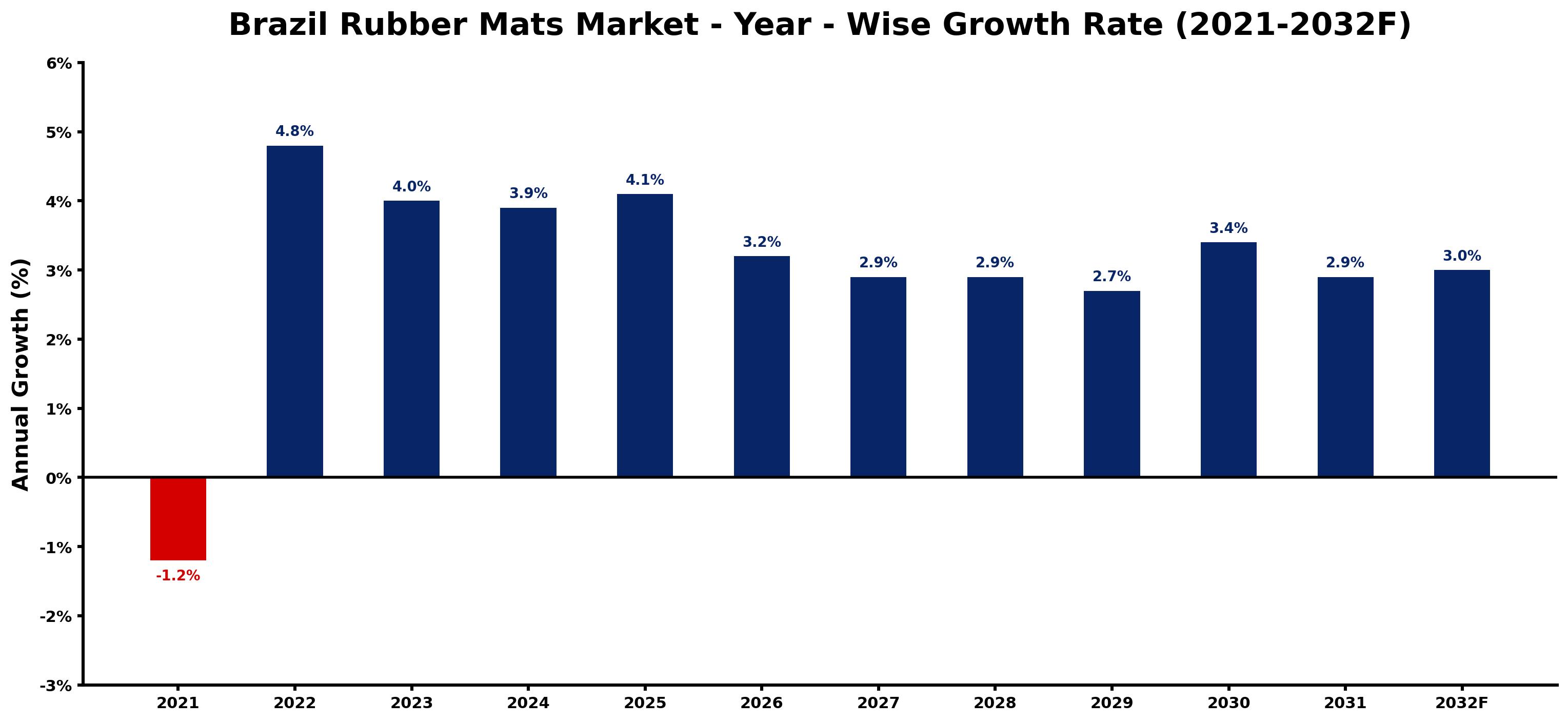
The table below presents the year wise growth rates along with the key drivers influencing the market
| Year | Growth Rate | Major Drivers |
| 2021 | -1.2% | Increased competition from alternative flooring solutions significantly diminished consumer interest in rubber mats. |
| 2022 | 4.8% | Urbanization trends spark a surge in residential and commercial flooring installations. |
| 2023 | 4.0% | Sustainability initiatives encourage eco-friendly materials, boosting rubber mat demand significantly. |
| 2024 | 3.9% | Innovations in rubber technology enhance durability, attracting industrial consumers more effectively. |
| 2025 | 4.1% | Infrastructure projects in major cities create new opportunities for rubber mat applications. |
| 2026 | 3.2% | Increased awareness of safer flooring options drives sales in gyms and schools. |
| 2027 | 2.9% | Local manufacturing capabilities improve cost efficiency, expanding market accessibility dramatically. |
| 2028 | 2.9% | E-commerce growth provides new platforms for distributing rubber mats nationwide. |
| 2029 | 2.7% | Revitalization of public spaces emphasizes aesthetic flooring solutions, enhancing market appeal. |
| 2030 | 3.4% | Health-conscious trends promote antimicrobial coatings on mats, attracting diverse customer segments. |
| 2031 | 2.9% | Partnerships with construction firms create bundled offers, increasing market penetration significantly. |
| 2032 | 3.0% | Technological advancements in manufacturing processes enable custom solutions for unique spaces. |
Note - Market size estimations and growth projections presented in this report are based on 6Wresearch's advanced forecasting approach, validated with industry datasets as of June 2026.
Brazil Rubber Mats Market Synopsis
The Brazil Rubber Mats Market is projected to reach 3.2% and witness significant growth during the forecast period (2026-2032). This market is characterized by the diverse applications of rubber mats across industrial, commercial, and residential sectors. The durability and slip-resistant properties of rubber mats make them a preferred choice, particularly in environments that require enhanced safety and comfort. The ongoing infrastructure projects in Brazil, alongside the booming construction and hospitality sectors, are expected to drive substantial demand for rubber mats throughout the forecast period.
Brazil Rubber Mats Market Growth Drivers
The growth of the Brazil Rubber Mats Market is primarily propelled by several key factors:
- Strong focus on workplace safety across industrial and commercial sectors is driving the demand for rubber mats that provide anti-fatigue and slip-resistant features.
- Infrastructure investments, including projects such as road construction and building expansions, are increasing the need for durable flooring solutions like rubber mats.
- Heightened awareness of the significance of employee well-being, compelling companies to adopt enhanced safety measures in work environments.
- The hospitality industry's commitment to guest safety and comfort is increasing the implementation of rubber mats in hotels, restaurants, and other service-oriented venues.
- Ongoing compliance with stringent safety regulations ensures that rubber mats remain integral in spaces where safety is paramount, thereby driving market demand.
Brazil Rubber Mats Market Challenges and Restraints
Despite the robust growth prospects, the Brazil Rubber Mats Market faces several challenges:
- The need for sustainable materials has become critical, as manufacturers are pressured to develop eco-friendly alternatives to traditional rubber sources.
- Quality assurance remains a significant concern, as the durability and safety of rubber mats must consistently meet industry standards and customer expectations.
- Market differentiation poses a challenge as competition intensifies, necessitating unique product offerings and innovative features to stand out in a crowded market.
- Regulatory complexities surrounding environmental compliance and product safety standards can complicate the manufacturing and distribution processes.
- Fluctuating raw material prices can impact production costs, thereby influencing pricing strategies and margin sustainability in the rubber mats sector.
Brazil Rubber Mats Market Government Investment and Initiatives
Government policies play a crucial role in shaping the landscape of the Brazil Rubber Mats Market. Recent initiatives focus on enhancing workplace safety through stringent regulations that require businesses to adopt specific safety measures, including the use of high-quality flooring systems like rubber mats. Furthermore, government investments in infrastructure projects ensure a steady demand for rubber mats as new facilities and buildings are constructed across the country.
In addition, environmental regulations are increasingly encouraging manufacturers to explore sustainable practices, promoting the development of eco-friendly rubber mats. The government may also offer incentives for enterprises that incorporate recycling initiatives and sustainable manufacturing processes, contributing to the overall reduction of environmental footprints while advancing market growth.
Brazil Rubber Mats Market Latest Developments (May 2025 - June 2026)
The period from May 2025 to June 2026 has witnessed notable developments within the Brazil Rubber Mats Market, marking significant shifts in industry dynamics. There has been an increase in the adoption of innovative technologies aimed at enhancing the performance and safety features of rubber mats. This trend reflects a broader commitment to improving workplace environments and aligning with evolving safety standards.
Additionally, there is a growing focus on sustainability, with many manufacturers exploring alternative materials and production processes to address environmental concerns. The incorporation of recycled rubber in product lines is becoming a common practice as businesses seek to align with consumer preferences for eco-friendly solutions. This shift not only supports sustainability efforts but also positions companies to meet regulatory requirements more effectively.
Brazil Rubber Mats Market - Key Attractiveness of the Report
- 10 Years of Market Numbers
- Historical Data Starting from 2022 to 2025
- Base Year: 2025
- Forecast Data until 2032
- Key Performance Indicators Impacting the Market
- Major Upcoming Developments and Projects
Key Highlights of the Report:
- Brazil Rubber Mats Market Outlook
- Market Size of Brazil Rubber Mats Market, 2025
- Forecast of Brazil Rubber Mats Market, 2032
- Historical Data and Forecast of Brazil Rubber Mats Revenues & Volume for the Period 2022-2032F
- Brazil Rubber Mats Market Trend Evolution
- Brazil Rubber Mats Market Drivers and Challenges
- Brazil Rubber Mats Price Trends
- Brazil Rubber Mats Porter's Five Forces
- Brazil Rubber Mats Industry Life Cycle
- Historical Data and Forecast of Brazil Rubber Mats Market Revenues & Volume By Type for the Period 2022-2032F
- Historical Data and Forecast of Brazil Rubber Mats Market Revenues & Volume By Natural Rubber for the Period 2022-2032F
- Historical Data and Forecast of Brazil Rubber Mats Market Revenues & Volume By Synthetic Rubber for the Period 2022-2032F
- Historical Data and Forecast of Brazil Rubber Mats Market Revenues & Volume By Others for the Period 2022-2032F
- Historical Data and Forecast of Brazil Rubber Mats Market Revenues & Volume By Applications for the Period 2022-2032F
- Historical Data and Forecast of Brazil Rubber Mats Market Revenues & Volume By Home Use for the Period 2022-2032F
- Historical Data and Forecast of Brazil Rubber Mats Market Revenues & Volume By Business Use for the Period 2022-2032F
- Brazil Rubber Mats Import Export Trade Statistics
- Market Opportunity Assessment By Type
- Market Opportunity Assessment By Applications
- Brazil Rubber Mats Top Companies Market Share
- Brazil Rubber Mats Competitive Benchmarking By Technical and Operational Parameters
- Brazil Rubber Mats Company Profiles
- Brazil Rubber Mats Key Strategic Recommendations






































