Brazil Semiconductor Memory Market Top 5 Importing Countries and Market Competition (HHI) Analysis
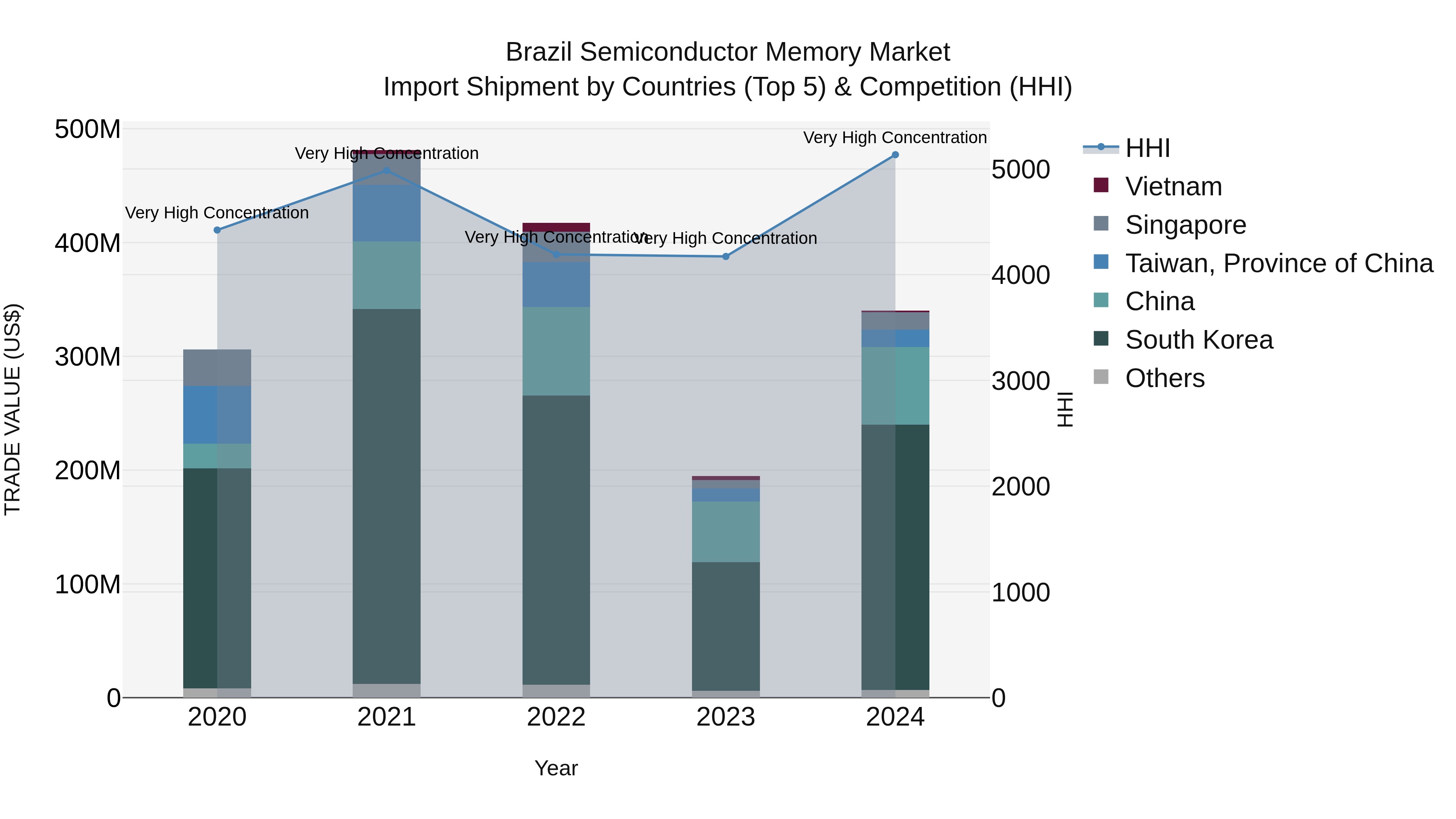
Brazil`s semiconductor memory import shipments in 2024 continued to showcase high concentration, with South Korea, China, Singapore, Taiwan, and Thailand being the top exporting countries. The industry demonstrated steady growth with a Compound Annual Growth Rate (CAGR) of 2.68% from 2020 to 2024. Additionally, the notable growth rate of 74.74% from 2023 to 2024 indicates a significant uptick in demand for semiconductor memory in the Brazilian market, highlighting opportunities for market expansion and development in the coming years.
Brazil Semiconductor Memory Market Overview
The semiconductor memory market in Brazil is witnessing significant growth, driven by the increasing demand for electronic devices and technological advancements. The rising adoption of smartphones, tablets, and other connected devices contributes to the expansion of this market. Key players in the industry are focused on innovation and product development to meet the evolving consumer needs.
Drivers of the market
The Brazil Semiconductor Memory Market is witnessing significant growth, driven by several key factors. The increasing demand for electronic devices, such as smartphones, tablets, and laptops, has fueled the need for advanced semiconductor memory solutions. Additionally, the rise of emerging technologies like artificial intelligence and the Internet of Things (IoT) has further propelled the demand for high-performance memory chips. The growing automotive industry in Brazil, with the integration of advanced electronics in vehicles, is another driving force behind the expansion of the semiconductor memory market.
Challenges of the market
The Brazil Semiconductor Memory Market faces several challenges that impact its growth and competitiveness. One key challenge is the constant demand for innovation and technological advancements. As the market evolves rapidly, companies need to invest significantly in research and development to stay ahead. Additionally, the industry contends with global supply chain disruptions, affecting the timely availability of critical components. Regulatory complexities and compliance with international standards also pose challenges for market players, influencing product development cycles and market entry strategies.
Government Policy of the market
The Brazil Semiconductor Memory Market has witnessed significant growth driven by the increasing demand for electronic devices. Government policies encouraging technological advancements and innovation have played a crucial role in fostering a competitive landscape. Incentives for research and development have spurred investments, contributing to the market`s expansion.
Key Highlights of the Report:
- Brazil Semiconductor Memory Market Outlook
- Market Size of Brazil Semiconductor Memory Market, 2024
- Forecast of Brazil Semiconductor Memory Market, 2031
- Historical Data and Forecast of Brazil Semiconductor Memory Revenues & Volume for the Period 2021-2031
- Brazil Semiconductor Memory Market Trend Evolution
- Brazil Semiconductor Memory Market Drivers and Challenges
- Brazil Semiconductor Memory Price Trends
- Brazil Semiconductor Memory Porter's Five Forces
- Brazil Semiconductor Memory Industry Life Cycle
- Historical Data and Forecast of Brazil Semiconductor Memory Market Revenues & Volume By Type for the Period 2021-2031
- Historical Data and Forecast of Brazil Semiconductor Memory Market Revenues & Volume By Static Random-access Memory (SRAM) for the Period 2021-2031
- Historical Data and Forecast of Brazil Semiconductor Memory Market Revenues & Volume By Magneto-resistive Random-access Memory (MRAM) for the Period 2021-2031
- Historical Data and Forecast of Brazil Semiconductor Memory Market Revenues & Volume By Dynamic Random-access Memory (DRAM) for the Period 2021-2031
- Historical Data and Forecast of Brazil Semiconductor Memory Market Revenues & Volume By Flash Memory (ROM) for the Period 2021-2031
- Historical Data and Forecast of Brazil Semiconductor Memory Market Revenues & Volume By Application for the Period 2021-2031
- Historical Data and Forecast of Brazil Semiconductor Memory Market Revenues & Volume By Aerospace & defense for the Period 2021-2031
- Historical Data and Forecast of Brazil Semiconductor Memory Market Revenues & Volume By Automotive for the Period 2021-2031
- Historical Data and Forecast of Brazil Semiconductor Memory Market Revenues & Volume By Consumer electronics for the Period 2021-2031
- Historical Data and Forecast of Brazil Semiconductor Memory Market Revenues & Volume By Industrial for the Period 2021-2031
- Historical Data and Forecast of Brazil Semiconductor Memory Market Revenues & Volume By Medical for the Period 2021-2031
- Historical Data and Forecast of Brazil Semiconductor Memory Market Revenues & Volume By Telecommunications for the Period 2021-2031
- Historical Data and Forecast of Brazil Semiconductor Memory Market Revenues & Volume By Others for the Period 2021-2031
- Brazil Semiconductor Memory Import Export Trade Statistics
- Market Opportunity Assessment By Type
- Market Opportunity Assessment By Application
- Brazil Semiconductor Memory Top Companies Market Share
- Brazil Semiconductor Memory Competitive Benchmarking By Technical and Operational Parameters
- Brazil Semiconductor Memory Company Profiles
- Brazil Semiconductor Memory Key Strategic Recommendations






































