Brazil Semiconductors and Related Devices Market Summary
The brazil semiconductors and related devices market was estimated at USD 305 Million in 2025 and is projected to reach USD 414 Million by 2032, growing at a CAGR of 5.1% from 2026 to 2032.
Brazil Semiconductors and Related Devices Market Year-wise Growth Rate and Key Drivers
This graph highlights how the Brazil Semiconductors and Related Devices Market has steadily grown over the past five years, supported by major growth factors.
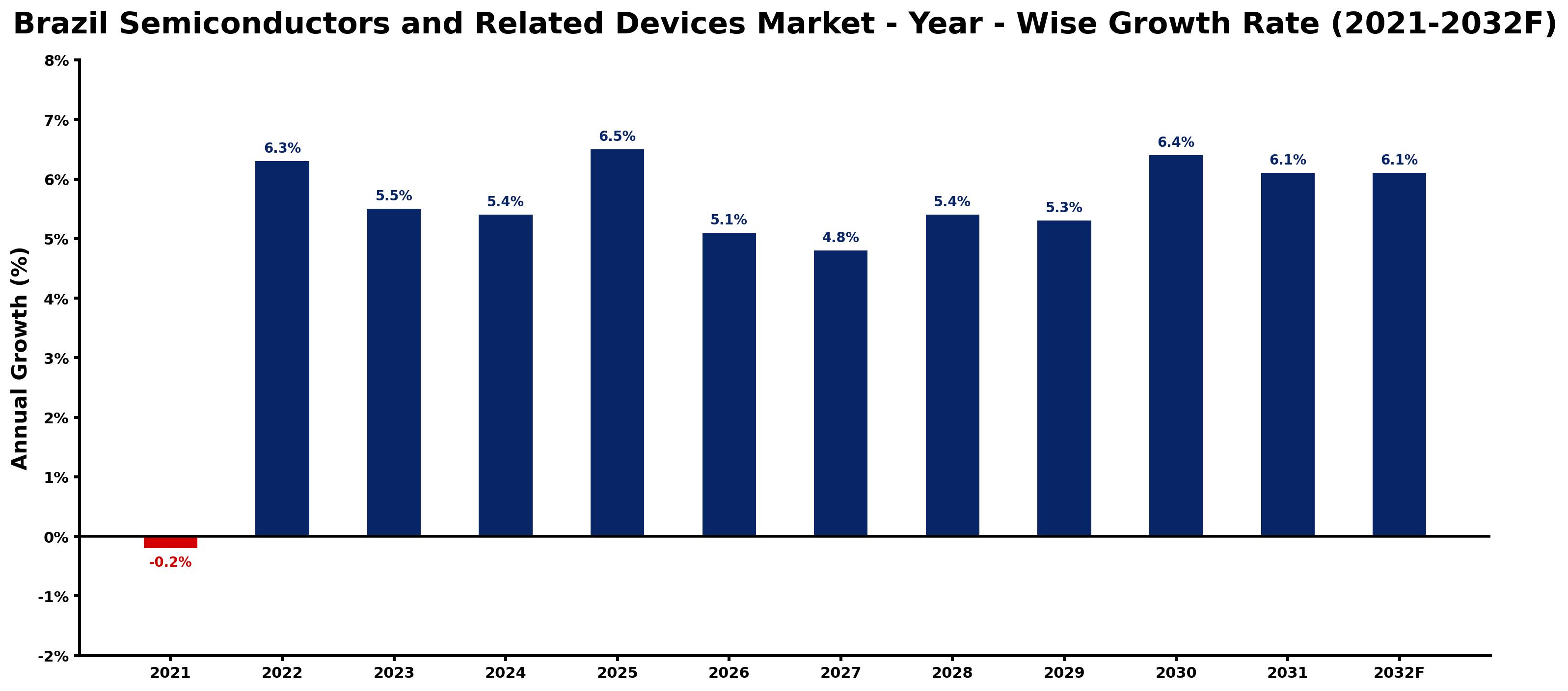
The table below presents the year wise growth rates along with the key drivers influencing the market
| Year | Growth Rate | Major Drivers |
| 2021 | -0.2% | Supply chain disruptions severely hindered semiconductor availability, impacting production schedules and stifling market expansion. |
| 2022 | 6.3% | Investment in electric vehicles sparked interest in semiconductor technologies across various industries. |
| 2023 | 5.5% | Brazil's burgeoning tech startups increasingly demand innovative semiconductor solutions for product development. |
| 2024 | 5.4% | Local manufacturing capabilities are improving, reducing reliance on imported semiconductor components significantly. |
| 2025 | 6.5% | The push for 5G infrastructure upgrades necessitates advanced semiconductor technologies for telecommunications. |
| 2026 | 5.1% | Sustainability concerns drive innovations in energy-efficient semiconductor devices across multiple applications. |
| 2027 | 4.8% | Collaborative ventures between local firms and global giants enhance technological capabilities and market reach. |
| 2028 | 5.4% | Increased focus on IoT applications fuels growth for semiconductors in smart consumer devices. |
| 2029 | 5.3% | Brazil's industrial modernization initiatives highlight semiconductor roles in automation and efficiency improvements. |
| 2030 | 6.4% | Evolving consumer electronics trends require continuous advancements in semiconductor design and manufacturing processes. |
| 2031 | 6.1% | Investment in educational programs boosts local talent familiar with semiconductor technology and applications. |
| 2032 | 6.1% | Emerging markets in Brazil begin to adopt advanced semiconductor solutions, expanding potential customer bases. |
Note - Market size estimations and growth projections presented in this report are based on 6Wresearch's advanced forecasting approach, validated with industry datasets as of June 2026.
Brazil Semiconductors and Related Devices Market Synopsis
The Brazil Semiconductors and Related Devices Market is projected to reach 5.1% and witness significant growth during the forecast period (2026-2032). As a pivotal aspect of the nation's technological framework, the market is driven by rapid advancements in electronics, telecommunications, and automation. A notable focus on innovation and the development of technology-driven industries is further propelling demand for semiconductors, which are integral to a variety of applications across different sectors.
Brazil Semiconductors and Related Devices Market Growth Drivers
The growth dynamics of the Brazil Semiconductors and Related Devices Market are influenced by several key drivers:
- Technological innovations are enhancing the performance and capability of semiconductor devices, leading to increased applications in diverse sectors such as automotive and consumer electronics.
- The rising demand for telecommunications infrastructure is fostering the need for advanced semiconductor technologies, facilitating improved connectivity and communication systems.
- Government initiatives aimed at promoting digital transformation are catalyzing investments in semiconductor research and development, enhancing local capabilities.
- As Brazil's automotive sector integrates more electronic components, the demand for semiconductor solutions is expected to surge, supporting developments in areas such as electric vehicles and autonomous driving technologies.
- The expanding consumer electronics market in Brazil, characterized by the growing adoption of smart devices, is also contributing significantly to the demand for semiconductors.
Brazil Semiconductors and Related Devices Market Challenges and Restraints
Despite the promising growth, the Brazil Semiconductors and Related Devices Market faces several challenges that could hinder its expansion:
- Maintaining a competitive edge requires continuous research and development investments, which can be a significant burden on local companies.
- Global supply chain disruptions, exacerbated by geopolitical tensions, pose risks to the consistent availability of essential semiconductor components.
- A skilled workforce is critical for advancing technology; however, Brazil faces challenges in education and training within the semiconductor industry.
- Addressing cybersecurity concerns is essential, especially as the integration of semiconductors into critical infrastructure increases.
- Market volatility, driven by fluctuating consumer demand and the rapid pace of technological evolution, can create uncertainty for companies operating within the sector.
Brazil Semiconductors and Related Devices Market Government Investment and Initiatives
Government policies play a significant role in shaping the Brazil Semiconductors and Related Devices Market. The Brazilian government is actively investing in initiatives designed to promote innovation and Research & Development (R&D) in semiconductor technologies. Key aspects include:
- Tax incentives for companies that invest in semiconductor manufacturing and R&D, aiming to attract both domestic and foreign investments.
- Support for educational initiatives focused on semiconductor technology, thereby fostering a skilled workforce to drive market growth.
- Efforts to create partnerships between public institutions and private enterprises to enhance technological advancements within Brazil's semiconductor ecosystem.
- Investment in infrastructure development to improve the supply chain and manufacturing capabilities of semiconductor components.
- Promotion of policies that facilitate collaboration between Brazilian firms and international semiconductor manufacturers, enhancing knowledge transfer and innovation.
Brazil Semiconductors and Related Devices Market Latest Developments (May 2025 - June 2026)
The period from May 2025 to June 2026 has seen significant developments within the Brazil Semiconductors and Related Devices Market, reflecting the sector's adaptability and responsiveness to global trends. Notable trends include:
- An increase in local collaborations aimed at developing cutting-edge semiconductor technologies, emphasizing Brazil's commitment to self-sufficiency in high-tech manufacturing.
- Enhanced focus on sustainability and eco-friendly materials in semiconductor production processes, aligning with global environmental trends.
- Government-backed initiatives to establish Brazil as a competitive player in the global semiconductor supply chain, leveraging strategic partnerships.
- The launch of educational programs and training workshops designed to upskill the workforce and address the technical talent gap in the semiconductor field.
- Growing investments aimed at expanding production capacities and innovating within the semiconductor space, driven by both local and international stakeholders.
Brazil Semiconductors and Related Devices Market - Key Attractiveness of the Report
- 10 Years of Market Numbers
- Historical Data Starting from 2022 to 2025
- Base Year: 2025
- Forecast Data until 2032
- Key Performance Indicators Impacting the Market
- Major Upcoming Developments and Projects
Key Highlights of the Report:
- Brazil Semiconductors and Related Devices Market Outlook
- Market Size of Brazil Semiconductors and Related Devices Market, 2025
- Forecast of Brazil Semiconductors and Related Devices Market, 2032
- Historical Data and Forecast of Brazil Semiconductors and Related Devices Revenues & Volume for the Period 2022-2032F
- Brazil Semiconductors and Related Devices Market Trend Evolution
- Brazil Semiconductors and Related Devices Market Drivers and Challenges
- Brazil Semiconductors and Related Devices Price Trends
- Brazil Semiconductors and Related Devices Porter's Five Forces
- Brazil Semiconductors and Related Devices Industry Life Cycle
- Historical Data and Forecast of Brazil Semiconductors and Related Devices Market Revenues & Volume By Types for the Period 2022-2032F
- Historical Data and Forecast of Brazil Semiconductors and Related Devices Market Revenues & Volume By Integrated Circuits for the Period 2022-2032F
- Historical Data and Forecast of Brazil Semiconductors and Related Devices Market Revenues & Volume By Memory Chips for the Period 2022-2032F
- Historical Data and Forecast of Brazil Semiconductors and Related Devices Market Revenues & Volume By Microprocessors for the Period 2022-2032F
- Historical Data and Forecast of Brazil Semiconductors and Related Devices Market Revenues & Volume By Others ? for the Period 2022-2032F
- Historical Data and Forecast of Brazil Semiconductors and Related Devices Market Revenues & Volume By End-users for the Period 2022-2032F
- Historical Data and Forecast of Brazil Semiconductors and Related Devices Market Revenues & Volume By Information Technology for the Period 2022-2032F
- Historical Data and Forecast of Brazil Semiconductors and Related Devices Market Revenues & Volume By Aerospace & Defense for the Period 2022-2032F
- Historical Data and Forecast of Brazil Semiconductors and Related Devices Market Revenues & Volume By Consumer Electronics for the Period 2022-2032F
- Historical Data and Forecast of Brazil Semiconductors and Related Devices Market Revenues & Volume By Automotive for the Period 2022-2032F
- Historical Data and Forecast of Brazil Semiconductors and Related Devices Market Revenues & Volume By Healthcare for the Period 2022-2032F
- Historical Data and Forecast of Brazil Semiconductors and Related Devices Market Revenues & Volume By Others for the Period 2022-2032F
- Brazil Semiconductors and Related Devices Import Export Trade Statistics
- Market Opportunity Assessment By Types
- Market Opportunity Assessment By End-users
- Brazil Semiconductors and Related Devices Top Companies Market Share
- Brazil Semiconductors and Related Devices Competitive Benchmarking By Technical and Operational Parameters
- Brazil Semiconductors and Related Devices Company Profiles
- Brazil Semiconductors and Related Devices Key Strategic Recommendations






































