Brazil Smart Doorbell Market Size, Share & Growth Rate
The Brazil Smart Doorbell Market was estimated at USD 239 Million in 2025 and is projected to reach USD 315 Million by 2032, growing at a CAGR of 4.0% from 2026 to 2032. This growth trajectory is largely influenced by increasing urbanization, which is prompting homeowners to seek integrated security solutions. Additionally, as disposable incomes rise, consumers are more willing to invest in innovative technologies that enhance home security and convenience.
Brazil Smart Doorbell Market Year-wise Growth Rate and Key Drivers
This graph highlights how the Brazil Smart Doorbell Market has steadily grown over the years, supported by major growth factors.
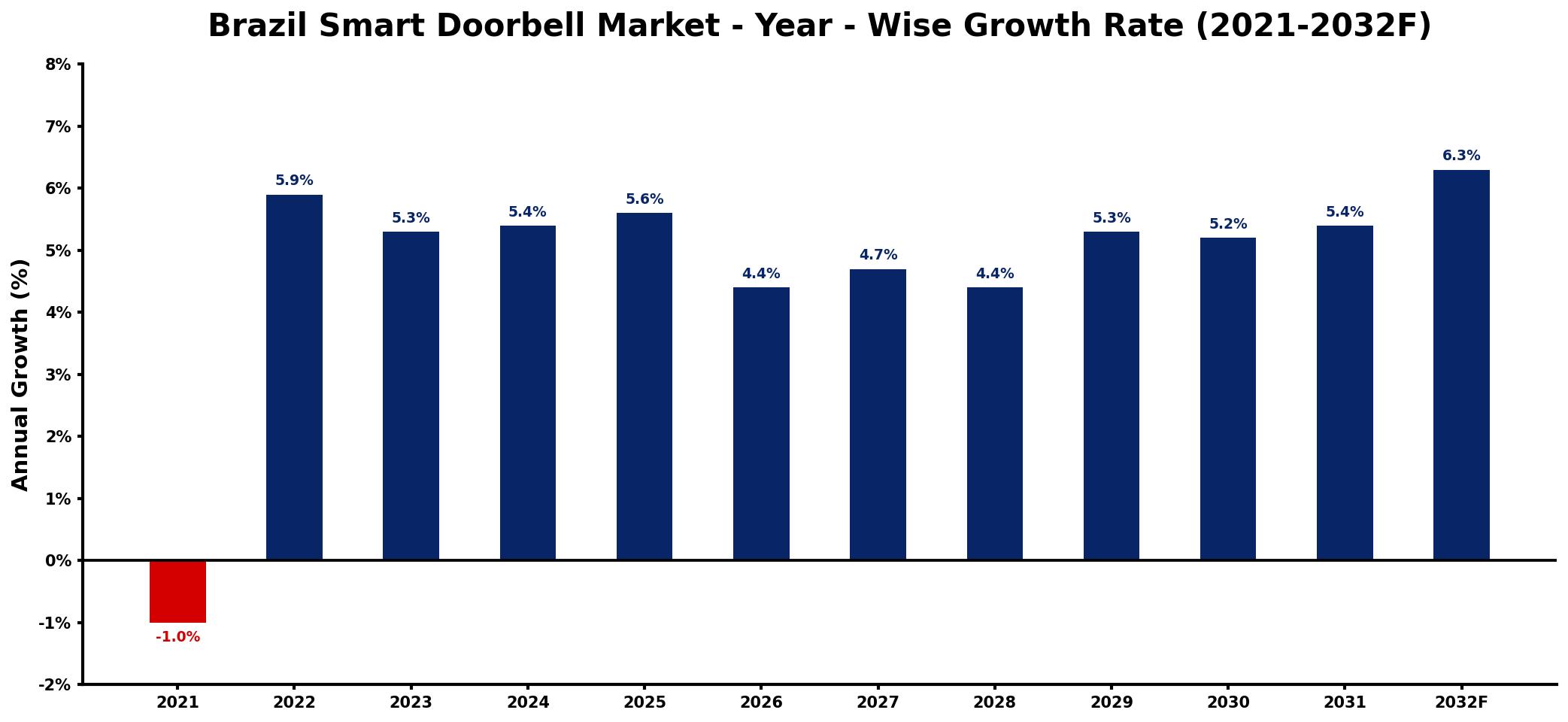
The table below presents the year‑wise growth rates along with the key drivers influencing the market
| Year | Growth Rate | Major Drivers |
| 2021 | -1.0% | decrease in consumer spending habits |
| 2022 | 5.9% | growth in home automation sector |
| 2023 | 5.3% | rise in security technology investments |
| 2024 | 5.4% | increased urban residential construction |
| 2025 | 5.6% | expansion of IoT applications market |
| 2026 | 4.4% | growing demand for remote monitoring |
| 2027 | 4.7% | surge in home improvement projects |
| 2028 | 4.4% | enhanced consumer awareness of security |
| 2029 | 5.3% | increase in digital connectivity adoption |
| 2030 | 5.2% | growing interest in energy efficiency |
| 2031 | 5.4% | expanding healthcare application demand |
| 2032 | 6.3% | rising popularity of subscription services |
Note: Market size estimations and growth projections presented in this report are based on 6Wresearch's proprietary forecasting methodology, utilizing the latest available industry data, government publications, and primary research inputs.
Brazil Smart Doorbell Market Synopsis
Brazil's smart doorbell market is seeing a marked shift towards advanced functionalities, particularly video surveillance and remote access features. This demand is driven by escalating concerns over burglary and unauthorized access, which have become particularly pronounced in urban areas.
Moreover, the increasing adoption of home automation systems further fuels interest in smart doorbell technologies. As more consumers recognize the benefits of smart home ecosystems, the integration of smart doorbells into these systems is becoming a standard preference.
Brazil Smart Doorbell Market Key Takeaways
- The market is benefitting from a rising urban population and greater disposable income, promoting investment in home security.
- Consumer awareness remains a significant barrier, with many potential buyers unaware of the advantages of smart doorbells.
- Government policies are emphasizing cybersecurity measures that bolster consumer trust in smart technologies.
- Integration with home automation systems is becoming a major selling point for smart doorbells.
- Concerns over privacy and data security continue to challenge market penetration in certain demographics.
Evaluation of Restraints in Brazil Smart Doorbell Market
Despite the promising growth of the smart doorbell market in Brazil, several real restraints continue to hinder wider adoption. A significant portion of the population remains unaware of the benefits that smart doorbells offer, leading to hesitance in making purchases. Moreover, affordability presents another substantial barrier, particularly in lower-income demographics, where cost-effective options may be scarce. Privacy concerns also play a crucial role, as potential customers express apprehension regarding data security and how their information will be managed. As the market continues to evolve, addressing these concerns will be vital for sustained growth.
Brazil Smart Doorbell Market Trends
Current trends in the Brazil smart doorbell market highlight a shift towards multifunctionality, with products increasingly integrating features such as motion detection, facial recognition, and two-way audio. Additionally, the compatibility of smart doorbells with existing home automation systems is becoming a preferred criterion for consumers. Emerging technologies, including AI-driven analytics and enhanced cloud storage solutions, are further driving innovation within this sector. There is also a notable trend towards mobile app integration, enabling users to monitor their doorbells from anywhere in real-time.
Brazil Smart Doorbell Market Opportunities
The smart doorbell market in Brazil presents genuine growth opportunities for investors and innovators alike. With rising urbanization trends, particularly in major cities like São Paulo and Rio de Janeiro, the demand for enhanced home security solutions is likely to increase. This market also offers prospects for collaboration with construction firms and home automation providers, as more developers integrate smart technology into new housing projects. Furthermore, emerging trends towards sustainability and energy efficiency provide avenues for the introduction of eco-friendly smart doorbell systems, appealing to environmentally conscious consumers.
Government Initiatives in the Brazil Smart Doorbell Market
Government initiatives in Brazil are increasingly aimed at enhancing cybersecurity measures related to smart doorbell technologies. Policies focus on ensuring that manufacturers adhere to regulatory standards that promote data encryption and interoperability. This is crucial for building consumer trust, as more Brazilians adopt smart technologies for their homes. Additionally, public spending initiatives aimed at promoting digital literacy can aid in raising awareness of the benefits and functionalities of smart doorbells.
Future Insights of the Brazil Smart Doorbell Market
Looking ahead to the period from 2026 to 2032, the Brazil smart doorbell market is expected to see significant advancements, driven by both technological innovation and shifting consumer preferences. The integration of AI and machine learning will likely enhance the functionality of these devices, making them more intuitive and user-friendly. Additionally, as awareness regarding smart home security grows, it is anticipated that barriers related to consumer knowledge will diminish. Consequently, the market is poised for continued expansion as it aligns with broader trends in smart home automation and security.
Brazil Smart Doorbell Market Latest Developments (2025 - 2026)
Recent developments in the Brazilian smart doorbell market indicate a growing emphasis on product innovation and user experience. Many manufacturers are focusing on enhancing the camera quality and reliability of remote features to cater to the increasingly sophisticated demands of consumers. Additionally, there has been a push towards creating more affordable options aimed at penetrating untapped demographics. With regulatory bodies tightening security standards, manufacturers are adapting by ensuring compliance with new data protection laws and emphasizing transparency to build consumer confidence.
Brazil Smart Doorbell Market - Key Attractiveness of the Report
- 10 Years of Market Numbers
- Historical Data Starting from 2022 to 2025
- Base Year: 2025
- Forecast Data until 2032
- Key Performance Indicators Impacting the Market
- Major Upcoming Developments and Projects
Key Highlights of the Report:
- Brazil Smart Doorbell Market Outlook
- Market Size of Brazil Smart Doorbell Market, 2025
- Forecast of Brazil Smart Doorbell Market, 2032
- Historical Data and Forecast of Brazil Smart Doorbell Revenues & Volume for the Period 2022-2032F
- Brazil Smart Doorbell Market Trend Evolution
- Brazil Smart Doorbell Market Drivers and Challenges
- Brazil Smart Doorbell Price Trends
- Brazil Smart Doorbell Porter's Five Forces
- Brazil Smart Doorbell Industry Life Cycle
- Historical Data and Forecast of Brazil Smart Doorbell Market Revenues & Volume By Product Type for the Period 2022-2032F
- Historical Data and Forecast of Brazil Smart Doorbell Market Revenues & Volume By Wired Doorbell for the Period 2022-2032F
- Historical Data and Forecast of Brazil Smart Doorbell Market Revenues & Volume By Wireless Doorbell for the Period 2022-2032F
- Historical Data and Forecast of Brazil Smart Doorbell Market Revenues & Volume By Distribution Channel for the Period 2022-2032F
- Historical Data and Forecast of Brazil Smart Doorbell Market Revenues & Volume By Online for the Period 2022-2032F
- Historical Data and Forecast of Brazil Smart Doorbell Market Revenues & Volume By Offline for the Period 2022-2032F
- Historical Data and Forecast of Brazil Smart Doorbell Market Revenues & Volume By End User for the Period 2022-2032F
- Historical Data and Forecast of Brazil Smart Doorbell Market Revenues & Volume By Residential for the Period 2022-2032F
- Historical Data and Forecast of Brazil Smart Doorbell Market Revenues & Volume By Commercial for the Period 2022-2032F
- Brazil Smart Doorbell Import Export Trade Statistics
- Market Opportunity Assessment By Product Type
- Market Opportunity Assessment By Distribution Channel
- Market Opportunity Assessment By End User
- Brazil Smart Doorbell Top Companies Market Share
- Brazil Smart Doorbell Competitive Benchmarking By Technical and Operational Parameters
- Brazil Smart Doorbell Company Profiles
- Brazil Smart Doorbell Key Strategic Recommendations






































