Brazil Special Occasions Clothes Market Summary
The brazil special occasions clothes market was estimated at USD 379 Million in 2025 and is projected to reach USD 453 Million by 2032, growing at a CAGR of 2.6% from 2026 to 2032.
Brazil Special Occasions Clothes Market Year-wise Growth Rate and Key Drivers
This graph highlights how the Brazil Special Occasions Clothes Market has steadily grown over the past five years, supported by major growth factors.
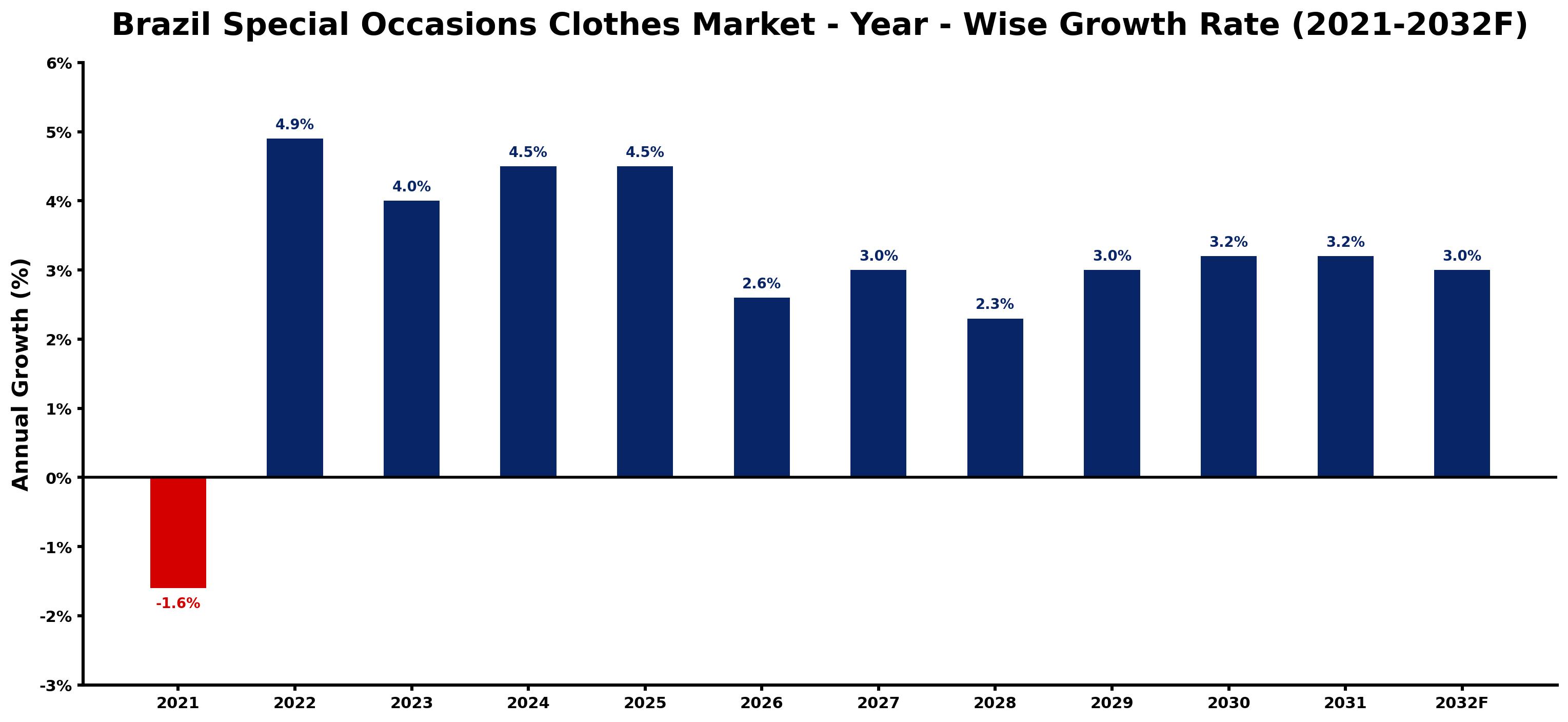
The table below presents the year wise growth rates along with the key drivers influencing the market
| Year | Growth Rate | Major Drivers |
| 2021 | -1.6% | Diminished social gatherings due to ongoing pandemic restrictions sharply reduced demand for special occasion attire. |
| 2022 | 4.9% | Emerging brands embraced sustainability, appealing to environmentally conscious buyers' preferences. |
| 2023 | 4.0% | Local artisans gained traction, offering unique and culturally relevant clothing options. |
| 2024 | 4.5% | Social media influencers drove trends, significantly impacting purchase decisions among millennials. |
| 2025 | 4.5% | Regional fashion weeks showcased diverse talent, promoting Brazil's unique style on international platforms. |
| 2026 | 2.6% | Economic recovery led to increased disposable incomes, encouraging spending on special occasion attire. |
| 2027 | 3.0% | Collaborations between designers and local celebrities enhanced brand visibility and consumer interest. |
| 2028 | 2.3% | Seasonal celebrations, such as Carnival, stimulated demand for vibrant and festive clothing options. |
| 2029 | 3.0% | Technological advancements in e-commerce improved shopping experiences, attracting more online customers. |
| 2030 | 3.2% | Environmental concerns prompted brands to adopt eco-friendly materials, resonating with mindful consumers. |
| 2031 | 3.2% | Cultural festivals expanded, creating new opportunities for specialty clothing markets to thrive. |
| 2032 | 3.0% | Diverse consumer demographics influenced fashion trends, driving innovation in special occasion collections. |
Note - Market size estimations and growth projections presented in this report are based on 6Wresearch's advanced forecasting approach, validated with industry datasets as of June 2026.
Brazil Special Occasions Clothes Market Synopsis
The Brazil Special Occasions Clothes Market is projected to reach 2.6% and witness significant growth during the forecast period (2026-2032). This market thrives on the rich tapestry of Brazil's cultural festivities, where clothing serves not only as a functional aspect but also as a representation of identity and tradition. The diversity in fashion preferences, spanning traditional garments worn during festivals to contemporary designs for weddings and other celebrations, shapes the dynamic landscape of this market.
Brazil Special Occasions Clothes Market Growth Drivers
Several factors are propelling the Brazil Special Occasions Clothes Market forward. First, the country's vibrant cultural celebrations, such as Carnival and various local festivals, create a continuous demand for special attire. Second, the increasing population and a growing middle class are contributing to higher disposable incomes, allowing consumers to invest in elegant clothing for significant events. Additionally, evolving fashion trends enhance the desire for unique and personalized outfits, which cater to individual expressions during special occasions. Finally, the rise of online shopping has made it easier for consumers to access a broader range of options, thus fueling market expansion.
Brazil Special Occasions Clothes Market Trends and Opportunities
The Brazil Special Occasions Clothes Market is witnessing notable trends that present various opportunities for growth. Notably, there is a rising inclination towards sustainable and ethically produced fashion among consumers who are becoming more environmentally conscious. This trend is encouraging designers and manufacturers to adopt eco-friendly practices. Moreover, the integration of technology into fashion, such as online customization and virtual fitting rooms, is enhancing customer experience and satisfaction. Emerging designers are also gaining traction, attracting consumers who seek exclusive and contemporary designs. Lastly, international collaborations are expanding the reach of Brazilian fashion, promoting its global competitiveness.
Brazil Special Occasions Clothes Market Challenges and Restraints
Despite its growth potential, the Brazil Special Occasions Clothes Market faces several challenges. Fluctuating economic conditions can significantly affect consumer spending, particularly for non-essential items like special occasion attire. Additionally, the need to keep pace with rapidly changing fashion trends can strain manufacturers' inventory management systems, leading to potential overstock or stockouts. Furthermore, competition from both international and local brands can pressure margins, making it vital for businesses to differentiate themselves through unique offerings and superior customer service. Finally, logistics and distribution challenges, particularly in remote areas, can hinder market accessibility.
Brazil Special Occasions Clothes Market Government Investment and Initiatives
The Brazilian government plays a significant role in supporting the special occasions clothes market through various initiatives and investments. Policies aimed at bolstering the textile and fashion industry include financial incentives for local designers and manufacturers, which promote homegrown talent and exports. Additionally, government programs designed to enhance vocational training in fashion-related fields ensure a steady flow of skilled labor. Public spending on cultural events and festivals also indirectly benefits this market by driving demand for special occasion garments. Furthermore, promotional initiatives aimed at showcasing Brazilian fashion on international platforms contribute to enhancing its global presence.
Brazil Special Occasions Clothes Market Latest Developments (May 2025 - June 2026)
Recent developments in the Brazil Special Occasions Clothes Market indicate a shift towards greater inclusivity and diversity in fashion. Designers are increasingly embracing varied representations of cultural identities, catering to a broader audience. Additionally, advancements in technology are reshaping retail strategies, with a focus on enhancing the omnichannel shopping experience. Emerging collaborations between local artisans and fashion houses are fostering innovative designs that celebrate Brazil's cultural heritage. Sustainability remains a focal point, with several brands adopting eco-friendly materials and practices, reflecting a growing consumer preference for responsible fashion. Overall, the period reflects a proactive adaptation to market demands and consumer preferences.
Brazil Special Occasions Clothes Market - Key Attractiveness of the Report
- 10 Years of Market Numbers
- Historical Data Starting from 2022 to 2025
- Base Year: 2025
- Forecast Data until 2032
- Key Performance Indicators Impacting the Market
- Major Upcoming Developments and Projects
Key Highlights of the Report:
- Brazil Special Occasions Clothes Market Outlook
- Market Size of Brazil Special Occasions Clothes Market, 2025
- Forecast of Brazil Special Occasions Clothes Market, 2032
- Historical Data and Forecast of Brazil Special Occasions Clothes Revenues & Volume for the Period 2022-2032F
- Brazil Special Occasions Clothes Market Trend Evolution
- Brazil Special Occasions Clothes Market Drivers and Challenges
- Brazil Special Occasions Clothes Price Trends
- Brazil Special Occasions Clothes Porter's Five Forces
- Brazil Special Occasions Clothes Industry Life Cycle
- Historical Data and Forecast of Brazil Special Occasions Clothes Market Revenues & Volume By Product Type for the Period 2022-2032F
- Historical Data and Forecast of Brazil Special Occasions Clothes Market Revenues & Volume By Gown for the Period 2022-2032F
- Historical Data and Forecast of Brazil Special Occasions Clothes Market Revenues & Volume By Suit/Tuxedo for the Period 2022-2032F
- Historical Data and Forecast of Brazil Special Occasions Clothes Market Revenues & Volume By Traditional Wear for the Period 2022-2032F
- Historical Data and Forecast of Brazil Special Occasions Clothes Market Revenues & Volume By Gender for the Period 2022-2032F
- Historical Data and Forecast of Brazil Special Occasions Clothes Market Revenues & Volume By Male for the Period 2022-2032F
- Historical Data and Forecast of Brazil Special Occasions Clothes Market Revenues & Volume By Female for the Period 2022-2032F
- Historical Data and Forecast of Brazil Special Occasions Clothes Market Revenues & Volume By Distribution Channel for the Period 2022-2032F
- Historical Data and Forecast of Brazil Special Occasions Clothes Market Revenues & Volume By Online for the Period 2022-2032F
- Historical Data and Forecast of Brazil Special Occasions Clothes Market Revenues & Volume By Offline for the Period 2022-2032F
- Brazil Special Occasions Clothes Import Export Trade Statistics
- Market Opportunity Assessment By Product Type
- Market Opportunity Assessment By Gender
- Market Opportunity Assessment By Distribution Channel
- Brazil Special Occasions Clothes Top Companies Market Share
- Brazil Special Occasions Clothes Competitive Benchmarking By Technical and Operational Parameters
- Brazil Special Occasions Clothes Company Profiles
- Brazil Special Occasions Clothes Key Strategic Recommendations






































