Brazil Sports Equipment Market Size, Share & Growth Rate
The Brazil Sports Equipment Market was estimated at USD 97 Million in 2025 and is projected to reach USD 115 Million by 2032, growing at a CAGR of 2.5% from 2026 to 2032. This growth is significantly driven by an increasing fitness consciousness among the Brazilian population, coupled with a robust interest in both traditional and niche sports. The rise of government initiatives aimed at promoting sports participation further accelerates demand, creating a vibrant market landscape ripe for exploration.
Brazil Sports Equipment Market Year-wise Growth Rate and Key Drivers
This graph highlights how the Brazil Sports Equipment Market has steadily grown over the years, supported by major growth factors.
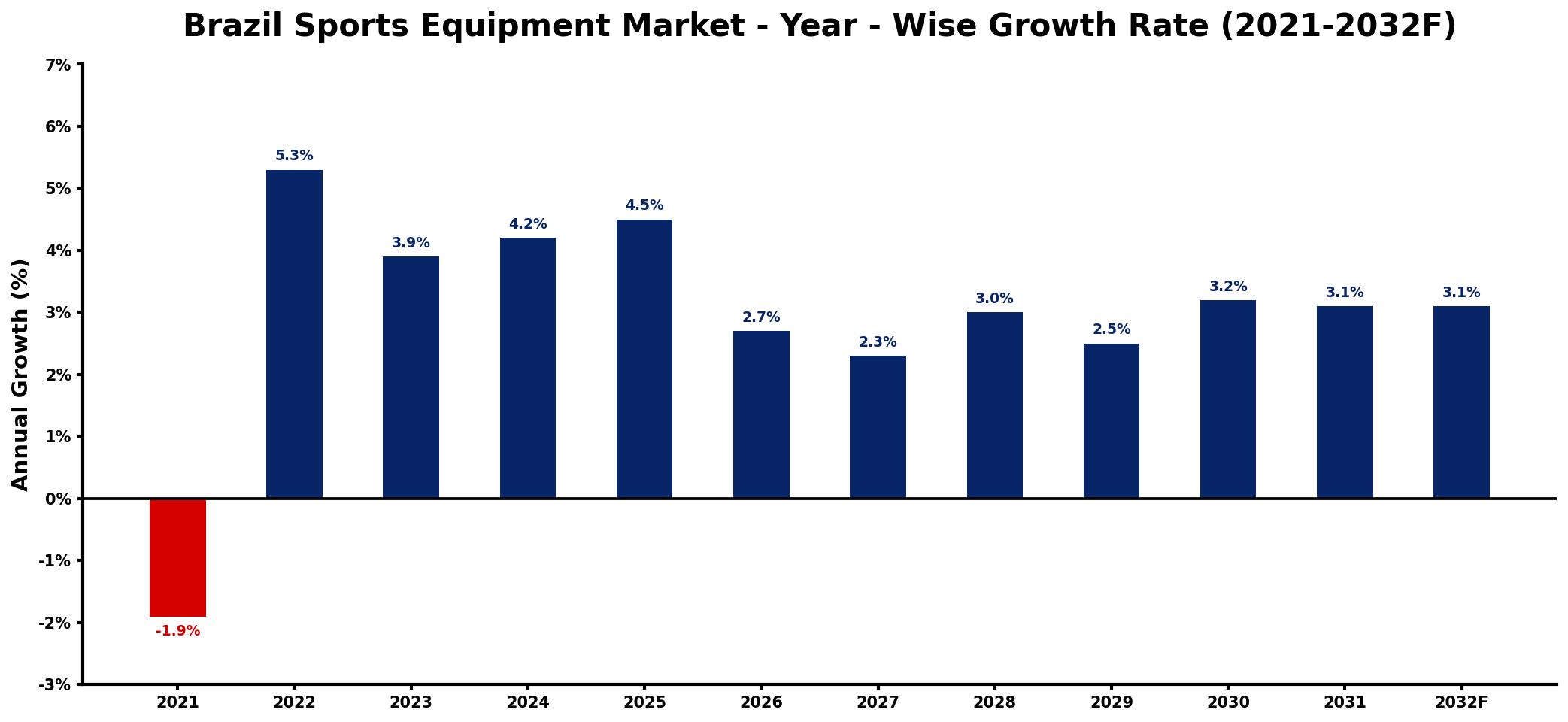
The table below presents the year‑wise growth rates along with the key drivers influencing the market
| Year | Growth Rate | Major Drivers |
| 2021 | -1.9% | decreased consumer spending on leisure |
| 2022 | 5.3% | increased health awareness among consumers |
| 2023 | 3.9% | growth in fitness technology adoption |
| 2024 | 4.2% | expansion of e-commerce platforms |
| 2025 | 4.5% | increased participation in recreational activities |
| 2026 | 2.7% | rising interest in outdoor adventures |
| 2027 | 2.3% | expanding industrial usage applications |
| 2028 | 3.0% | increased corporate wellness initiatives |
| 2029 | 2.5% | development of sustainable manufacturing practices |
| 2030 | 3.2% | rise in online fitness communities |
| 2031 | 3.1% | growing demand for personalized training |
| 2032 | 3.1% | strengthening underlying market demand |
Note: Market size estimations and growth projections presented in this report are based on 6Wresearch's proprietary forecasting methodology, utilizing the latest available industry data, government publications, and primary research inputs.
Brazil Sports Equipment Market Synopsis
The Brazilian sports equipment market is a dynamic arena that reflects the country's diverse sporting culture. With soccer and volleyball at the forefront, theres also a burgeoning interest in activities such as surfing and skateboarding, appealing to a younger demographic seeking variety in their sports pursuits.
In recent years, a notable shift has occurred as more Brazilians embrace fitness as a lifestyle choice. This burgeoning health awareness is driving demand for high-quality sports and fitness gear, from apparel to advanced equipment, indicating a promising future for the market.
Brazil Sports Equipment Market Key Takeaways
- The market is experiencing steady growth fueled by increased fitness consciousness among consumers.
- Government policies are actively fostering sports participation and enhancing local manufacturing capabilities.
- Shifts in consumer preferences towards quality and technologically advanced products are influencing market dynamics.
- Emerging sports trends are opening avenues for niche markets within the broader sports equipment category.
- The economic landscape poses risks but also opportunities for adaptive companies to thrive.
Evaluation of Restraints in Brazil Sports Equipment Market
Despite the positive trajectory, the Brazil Sports Equipment Market faces several restraints that could limit its potential. A significant challenge is the rapidly changing consumer preferences influenced by global trends; staying relevant requires agility and innovation from manufacturers. Furthermore, economic fluctuations can alter consumer spending patterns, impacting demand for sports equipment. Additionally, external factors such as public health crises can lead to unpredictable market shifts, necessitating a robust strategy for market players to navigate these challenges effectively.
Brazil Sports Equipment Market Trends
Current trends highlight a growing inclination towards multifunctional and technologically integrated sports equipment. Wearable technology is becoming increasingly popular among fitness enthusiasts, allowing them to track performance and enhance their training regimens. Furthermore, sustainability has emerged as a key consideration among consumers, with a notable demand for eco-friendly materials in sports gear production.
Brazil Sports Equipment Market Opportunities
Opportunities for growth in the Brazil Sports Equipment Market are vast. There is considerable potential in the expansion of niche sports segments, such as skateboarding and surfing, especially with Brazil's extensive coastline. Additionally, as community fitness initiatives gain traction, brands that align with these movements are likely to capture a loyal customer base. Investing in innovative technologies that promote enhanced user experience will also provide a competitive edge in this evolving market.
Government Initiatives in the Brazil Sports Equipment Market
The Brazilian government plays a proactive role in promoting the sports equipment sector through various initiatives. Policies designed to support research and development in sports technology are paving the way for advancements in product quality and performance. Moreover, grants and subsidies aimed at local manufacturers encourage the production of competitive sports equipment, ultimately benefiting consumers and the industry as a whole.
Future Insights of the Brazil Sports Equipment Market
Looking ahead to 2026-2032, the Brazil Sports Equipment Market is poised for steady growth driven by continued health consciousness and evolving consumer demands. The integration of technology in sports equipment is expected to deepen, enhancing user engagement and product utility. As government initiatives continue to foster sports participation, market players that adapt swiftly to changing trends and consumer preferences will likely find themselves at the forefront of this promising market landscape.
Brazil Sports Equipment Market Latest Developments (2025 - 2026)
Recent industry developments suggest a concerted effort among companies to innovate and cater to the evolving demands of Brazilian consumers. Enhanced collaborations between local manufacturers and technology firms are emerging, focusing on creating smarter sports equipment. Additionally, marketing strategies are increasingly targeting the youth demographic, utilizing digital platforms to engage potential customers. Such initiatives reflect the industry's responsiveness to shifting consumer dynamics.
Brazil Sports Equipment Market - Key Attractiveness of the Report
- 10 Years of Market Numbers
- Historical Data Starting from 2022 to 2025
- Base Year: 2025
- Forecast Data until 2032
- Key Performance Indicators Impacting the Market
- Major Upcoming Developments and Projects
Key Highlights of the Report:
- Brazil Sports Equipment Market Outlook
- Market Size of Brazil Sports Equipment Market, 2025
- Forecast of Brazil Sports Equipment Market, 2032
- Historical Data and Forecast of Brazil Sports Equipment Revenues & Volume for the Period 2022-2032F
- Brazil Sports Equipment Market Trend Evolution
- Brazil Sports Equipment Market Drivers and Challenges
- Brazil Sports Equipment Price Trends
- Brazil Sports Equipment Porter's Five Forces
- Brazil Sports Equipment Industry Life Cycle
- Historical Data and Forecast of Brazil Sports Equipment Market Revenues & Volume By Product for the Period 2022-2032F
- Historical Data and Forecast of Brazil Sports Equipment Market Revenues & Volume By Ball over net games for the Period 2022-2032F
- Historical Data and Forecast of Brazil Sports Equipment Market Revenues & Volume By Ball games for the Period 2022-2032F
- Historical Data and Forecast of Brazil Sports Equipment Market Revenues & Volume By Fitness/Strength equipment for the Period 2022-2032F
- Historical Data and Forecast of Brazil Sports Equipment Market Revenues & Volume By Athletic training equipment for the Period 2022-2032F
- Historical Data and Forecast of Brazil Sports Equipment Market Revenues & Volume By Others for the Period 2022-2032F
- Historical Data and Forecast of Brazil Sports Equipment Market Revenues & Volume By Distribution Channel for the Period 2022-2032F
- Historical Data and Forecast of Brazil Sports Equipment Market Revenues & Volume By Online retail for the Period 2022-2032F
- Historical Data and Forecast of Brazil Sports Equipment Market Revenues & Volume By Specialty & sports shops for the Period 2022-2032F
- Historical Data and Forecast of Brazil Sports Equipment Market Revenues & Volume By Department & discount stores for the Period 2022-2032F
- Brazil Sports Equipment Import Export Trade Statistics
- Market Opportunity Assessment By Product
- Market Opportunity Assessment By Distribution Channel
- Brazil Sports Equipment Top Companies Market Share
- Brazil Sports Equipment Competitive Benchmarking By Technical and Operational Parameters
- Brazil Sports Equipment Company Profiles
- Brazil Sports Equipment Key Strategic Recommendations






































