Brazil Sugar Refinery Machinery and Equipment Market Summary
The brazil sugar refinery machinery and equipment market was estimated at USD 489 Million in 2025 and is projected to reach USD 585 Million by 2032, growing at a CAGR of 2.6% from 2026 to 2032.
Brazil Sugar Refinery Machinery and Equipment Market Year-wise Growth Rate and Key Drivers
This graph highlights how the Brazil Sugar Refinery Machinery and Equipment Market has steadily grown over the past five years, supported by major growth factors.
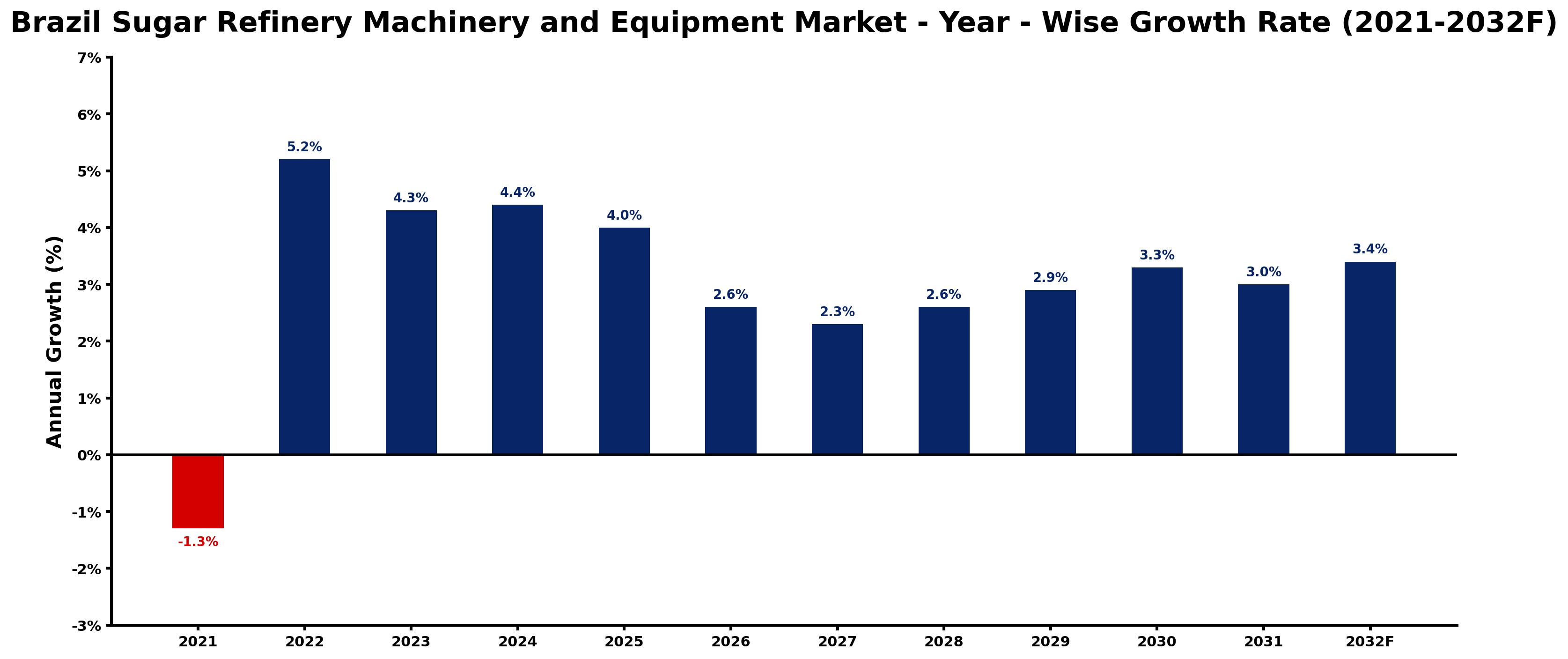
The table below presents the year wise growth rates along with the key drivers influencing the market
| Year | Growth Rate | Major Drivers |
| 2021 | -1.3% | Unfavorable weather conditions significantly impacted sugarcane yields, leading to decreased demand for refinery machinery. |
| 2022 | 5.2% | Investment in automation technologies improves production consistency and reduces labor costs. |
| 2023 | 4.3% | Emerging biofuel policies generate interest in sugar byproducts for energy applications. |
| 2024 | 4.4% | Brazil's export markets expand, increasing demand for high-capacity refinery machinery. |
| 2025 | 4.0% | Local manufacturers emphasize sustainable practices, attracting environmentally-focused investments. |
| 2026 | 2.6% | Technological collaboration with global firms enhances innovation in sugar processing equipment. |
| 2027 | 2.3% | Rural infrastructure improvements facilitate better access to machinery for remote producers. |
| 2028 | 2.6% | Rise in global sugar prices incentivizes investment in enhanced refinery technologies. |
| 2029 | 2.9% | Urbanization drives demand for processed sugar products, boosting machinery requirements. |
| 2030 | 3.3% | Climate change initiatives push for energy-efficient machinery within the refining sector. |
| 2031 | 3.0% | Post-pandemic recovery strengthens local sugar markets, increasing equipment procurement budgets. |
| 2032 | 3.4% | Market consolidation among refineries leads to larger-scale machinery investments and upgrades. |
Note - Market size estimations and growth projections presented in this report are based on 6Wresearch's advanced forecasting approach, validated with industry datasets as of June 2026.
Brazil Sugar Refinery Machinery and Equipment Market Synopsis
The Brazil Sugar Refinery Machinery and Equipment Market is projected to reach 2.6% and witness significant growth during the forecast period (2026-2032). Brazil's prominent position in the global sugar industry necessitates a robust machinery and equipment sector that supports increased production and refined processes. This market is shaped by several interlinked factors which include technological advancements, evolving production methods, and policy frameworks that aim to enhance overall efficiency within the sector.
Brazil Sugar Refinery Machinery and Equipment Market Growth Drivers
The growth of the Brazil Sugar Refinery Machinery and Equipment Market is primarily driven by the following elements:
- The country's standing as one of the largest sugar producers worldwide necessitates the continual upgrading of refinery equipment to maintain and enhance production efficiency.
- Technological innovations in refining processes allow for improved extraction rates and lower operational costs, compelling sugar producers to invest in modern machinery.
- The increasing demand for sustainable and eco-friendly production methods is driving investments in machinery that supports energy efficiency and waste reduction.
- As sugar consumption rises in domestic and international markets, manufacturers are compelled to expand and modernize their refining capacity, resulting in heightened demand for advanced machinery.
- Government policies promoting the sugar industry's growth further incentivize investments in updated refining technology as producers seek to align with national objectives.
Brazil Sugar Refinery Machinery and Equipment Market Challenges and Restraints
Despite its potential for growth, the Brazil Sugar Refinery Machinery and Equipment Market faces significant challenges:
- Fluctuating sugar prices on the global market create instability, affecting investment decisions among sugar producers regarding machinery procurement.
- Technological obsolescence presents a challenge, where older refinery equipment may hinder operational efficiency, leading to decreased competitiveness in an evolving market.
- High initial capital costs associated with procuring advanced machinery can deter smaller sugar producers from upgrading their facilities, potentially leading to inefficiencies.
- Regulatory frameworks and standards can change, creating uncertainty for manufacturers and impacting long-term planning for machinery investments.
- The global economic environment can influence consumer demand and supply chains, affecting the viability of investments in sugar refining technology.
Brazil Sugar Refinery Machinery and Equipment Market Government Investment and Initiatives
Government initiatives play a crucial role in shaping the Brazil Sugar Refinery Machinery and Equipment Market. The Brazilian government has implemented several policies aimed at supporting the sugar sector:
- Financial incentives and subsidies for sugar producers are provided to encourage the modernization of refining processes and machinery, thereby increasing production efficiency.
- Research and development programs funded by the government aim to advance technological innovation within the industry, promoting better machinery solutions.
- Public investments in infrastructure have been pivotal in enhancing supply chain logistics, which indirectly supports the efficiency of sugar refineries.
- Regulatory frameworks that emphasize sustainable practices compel refineries to adopt modern machinery that aligns with environmental standards.
- Collaborative initiatives between the government and the sugar industry focus on improving workforce skills, ensuring that operators of new machinery are adequately trained.
Brazil Sugar Refinery Machinery and Equipment Market Latest Developments (May 2025 - June 2026)
Recent trends in the Brazil Sugar Refinery Machinery and Equipment Market indicate significant shifts aimed at modernization and sustainability. Over the period from May 2025 to June 2026, several developments have been observed:
- Increased investment in automation and smart technologies is becoming commonplace, with refineries looking to reduce labor costs and improve operational precision.
- Producers are increasingly adopting eco-friendly machinery, in response to both consumer demand and regulatory incentives for sustainable production.
- Emerging technologies in bioenergy from sugarcane processing waste are gaining attention, prompting refineries to adapt their equipment accordingly.
- Collaborative partnerships between machinery manufacturers and sugar producers are evolving, focusing on tailored solutions that enhance refining processes.
- Market players are actively engaging in trade exhibitions and industry events to showcase innovative technologies and gather insights on upcoming trends.
Brazil Sugar Refinery Machinery and Equipment Market - Key Attractiveness of the Report
- 10 Years of Market Numbers
- Historical Data Starting from 2022 to 2025
- Base Year: 2025
- Forecast Data until 2032
- Key Performance Indicators Impacting the Market
- Major Upcoming Developments and Projects
Key Highlights of the Report:
- Brazil Sugar Refinery Machinery and Equipment Market Outlook
- Market Size of Brazil Sugar Refinery Machinery and Equipment Market, 2025
- Forecast of Brazil Sugar Refinery Machinery and Equipment Market, 2032
- Historical Data and Forecast of Brazil Sugar Refinery Machinery and Equipment Revenues & Volume for the Period 2022-2032F
- Brazil Sugar Refinery Machinery and Equipment Market Trend Evolution
- Brazil Sugar Refinery Machinery and Equipment Market Drivers and Challenges
- Brazil Sugar Refinery Machinery and Equipment Price Trends
- Brazil Sugar Refinery Machinery and Equipment Porter's Five Forces
- Brazil Sugar Refinery Machinery and Equipment Industry Life Cycle
- Historical Data and Forecast of Brazil Sugar Refinery Machinery and Equipment Market Revenues & Volume By Refineries Type for the Period 2022-2032F
- Historical Data and Forecast of Brazil Sugar Refinery Machinery and Equipment Market Revenues & Volume By Front End Refineries for the Period 2022-2032F
- Historical Data and Forecast of Brazil Sugar Refinery Machinery and Equipment Market Revenues & Volume By Back End Refineries for the Period 2022-2032F
- Historical Data and Forecast of Brazil Sugar Refinery Machinery and Equipment Market Revenues & Volume By Machinery and Equipment Type for the Period 2022-2032F
- Historical Data and Forecast of Brazil Sugar Refinery Machinery and Equipment Market Revenues & Volume By Cane Handling Equipment for the Period 2022-2032F
- Historical Data and Forecast of Brazil Sugar Refinery Machinery and Equipment Market Revenues & Volume By Cutting & Grinding Equipment for the Period 2022-2032F
- Historical Data and Forecast of Brazil Sugar Refinery Machinery and Equipment Market Revenues & Volume By Processing Equipment for the Period 2022-2032F
- Historical Data and Forecast of Brazil Sugar Refinery Machinery and Equipment Market Revenues & Volume By Packaging Equipment for the Period 2022-2032F
- Brazil Sugar Refinery Machinery and Equipment Import Export Trade Statistics
- Market Opportunity Assessment By Refineries Type
- Market Opportunity Assessment By Machinery and Equipment Type
- Brazil Sugar Refinery Machinery and Equipment Top Companies Market Share
- Brazil Sugar Refinery Machinery and Equipment Competitive Benchmarking By Technical and Operational Parameters
- Brazil Sugar Refinery Machinery and Equipment Company Profiles
- Brazil Sugar Refinery Machinery and Equipment Key Strategic Recommendations






































