Brazil Switchgear and switchboard apparatus Market Summary
The brazil switchgear and switchboard apparatus market was estimated at USD 248 Million in 2025 and is projected to reach USD 295 Million by 2032, growing at a CAGR of 2.7% from 2026 to 2032.
Brazil Switchgear and switchboard apparatus Market Year-wise Growth Rate and Key Drivers
This graph highlights how the Brazil Switchgear and switchboard apparatus Market has steadily grown over the past five years, supported by major growth factors.
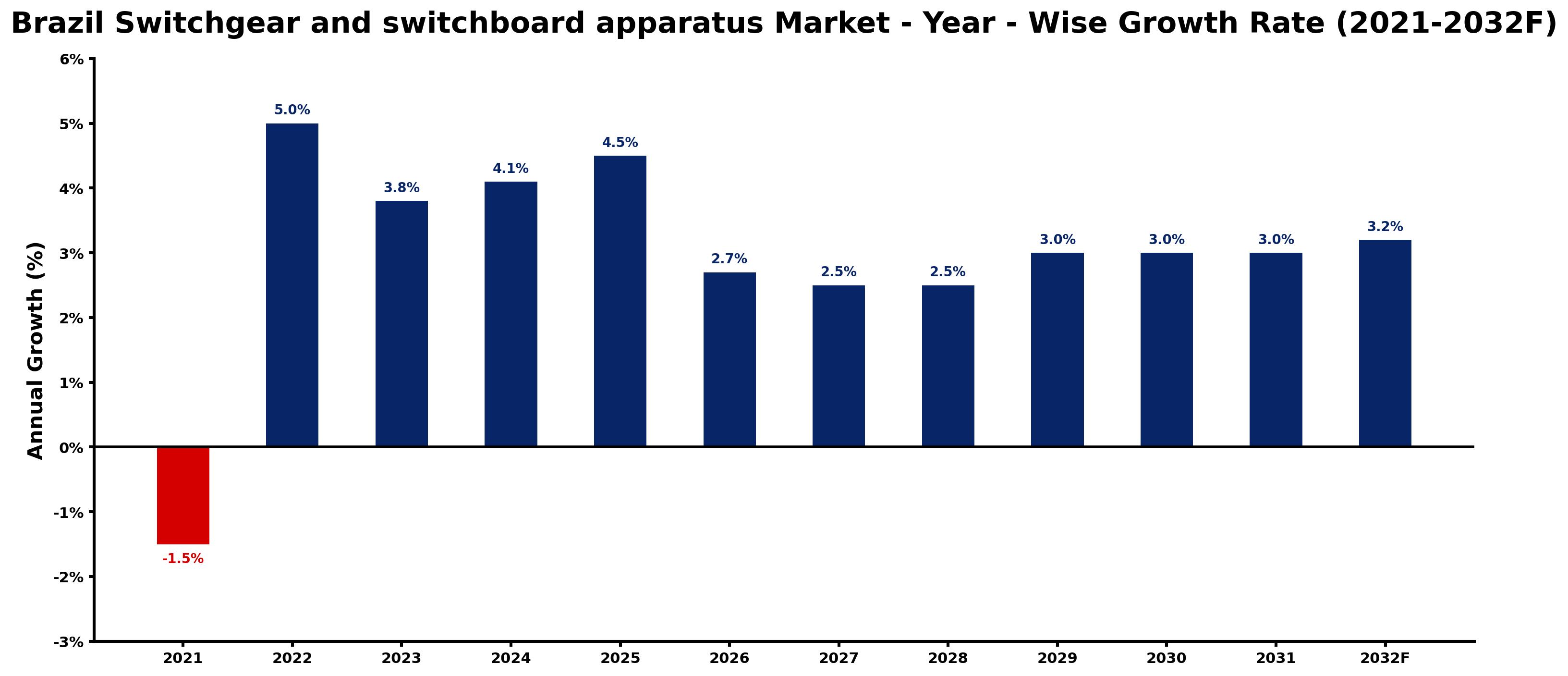
The table below presents the year wise growth rates along with the key drivers influencing the market
| Year | Growth Rate | Major Drivers |
| 2021 | -1.5% | Increased competition from alternative energy solutions diminished reliance on traditional switchgear products. |
| 2022 | 5.0% | Energy distribution projects expanded significantly, enhancing demand for switchgear solutions. |
| 2023 | 3.8% | Transition to renewable energy sources required updated switchboard apparatus for grid stability. |
| 2024 | 4.1% | Elevated urbanization rates led to higher electricity consumption in metropolitan areas. |
| 2025 | 4.5% | Technological upgrades in manufacturing encouraged automation, boosting switchgear market potential. |
| 2026 | 2.7% | Private sector engagements increased, highlighting foreign investments in power infrastructure. |
| 2027 | 2.5% | Smart grid initiatives gained traction, necessitating advanced switchboard technologies for efficiency. |
| 2028 | 2.5% | Local manufacturers innovated, focusing on sustainable practices and eco-friendly switchgear designs. |
| 2029 | 3.0% | Data centers proliferated, driving demand for customized switchboard apparatus solutions. |
| 2030 | 3.0% | Increased electrification in remote areas raised the need for reliable switchgear products. |
| 2031 | 3.0% | The construction sector flourished, creating opportunities for enhanced electrical distribution systems. |
| 2032 | 3.2% | Integration of IoT technologies into switchgear paved the way for smarter energy management. |
Note - Market size estimations and growth projections presented in this report are based on 6Wresearch's advanced forecasting approach, validated with industry datasets as of June 2026.
Brazil Switchgear and switchboard apparatus Market Synopsis
The Brazil Switchgear and switchboard apparatus Market is projected to reach 2.7% and witness significant growth during the forecast period (2026-2032). This market serves as a fundamental component for the electrical power distribution sector, especially as Brazil increasingly pivots towards renewable energy sources. The evolving technological landscape in switchgear systems and the rising investments in energy infrastructure are paramount to ongoing market developments.
Brazil Switchgear and switchboard apparatus Market Growth Drivers
Several key factors drive the Brazil Switchgear and switchboard apparatus Market. Notably:
- The escalating demand for reliable and efficient electrical infrastructure, particularly within the industrial and commercial sectors, is a pivotal growth driver. As businesses aim to enhance productivity, they increasingly rely on advanced switchgear solutions.
- Government initiatives aimed at modernizing the power sector are fostering the expansion of critical infrastructure projects. This includes investments in renewable energy, which necessitate sophisticated switchgear and switchboard apparatus.
- Technological innovations play a crucial role in market growth. The integration of automation and smart technologies in switchgear systems enhances operational efficiency and safety, making them essential for contemporary energy solutions.
- Furthermore, the shift toward sustainable energy practices is creating a surge in demand for switchgear that can efficiently integrate renewable energy sources, such as solar and wind energy, into the national grid.
- Finally, the increasing urbanization in Brazil leads to heightened energy consumption, necessitating robust switchgear systems to support urban infrastructure development.
Brazil Switchgear and switchboard apparatus Market Challenges and Restraints
Despite the promising outlook, the Brazil Switchgear and switchboard apparatus Market faces several challenges:
- The integration of renewable energy sources poses significant technical challenges. Switchgear systems must adapt to varying energy outputs, which can complicate existing electrical infrastructures.
- Advancements in smart grid technologies necessitate updates to switchgear systems, adding complexity to implementation and requiring substantial investment.
- Issues related to standardization can hinder efficient deployment across the industry, potentially leading to interoperability challenges among different systems and manufacturers.
- Cybersecurity concerns are increasingly relevant as switchgear and switchboard systems become more interconnected. Companies must invest in protective measures to mitigate risks associated with smart technologies.
- Finally, the complexity of modern electrical systems may lead to operational inefficiencies if not addressed properly, creating potential hazards and increasing maintenance costs.
Brazil Switchgear and switchboard apparatus Market Government Investment and Initiatives
The Brazilian government plays a crucial role in shaping the landscape of the Switchgear and switchboard apparatus market through various initiatives and investments. Regulatory frameworks emphasize the importance of electrical safety and reliability, driving compliance with international standards. This is evident in policies designed to foster the adoption of smart and energy-efficient technologies. Additionally, public spending is increasingly directed toward modernizing energy infrastructure, which includes investment in renewable energy projects and their associated switchgear needs.
Moreover, collaborative efforts between the government and industry stakeholders are essential in creating a secure and competitive environment for market players. These partnerships lead to shared resources and knowledge, promoting innovation within the sector. Incentives for adopting advanced technologies are also prevalent, encouraging the transition to modernized electrical systems capable of meeting future energy demands.
Brazil Switchgear and switchboard apparatus Market Latest Developments (May 2025 - June 2026)
In the period from May 2025 to June 2026, the Brazil Switchgear and switchboard apparatus Market has witnessed notable developments. There has been a marked increase in interest surrounding the adoption of smart grid technologies, as utilities and companies alike seek to enhance energy efficiency and resilience. Innovations focusing on IoT-enabled switchgear systems have become more prevalent, aligning with broader trends towards digitalization in the energy sector.
Furthermore, discussions around regulatory updates continued to shape industry standards, emphasizing the need for compliance with emerging safety protocols. The government has maintained its focus on promoting investments in renewable energy infrastructure, leading to an increased demand for switchgear and associated technologies. Overall, these developments indicate a vibrant market poised for significant growth driven by technological advancements and a commitment to sustainable energy solutions.
Brazil Switchgear and switchboard apparatus Market - Key Attractiveness of the Report
- 10 Years of Market Numbers
- Historical Data Starting from 2022 to 2025
- Base Year: 2025
- Forecast Data until 2032
- Key Performance Indicators Impacting the Market
- Major Upcoming Developments and Projects
Key Highlights of the Report:
- Brazil Switchgear and switchboard apparatus Market Outlook
- Market Size of Brazil Switchgear and switchboard apparatus Market, 2025
- Forecast of Brazil Switchgear and switchboard apparatus Market, 2032
- Historical Data and Forecast of Brazil Switchgear and switchboard apparatus Revenues & Volume for the Period 2022-2032F
- Brazil Switchgear and switchboard apparatus Market Trend Evolution
- Brazil Switchgear and switchboard apparatus Market Drivers and Challenges
- Brazil Switchgear and switchboard apparatus Price Trends
- Brazil Switchgear and switchboard apparatus Porter's Five Forces
- Brazil Switchgear and switchboard apparatus Industry Life Cycle
- Historical Data and Forecast of Brazil Switchgear and switchboard apparatus Market Revenues & Volume By Type for the Period 2022-2032F
- Historical Data and Forecast of Brazil Switchgear and switchboard apparatus Market Revenues & Volume By Switchgear for the Period 2022-2032F
- Historical Data and Forecast of Brazil Switchgear and switchboard apparatus Market Revenues & Volume By Switchboard for the Period 2022-2032F
- Historical Data and Forecast of Brazil Switchgear and switchboard apparatus Market Revenues & Volume By Application for the Period 2022-2032F
- Historical Data and Forecast of Brazil Switchgear and switchboard apparatus Market Revenues & Volume By Industrial for the Period 2022-2032F
- Historical Data and Forecast of Brazil Switchgear and switchboard apparatus Market Revenues & Volume By Residential for the Period 2022-2032F
- Historical Data and Forecast of Brazil Switchgear and switchboard apparatus Market Revenues & Volume By Commercial for the Period 2022-2032F
- Brazil Switchgear and switchboard apparatus Import Export Trade Statistics
- Market Opportunity Assessment By Type
- Market Opportunity Assessment By Application
- Brazil Switchgear and switchboard apparatus Top Companies Market Share
- Brazil Switchgear and switchboard apparatus Competitive Benchmarking By Technical and Operational Parameters
- Brazil Switchgear and switchboard apparatus Company Profiles
- Brazil Switchgear and switchboard apparatus Key Strategic Recommendations






































