Brazil Synthetic Lubricants Market Top 5 Importing Countries and Market Competition (HHI) Analysis
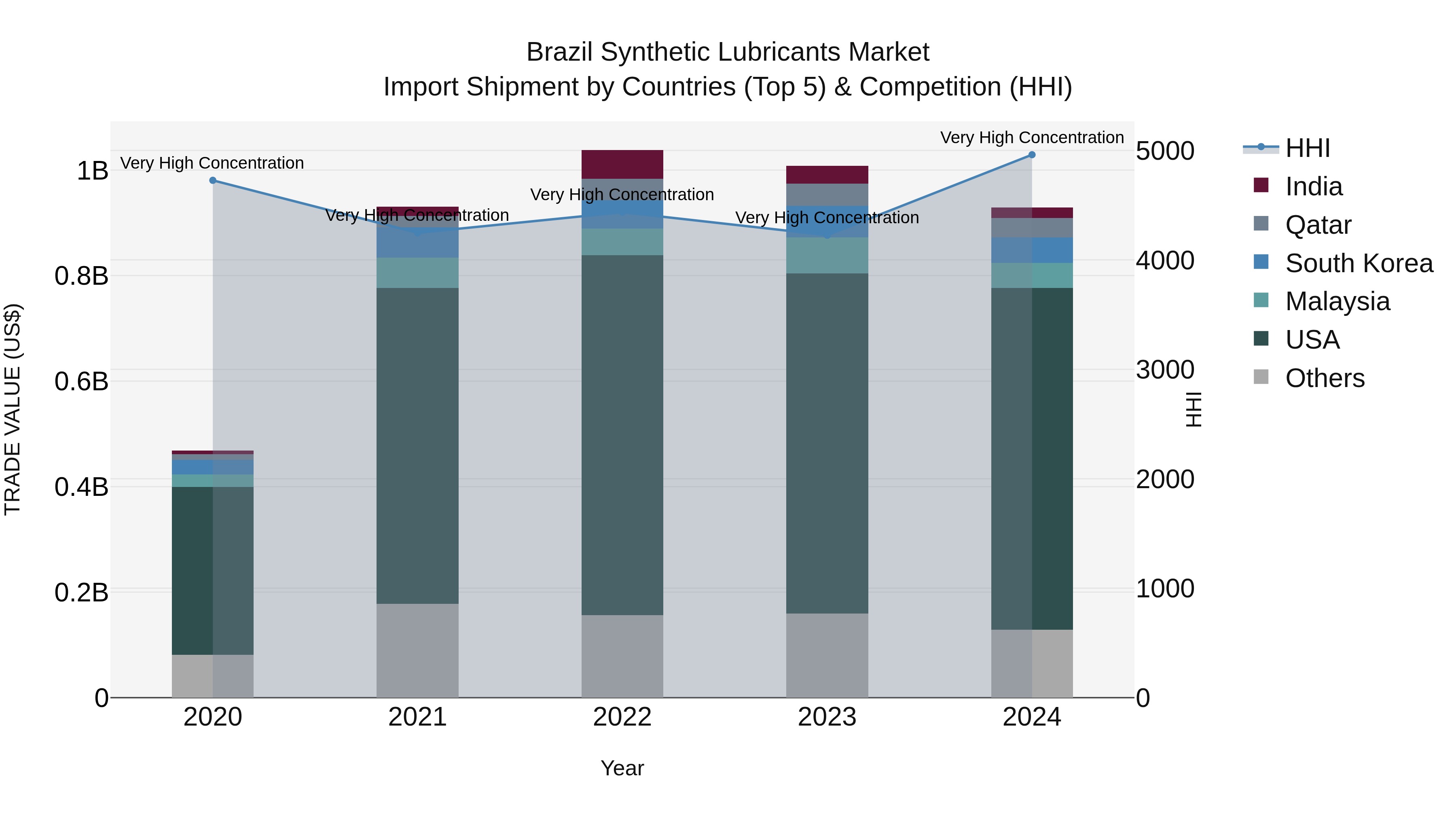
In 2024, Brazil continued to see significant imports of synthetic lubricants, with top exporters including the USA, South Korea, Malaysia, Bahrain, and Qatar. The high Herfindahl-Hirschman Index (HHI) indicates a concentrated market. Despite a strong compound annual growth rate (CAGR) of 18.68% from 2020-24, there was a slight decline in growth from 2023-24 (-7.81%). This data suggests a competitive landscape in the Brazilian synthetic lubricants market, influenced by key players from various countries.
Brazil Synthetic Lubricants Market Highlights
| Report Name | Brazil Synthetic Lubricants Market |
| Forecast period | 2025-2031 |
| CAGR | 4.5% |
| Growing Sector | Automotive |
Topics Covered in the Brazil Synthetic Lubricants Market Report
The Brazil Synthetic Lubricants Market report thoroughly covers the market by type, by product type and by end-use industry. The Brazil Synthetic Lubricants Market report provides an unbiased and detailed analysis of the ongoing Brazil Synthetic Lubricants Market trends, opportunities/high growth areas, and market drivers which would help the stakeholders to devise and align their market strategies according to the current and future market dynamics.
Brazil Synthetic Lubricants Market Synopsis
Brazil Synthetic Lubricants Market has experienced significant success and is expected to continue growing in the future. The market is experiencing steady growth driven by industrial and automotive sectors. Synthetic lubricants offer enhanced performance and longevity compared to conventional oils, attracting demand in high-performance machinery and vehicles. Key players are investing in research for eco-friendly formulations and expanding distribution networks to reach diverse industries. Regulatory support for sustainable practices and technological advancements in lubricant formulations are shaping the market growth, with a focus on efficiency and environmental responsibility.
According to 6Wresearch, the Brazil Synthetic Lubricants Market size is expected to grow at a significant CAGR of 4.5% during the forecast period 2025-2031. One major driver of the Brazil Synthetic Lubricants Market is the increasing demand from the automotive sector. As automotive manufacturers focus on improving engine performance and fuel efficiency, they are turning to synthetic lubricants for their superior properties. Synthetic lubricants offer better viscosity control, thermal stability, and resistance to oxidation compared to conventional oils, leading to reduced friction and wear in engines. This results in extended engine life and improved fuel economy, aligning with regulatory requirements for lower emissions and environmental sustainability. Additionally, the industrial sector is another significant driver. Industries such as manufacturing, energy, and construction rely heavily on machinery and equipment that require efficient lubrication for optimal performance. Synthetic lubricants provide better protection against wear and corrosion, ensuring smooth operation and reducing downtime for maintenance. The growing awareness among industries about the benefits of synthetic lubricants in enhancing equipment lifespan and reducing overall operating costs further fuels the market growth.
However, one major hurdle facing the Synthetic Lubricants Market in Brazil is the competition from conventional lubricants. While synthetic lubricants offer superior performance, their higher initial cost can stop some consumers. Additionally, market education and awareness about the benefits of synthetic lubricants are essential to overcome misconceptions and increase adoption rates. Regulatory compliance and environmental concerns regarding disposal and recycling of synthetic lubricants also present challenges, requiring innovative solutions for sustainable practices and waste management in the industry.
Brazil Synthetic Lubricants Industry: Leading Players
Some leading players in the Brazil Synthetic Lubricants Industry include Petrobras Lubrificantes, Chevron Corporation, Exxon Mobil Corporation, Shell Brazil, and TotalEnergies. These companies have established strong footholds in the market through their extensive product portfolios, technological expertise, and strong distribution networks. They focus on developing advanced synthetic lubricants designed to meet the specific needs of diverse industries, including automotive, manufacturing, and aerospace. Their strategic partnerships, research and development initiatives, and emphasis on sustainability contribute to their prominence in the market, providing to the growing demand for high-performance lubrication solutions in Brazil.
Synthetic Lubricants Market in Brazil: Government Regulations
In Brazil, government regulations play a significant role in shaping the Synthetic Lubricants Market. The National Petroleum Agency (ANP) oversees regulations related to lubricants, including quality standards and labeling requirements. ANP's regulations ensure that synthetic lubricants meet specified performance criteria and labeling guidelines, providing consumers with accurate information about product specifications and usage. Additionally, environmental regulations, such as waste disposal and recycling policies, influence the development and adoption of eco-friendly synthetic lubricants. Companies operating in the market must comply with these regulations to ensure product safety, quality, and environmental responsibility. The government focus on sustainable practices and energy efficiency further drives innovation in synthetic lubricants, encouraging the market to evolve towards more environmentally friendly and technologically advanced solutions.
Future Insights of the Market
The Brazil Synthetic Lubricants Market has been experiencing significant growth over the past few years. The future of the market looks promising with several key trends and developments. One major trend is the shift towards eco-friendly lubricants, driven by strict environmental regulations and increasing consumer awareness of sustainability. Companies are investing in research and development to create bio-based synthetic lubricants that offer superior performance while minimizing environmental impact. Moreover, technological advancements such as nanotechnology and additive formulations are enhancing the properties of synthetic lubricants, improving efficiency and extending equipment lifespan. The market is also witnessing growing demand from emerging industries like renewable energy and electric vehicles, driving innovation in lubricant formulations designed to these sectors unique requirements. Overall, the Brazil Synthetic Lubricants Market Growth is fueled by sustainability initiatives, technological advancements, and expanding applications across various industries.
Market Segmentation by Type
According to Ravi Bhandari, Head of Research, 6Wresearch, PAO (Polyalphaolefin) lubricants have historically dominated due to their superior performance in extreme temperatures and their compatibility with a wide range of applications from automotive to industrial machinery. However, Group III base oils have been gaining considerable growth, attributed to advancements in refining technology and their cost-effectiveness compared to PAO. On the horizon, PAG (Polyalkylene Glycol) and Esters are forecasted to experience significant growth. The trend towards environmentally friendly and biodegradable lubricants is propelling Esters into a favorable position, especially in industries with strict environmental regulations. PAG lubricants, known for their exceptional heat resistance and natural lubricity, are increasingly being adopted in the automotive sector, notably in electric vehicle components. This shift reflects the market evolving requirements and the growing emphasis on sustainability and performance efficiency.
Market Segmentation by Product Type
On the basis of product type, the Engine Oil segment commands a significant share of the Brazil synthetic lubricants market, driven primarily by its crucial role in the automotive sector. Engine oils are vital for the smooth operation of vehicle engines, providing the necessary lubrication to reduce friction and wear between moving parts. The growing automotive industry in Brazil, coupled with increasing consumer awareness regarding vehicle maintenance and the benefits of synthetic lubricants, contributes to the growth of this segment.
Market Segmentation by End-Use Industry
On the basis of end-use industry, the automotive manufacturing sector is anticipated to dominate in terms of consumption. The growing automotive industry, driven by increasing vehicle production and the demand for high-performance lubricants suitable for modern engines, positions this segment for substantial growth. Furthermore, the power generation segment is expected to witness significant expansion. This growth can be attributed to the rising need for energy efficiency and the extension of machinery life, emphasizing the importance of synthetic lubricants in reducing wear and tear. Each sector unique requirements underline the versatility and essential nature of synthetic lubricants in promoting operational efficiency and longevity.
Key Attractiveness of the Report
- 10 Years Market Numbers.
- Historical Data Starting from 2021 to 2024.
- Base Year: 2024
- Forecast Data until 2031.
- Key Performance Indicators Impacting the Market.
- Major Upcoming Developments and Projects.
Key Highlights of the Report:
- Brazil Synthetic Lubricants Market Outlook
- Market Size of Brazil Synthetic Lubricants Market, 2024
- Forecast of Brazil Synthetic Lubricants Market, 2031
- Historical Data and Forecast of Brazil Synthetic Lubricants Revenues & Volume for the Period 2021-2031
- Brazil Synthetic Lubricants Market Trend Evolution
- Brazil Synthetic Lubricants Market Drivers and Challenges
- Brazil Synthetic Lubricants Price Trends
- Brazil Synthetic Lubricants Porter's Five Forces
- Brazil Synthetic Lubricants Industry Life Cycle
- Historical Data and Forecast of Brazil Synthetic Lubricants Market Revenues & Volume By Type for the Period 2021-2031
- Historical Data and Forecast of Brazil Synthetic Lubricants Market Revenues & Volume By PAO for the Period 2021-2031
- Historical Data and Forecast of Brazil Synthetic Lubricants Market Revenues & Volume By PAG for the Period 2021-2031
- Historical Data and Forecast of Brazil Synthetic Lubricants Market Revenues & Volume By Esters for the Period 2021-2031
- Historical Data and Forecast of Brazil Synthetic Lubricants Market Revenues & Volume By Group III for the Period 2021-2031
- Historical Data and Forecast of Brazil Synthetic Lubricants Market Revenues & Volume By Product Type for the Period 2021-2031
- Historical Data and Forecast of Brazil Synthetic Lubricants Market Revenues & Volume By Engine oil for the Period 2021-2031
- Historical Data and Forecast of Brazil Synthetic Lubricants Market Revenues & Volume By Hydraulic fluids for the Period 2021-2031
- Historical Data and Forecast of Brazil Synthetic Lubricants Market Revenues & Volume By Metalworking fluids for the Period 2021-2031
- Historical Data and Forecast of Brazil Synthetic Lubricants Market Revenues & Volume By Compressor oil for the Period 2021-2031
- Historical Data and Forecast of Brazil Synthetic Lubricants Market Revenues & Volume By Gear oil for the Period 2021-2031
- Historical Data and Forecast of Brazil Synthetic Lubricants Market Revenues & Volume By Refrigeration oil for the Period 2021-2031
- Historical Data and Forecast of Brazil Synthetic Lubricants Market Revenues & Volume By Transmission fluids for the Period 2021-2031
- Historical Data and Forecast of Brazil Synthetic Lubricants Market Revenues & Volume By Turbine oil for the Period 2021-2031
- Historical Data and Forecast of Brazil Synthetic Lubricants Market Revenues & Volume By End-Use Industry for the Period 2021-2031
- Historical Data and Forecast of Brazil Synthetic Lubricants Market Revenues & Volume By Construction for the Period 2021-2031
- Historical Data and Forecast of Brazil Synthetic Lubricants Market Revenues & Volume By Mining for the Period 2021-2031
- Historical Data and Forecast of Brazil Synthetic Lubricants Market Revenues & Volume By Metal Production for the Period 2021-2031
- Historical Data and Forecast of Brazil Synthetic Lubricants Market Revenues & Volume By Cement Production for the Period 2021-2031
- Historical Data and Forecast of Brazil Synthetic Lubricants Market Revenues & Volume By Power Generation for the Period 2021-2031
- Historical Data and Forecast of Brazil Synthetic Lubricants Market Revenues & Volume By Automotive Manufacturing for the Period 2021-2031
- Historical Data and Forecast of Brazil Synthetic Lubricants Market Revenues & Volume By Chemical for the Period 2021-2031
- Brazil Synthetic Lubricants Import Export Trade Statistics
- Market Opportunity Assessment By Type
- Market Opportunity Assessment By Product Type
- Market Opportunity Assessment By End-Use Industry
- Brazil Synthetic Lubricants Top Companies Market Share
- Brazil Synthetic Lubricants Competitive Benchmarking By Technical and Operational Parameters
- Brazil Synthetic Lubricants Company Profiles
- Brazil Synthetic Lubricants Key Strategic Recommendations
Market Covered
The report offers a comprehensive study of the subsequent market segments:
By Type
- PAO
- PAG
- Esters
- Group III
By Product Type
- Engine Oil
- Hydraulic Fluids
- Metalworking Fluids
- Compressor Oil
- Gear Oil
- Refrigeration Oil
- Transmission Fluids
- Turbine Oil
By End-Use Industry
- Construction
- Mining
- Metal Production
- Cement Production
- Power Generation
- Automotive Manufacturing
- Chemical






































