Brazil Textile Felt Market Size, Share & Growth Rate
The Brazil Textile Felt Market was estimated at USD 188 Million in 2025 and is projected to reach USD 224 Million by 2032, growing at a CAGR of 2.5% from 2026 to 2032. This steady growth can be attributed to the increasing industrial applications of textile felt, particularly in automotive interiors and soundproofing, which are becoming more prevalent in Brazil's expanding manufacturing sector. Furthermore, innovations in textile manufacturing technology are allowing for the development of advanced felt products that cater to specific performance needs across various industries.
Brazil Textile Felt Market Year-wise Growth Rate and Key Drivers
This graph highlights how the Brazil Textile Felt Market has steadily grown over the years, supported by major growth factors.
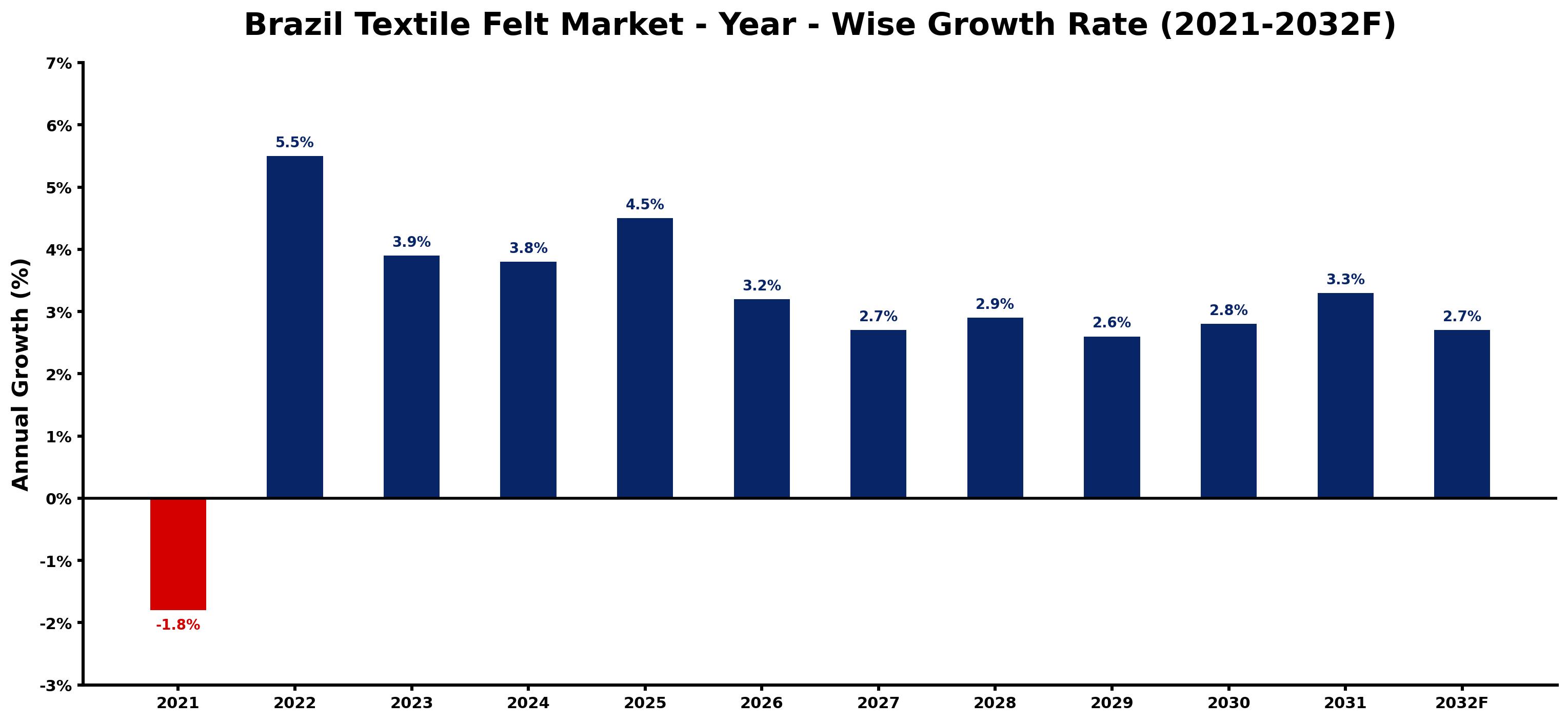
The table below presents the year‑wise growth rates along with the key drivers influencing the market
| Year | Growth Rate | Major Drivers |
| 2021 | -1.8% | Expansion of transportation and logistics networks |
| 2022 | 5.5% | Expansion of commercial construction activities |
| 2023 | 3.9% | Government infrastructure modernization initiatives |
| 2024 | 3.8% | Increasing industrial automation investments |
| 2025 | 4.5% | Increasing industrial infrastructure investments |
| 2026 | 3.2% | Increasing adoption of advanced technologies |
| 2027 | 2.7% | Rising electricity demand across industries |
| 2028 | 2.9% | Rising electricity demand across industries |
| 2029 | 2.6% | Growing urbanization and commercial development |
| 2030 | 2.8% | Increasing adoption of advanced technologies |
| 2031 | 3.3% | Government infrastructure modernization initiatives |
| 2032 | 2.7% | Rising electricity demand across industries |
Note - Market size estimations and growth projections presented in this report are based on 6Wresearch’s advanced forecasting approach, validated with industry datasets as of June 2026.
Brazil Textile Felt Market Synopsis
The Brazilian textile felt market is currently experiencing a dynamic shift driven by rising industrial demand and technological advancements. As industries seek high-performance materials for insulation, padding, and filtration, the versatility of textile felt has positioned it as a crucial component across several sectors, including automotive and construction.
In addition to robust industrial applications, the sustainability movement is reshaping the textile felt landscape. Manufacturers are increasingly challenged to adopt eco-friendly practices in production, leading to innovative approaches that promise reduced environmental impact while maintaining performance standards.
Brazil Textile Felt Market Key Takeaways
- The market is driven by diverse applications, including automotive, construction, and manufacturing.
- Technological advancements are enhancing the performance properties of textile felts.
- Environmental sustainability is a growing concern, prompting the need for eco-friendly production practices.
- Price volatility of raw materials, particularly natural fibers like wool and cotton, remains a critical consideration.
- Government policies are supportive, fostering innovation and product quality within the textile industry.
Evaluation of Restraints in Brazil Textile Felt Market
Despite its growth potential, the Brazilian textile felt market encounters significant restraints, primarily stemming from the competitive pressure of synthetic materials. Products made from polyester and nylon are often preferred due to their durability and cost-effectiveness. Additionally, the industry's reliance on natural fibers subjects it to market volatility influenced by global supply dynamics and climate-related factors. As manufacturers navigate these challenges, the need for strategic adaptations and investments in alternative fibers becomes paramount. Furthermore, the mounting emphasis on sustainable practices demands a delicate balance between innovation and environmental responsibility.
Brazil Textile Felt Market Trends
Key trends shaping the Brazil textile felt market include an increased focus on specialized felts that cater to niche applications, such as advanced soundproofing solutions and energy-efficient insulation materials. Furthermore, the integration of automation and digital technologies in manufacturing processes is streamlining production while enhancing product quality. Additionally, there is a discernible shift toward sourcing eco-friendly materials, with many manufacturers exploring biobased and recycled fiber options as a response to consumer demand for sustainability.
Brazil Textile Felt Market Opportunities
Genuine growth opportunities in the Brazil textile felt market lie in the burgeoning automotive sector, particularly as manufacturers focus on enhancing vehicle interiors and sound insulation capabilities. Moreover, with construction activity on the rise, the demand for advanced textile felts for insulation and filtration is expected to grow. Investment in research and development of sustainable textile technologies presents another lucrative area for exploration, as businesses seek to align with global eco-friendly trends while meeting regulatory standards.
Government Initiatives in the Brazil Textile Felt Market
The Brazilian government actively promotes the textile industry through policies aimed at ensuring product quality, safety, and innovation. These initiatives often include implementing standards for textile materials and production processes, along with financial incentives for research and development. Additionally, programs designed to enhance competitiveness in the textile felt sector, such as export promotion and infrastructure improvements, further bolster the market's growth potential.
Future Insights of the Brazil Textile Felt Market
Looking ahead to 2026-2032, the Brazil textile felt market is poised for continued growth, driven by technological advancements and rising industrial applications. As manufacturers strive to meet evolving consumer demands for both performance and sustainability, the industry may witness a transformation in production practices. By harnessing innovative materials and eco-friendly practices, the sector can address environmental concerns while capturing new market segments, thereby ensuring its long-term viability.
Brazil Textile Felt Market Latest Developments (May 2025 - June 2026)
Recent developments in the Brazilian textile felt market indicate a growing emphasis on sustainability and innovation. Manufacturers are increasingly investing in green technologies to improve production efficiency and reduce environmental impact. The market is also seeing a rise in collaborative efforts between industry players and research institutions to develop cutting-edge materials that meet specific performance requirements, particularly in automotive and construction applications.
Brazil Textile Felt Market - Key Attractiveness of the Report
- 10 Years of Market Numbers
- Historical Data Starting from 2022 to 2025
- Base Year: 2025
- Forecast Data until 2032
- Key Performance Indicators Impacting the Market
- Major Upcoming Developments and Projects
Key Highlights of the Report:
- Brazil Textile Felt Market Outlook
- Market Size of Brazil Textile Felt Market, 2025
- Forecast of Brazil Textile Felt Market, 2032
- Historical Data and Forecast of Brazil Textile Felt Revenues & Volume for the Period 2022-2032F
- Brazil Textile Felt Market Trend Evolution
- Brazil Textile Felt Market Drivers and Challenges
- Brazil Textile Felt Price Trends
- Brazil Textile Felt Porter's Five Forces
- Brazil Textile Felt Industry Life Cycle
- Historical Data and Forecast of Brazil Textile Felt Market Revenues & Volume By Raw Material for the Period 2022-2032F
- Historical Data and Forecast of Brazil Textile Felt Market Revenues & Volume By Natural Raw Material for the Period 2022-2032F
- Historical Data and Forecast of Brazil Textile Felt Market Revenues & Volume By Synthetic Raw Material for the Period 2022-2032F
- Historical Data and Forecast of Brazil Textile Felt Market Revenues & Volume By Applications for the Period 2022-2032F
- Historical Data and Forecast of Brazil Textile Felt Market Revenues & Volume By Clothing for the Period 2022-2032F
- Historical Data and Forecast of Brazil Textile Felt Market Revenues & Volume By Footwear for the Period 2022-2032F
- Historical Data and Forecast of Brazil Textile Felt Market Revenues & Volume By Rugs for the Period 2022-2032F
- Historical Data and Forecast of Brazil Textile Felt Market Revenues & Volume By Tents for the Period 2022-2032F
- Historical Data and Forecast of Brazil Textile Felt Market Revenues & Volume By Craft Projects for the Period 2022-2032F
- Historical Data and Forecast of Brazil Textile Felt Market Revenues & Volume By Others for the Period 2022-2032F
- Brazil Textile Felt Import Export Trade Statistics
- Market Opportunity Assessment By Raw Material
- Market Opportunity Assessment By Applications
- Brazil Textile Felt Top Companies Market Share
- Brazil Textile Felt Competitive Benchmarking By Technical and Operational Parameters
- Brazil Textile Felt Company Profiles
- Brazil Textile Felt Key Strategic Recommendations






































