Brazil Thermal Paper Market Size, Share & Growth Rate
The Brazil Thermal Paper Market was estimated at USD 161 Million in 2025 and is projected to reach USD 192 Million by 2032, growing at a CAGR of 2.5% from 2026 to 2032. This growth trajectory is largely propelled by the increasing adoption of thermal printing technology across diverse industries such as retail, healthcare, and logistics, where the demand for efficient printing solutions is paramount. Furthermore, the burgeoning e-commerce sector in Brazil is expected to enhance the consumption of thermal paper, especially for receipts and shipping labels.
Brazil Thermal Paper Market Year-wise Growth Rate and Key Drivers
This graph highlights how the Brazil Thermal Paper Market has steadily grown over the years, supported by major growth factors.
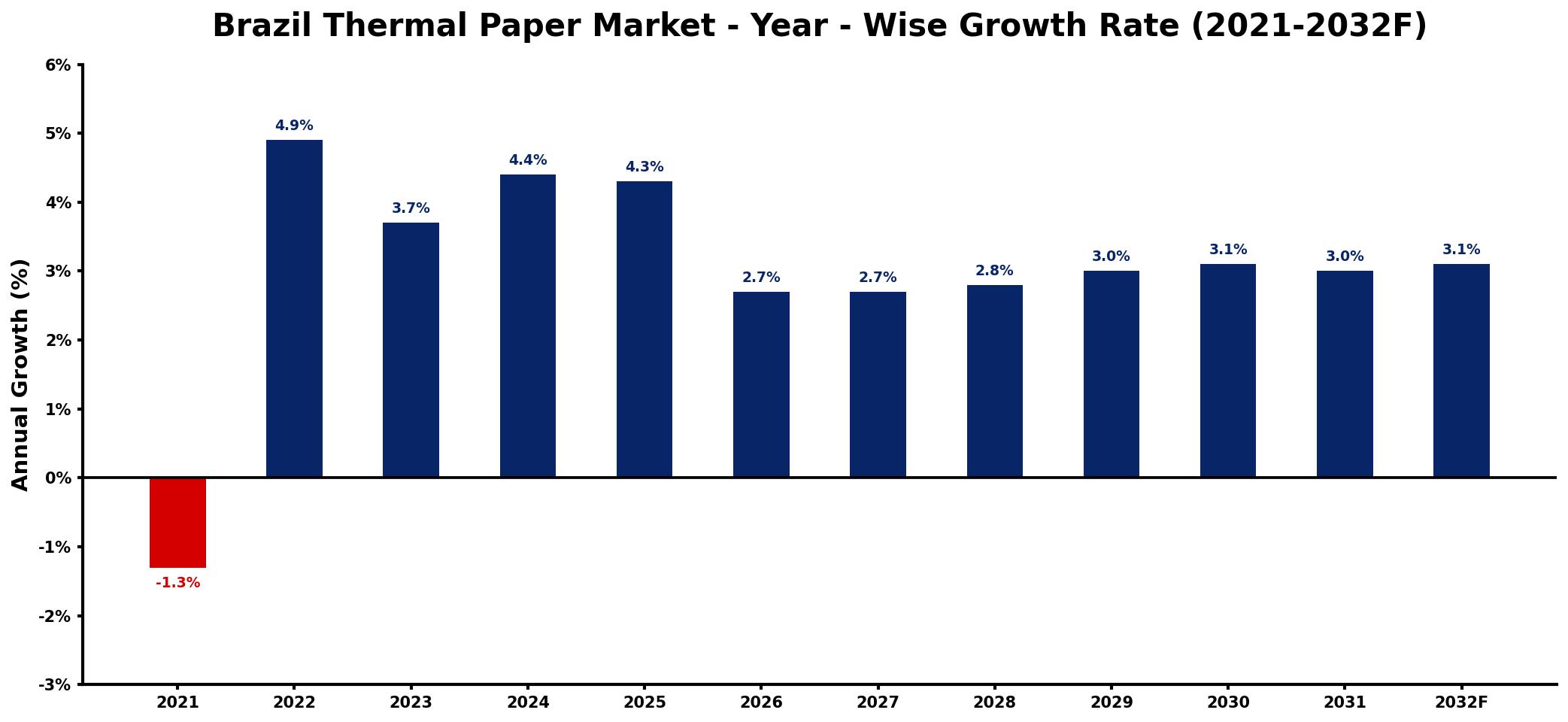
The table below presents the year‑wise growth rates along with the key drivers influencing the market
| Year | Growth Rate | Major Drivers |
| 2021 | -1.3% | decreased consumer spending on essentials |
| 2022 | 4.9% | rise in retail sector transactions |
| 2023 | 3.7% | increased demand from hospitality industry |
| 2024 | 4.4% | growth in e-commerce shipping needs |
| 2025 | 4.3% | expansion of healthcare sector requirements |
| 2026 | 2.7% | rising procurement volume requirements |
| 2027 | 2.7% | enhanced government infrastructure projects |
| 2028 | 2.8% | development of smart retail technologies |
| 2029 | 3.0% | rising end-use demand growth |
| 2030 | 3.1% | growing emerging market penetration |
| 2031 | 3.0% | rising adoption of digital printing |
| 2032 | 3.1% | increased focus on sustainable practices |
Note: Market size estimations and growth projections presented in this report are based on 6Wresearch's proprietary forecasting methodology, utilizing the latest available industry data, government publications, and primary research inputs.
Brazil Thermal Paper Market Synopsis
The strongest force shaping the Brazil Thermal Paper Market today is the evolution of consumer preferences towards digital solutions. As businesses increasingly pivot to digital receipts and documentation, there is a growing need for thermal paper to complement this transition, particularly in environments where speed and print quality are essential.
Additionally, environmental concerns surrounding traditional paper products are steering both consumers and corporations toward more sustainable options. This shift is encouraging innovation within the thermal paper sector, as manufacturers seek to balance performance with eco-friendly practices.
Brazil Thermal Paper Market Key Takeaways
- The Brazil thermal paper market is projected to grow steadily, fueled by technological advancements and the growing e-commerce landscape.
- Consumer preferences are shifting towards eco-friendly solutions, impacting manufacturers' production methods.
- Government regulations focusing on chemical safety and environmental sustainability are redefining market dynamics.
- The competition from digital alternatives is pressing thermal paper providers to explore new applications.
- Various sectors, including retail and healthcare, are increasingly relying on thermal printing for operational efficiency.
Evaluation of Restraints in Brazil Thermal Paper Market
The Brazil thermal paper market faces significant restraints, particularly due to the rapid shift toward digital alternatives. With consumers and businesses opting for digital receipts, the demand for traditional thermal paper is being challenged. This shift not only diminishes the volume of thermal paper sales but also compels manufacturers to innovate continuously. Moreover, increasing regulatory scrutiny surrounding the use of chemicals like bisphenol-A (BPA) poses an additional layer of complexity for producers aiming to comply with safety standards while maintaining product quality.
Brazil Thermal Paper Market Trends
Current trends indicate a growing focus on sustainability within the thermal paper market. Manufacturers are exploring alternatives to BPA and are adopting eco-friendly production practices in response to both consumer demand and government regulations. Moreover, advancements in thermal printing technology are enhancing print speed and quality, making thermal printing a more attractive option for businesses across sectors.
Brazil Thermal Paper Market Opportunities
Genuine growth opportunities exist in sectors that have not yet fully embraced thermal printing solutions. For example, the burgeoning field of e-commerce presents substantial potential for thermal paper utilization in shipping labels and order confirmations. Additionally, innovations in eco-friendly thermal paper could attract environmentally conscious consumers, allowing companies to differentiate themselves in a competitive market. Businesses that adapt to these trends are likely to capitalize on the evolving landscape.
Government Initiatives in the Brazil Thermal Paper Market
The Brazilian government is actively regulating the thermal paper market through policies aimed at promoting environmental sustainability and ensuring chemical safety. These initiatives encourage manufacturers to implement eco-friendly practices and reduce the use of harmful chemicals in their products. Additionally, public awareness campaigns are aimed at educating consumers about the benefits of sustainable options, thereby driving demand for greener alternatives in thermal paper.
Future Insights of the Brazil Thermal Paper Market
Looking ahead, from 2026 to 2032, the Brazil thermal paper market is anticipated to navigate a landscape shaped by increasing digitalization and evolving consumer expectations. As digital receipts become more prevalent, thermal paper manufacturers will need to innovate continuously, exploring new applications and enhancing product sustainability. The integration of digital technologies with thermal printing could create hybrid solutions, offering a unique value proposition to businesses and consumers alike.
Brazil Thermal Paper Market Latest Developments (2025 - 2026)
Recent developments in the Brazil thermal paper market reflect a heightened focus on sustainability and innovation. Manufacturers are increasingly adopting greener production methods and exploring alternatives to traditional thermal paper chemicals. Moreover, partnerships between companies and technology providers are emerging, aimed at integrating smart solutions with thermal printing technology to enhance efficiency and customer experience.
Brazil Thermal Paper Market - Key Attractiveness of the Report
- 10 Years of Market Numbers
- Historical Data Starting from 2022 to 2025
- Base Year: 2025
- Forecast Data until 2032
- Key Performance Indicators Impacting the Market
- Major Upcoming Developments and Projects
Key Highlights of the Report:
- Brazil Thermal Paper Market Outlook
- Market Size of Brazil Thermal Paper Market, 2025
- Forecast of Brazil Thermal Paper Market, 2032
- Historical Data and Forecast of Brazil Thermal Paper Revenues & Volume for the Period 2022-2032F
- Brazil Thermal Paper Market Trend Evolution
- Brazil Thermal Paper Market Drivers and Challenges
- Brazil Thermal Paper Price Trends
- Brazil Thermal Paper Porter's Five Forces
- Brazil Thermal Paper Industry Life Cycle
- Historical Data and Forecast of Brazil Thermal Paper Market Revenues & Volume By Application for the Period 2022-2032F
- Historical Data and Forecast of Brazil Thermal Paper Market Revenues & Volume By Point of Sale (PoS) for the Period 2022-2032F
- Historical Data and Forecast of Brazil Thermal Paper Market Revenues & Volume By Tags & Labels for the Period 2022-2032F
- Historical Data and Forecast of Brazil Thermal Paper Market Revenues & Volume By Lottery & Gaming for the Period 2022-2032F
- Historical Data and Forecast of Brazil Thermal Paper Market Revenues & Volume By Others for the Period 2022-2032F
- Brazil Thermal Paper Import Export Trade Statistics
- Market Opportunity Assessment By Application
- Brazil Thermal Paper Top Companies Market Share
- Brazil Thermal Paper Competitive Benchmarking By Technical and Operational Parameters
- Brazil Thermal Paper Company Profiles
- Brazil Thermal Paper Key Strategic Recommendations






































