Brazil Traffic Management Market Size & Growth Rate (2026-2032)
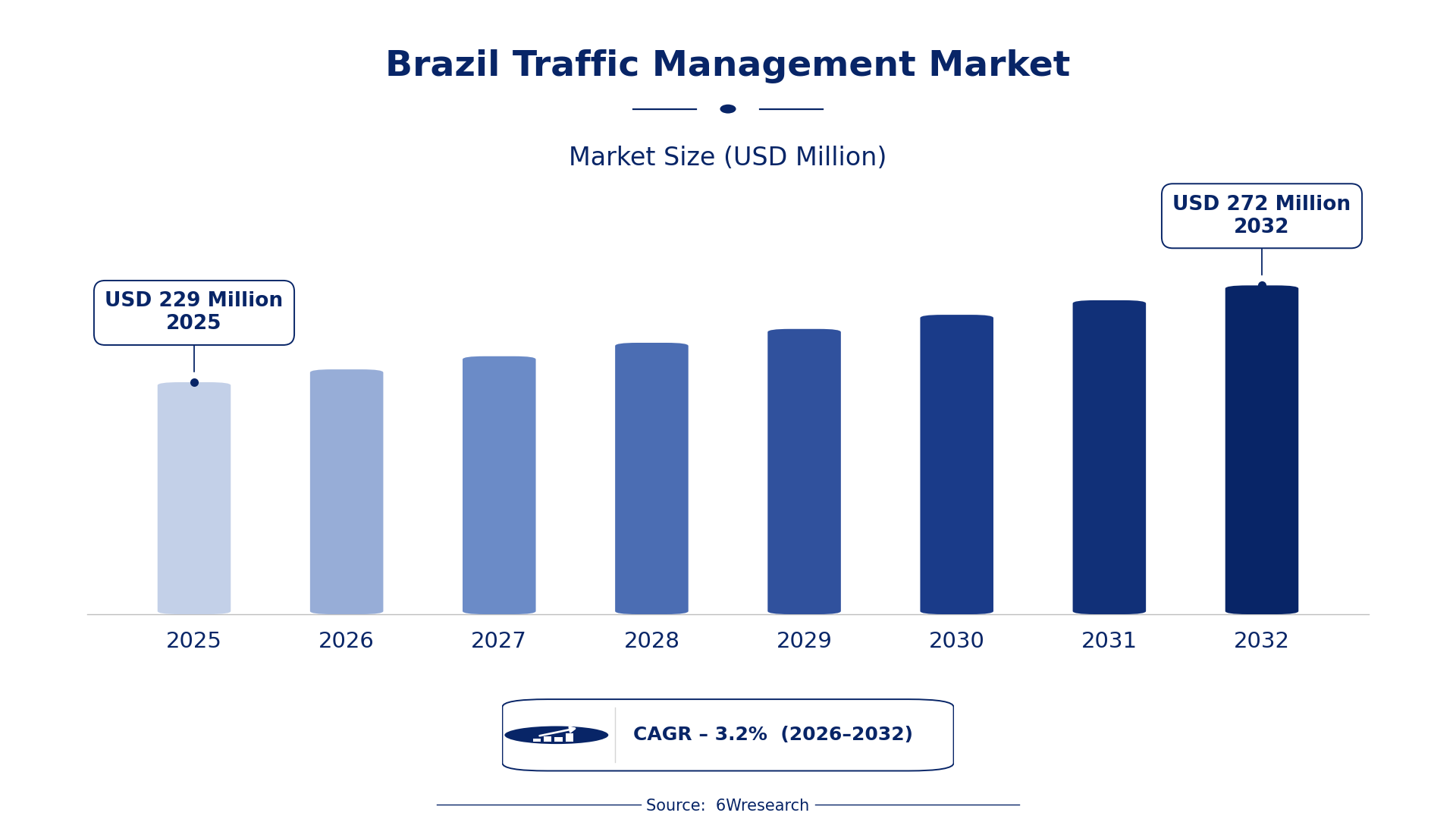
The Brazil Traffic Management Market was estimated at USD 229 Million in 2025 and is projected to reach USD 272 Million by 2032, growing at a CAGR of 3.2% from 2026 to 2032.
Brazil Traffic Management Market Synopsis
The Brazil Traffic Management Market is currently experiencing a dynamic shift, driven by urbanization and increasing vehicular density. With municipalities investing in advanced traffic solutions, this market is evolving rapidly, aligning with the global trend towards smarter cities.
As technology continues to integrate into traffic management systems, Brazil is set to enhance its infrastructure significantly. The focus is on optimizing traffic flow and enhancing road safety, which is crucial for managing the congestion that plagues many of its major cities.
Brazil Traffic Management Market Year-wise Growth Rate and Key Drivers
This graph illustrates the annual growth rates of the Brazil Traffic Management Market from 2021 to 2032, highlighting a steady upward trajectory and projected expansion over the forecast period.
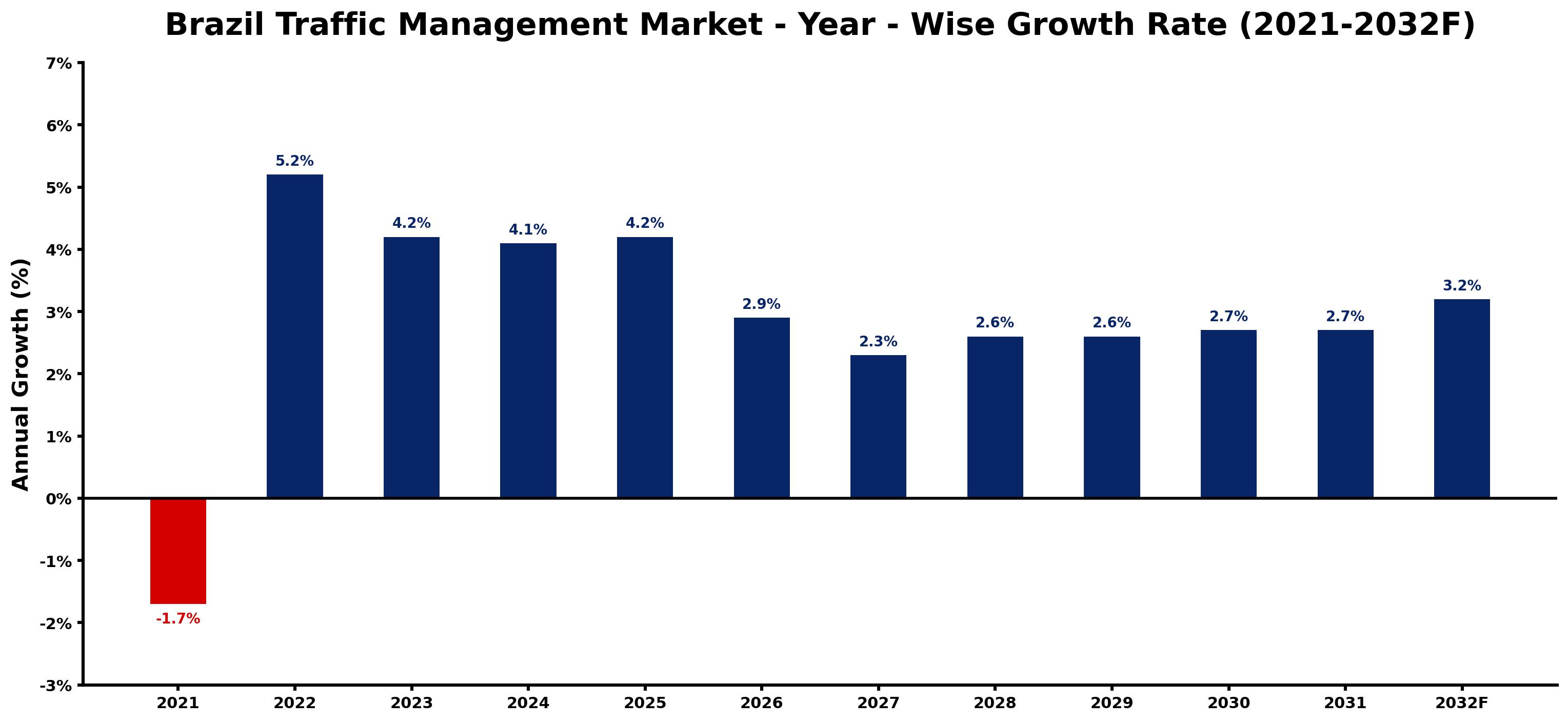
The table below presents the year‑wise growth rates along with the key drivers influencing the market
| Year | Growth Rate | Major Drivers |
| 2021 | -1.7% | Pandemic restrictions limited traffic management installations. |
| 2022 | 5.2% | New Smart City program by São Paulo government |
| 2023 | 4.2% | Increased investment in traffic sensor technology installations |
| 2024 | 4.1% | Federal funding for urban mobility improvement projects |
| 2025 | 4.2% | Growing emphasis on sustainable transportation solutions |
| 2026 | 2.9% | Launch of Rio's advanced traffic management system |
| 2027 | 2.3% | Adoption of vehicle-to-everything (V2X) communication technology |
| 2028 | 2.6% | Implementation of stricter traffic regulation enforcement policies |
| 2029 | 2.6% | Development of integrated mobility apps for travelers |
| 2030 | 2.7% | Support for electric vehicle infrastructure by local authorities |
| 2031 | 2.7% | Continued growth in ride-sharing service demand |
| 2032 | 3.2% | Rising public awareness of traffic safety initiatives |
Note: Market size estimations and growth projections presented in this report are based on 6Wresearch's proprietary forecasting methodology, utilizing the latest available industry data, government publications, and primary research inputs.
Brazil Traffic Management Market Key Takeaways
Below are some of the specific key takeaways from the market, including:
- Urbanization and population growth in Brazil are primary drivers of the traffic management market.
- Investment in intelligent transportation systems is crucial for alleviating traffic congestion.
- Government initiatives are fostering the development of smart traffic management solutions.
- Integration of AI and IoT technologies is expected to enhance traffic management efficiency.
- Budget constraints and infrastructure complexity present challenges for market implementation.
Evaluation of Restraints in Brazil Traffic Management Market
Several factors are hindering the growth of the Brazil Traffic Management Market. The complexity of urban infrastructure often complicates the implementation of advanced systems. Budget constraints further limit municipalities' ability to invest in the necessary technologies. Additionally, there is a pressing need for collaboration between public and private sectors to ensure synchronized efforts in deploying effective traffic management solutions. Without addressing these restraints, the potential for improvement in traffic flow and safety remains limited.
Brazil Traffic Management Market Trends
The market is witnessing several key trends that are shaping its future. The integration of data analytics into traffic management systems is becoming increasingly prevalent, enabling real-time monitoring and response. Additionally, the rise of connected vehicles is pushing municipalities to adapt their infrastructure to accommodate these technologies. Smart signaling systems are gaining traction, allowing for more efficient traffic flow and reduced congestion. This trend is expected to continue, as cities seek innovative solutions to improve their transportation networks.
Brazil Traffic Management Market Opportunities
The potential for growth in the Brazil Traffic Management Market is considerable. Investment in public transportation systems offers an avenue for enhanced traffic management solutions. on top of that, developing smart city initiatives presents opportunities for companies to introduce innovative technologies. Collaboration with tech firms to implement AI and IoT solutions could also enhance operational efficiency. As government policies evolve to support modernization, the market stands to benefit from increased funding and strategic partnerships.
Government Initiatives in the Brazil Traffic Management Market
The Brazilian government is actively shaping the Traffic Management Market through a series of strategic initiatives aimed at modernizing infrastructure and enhancing urban mobility. By focusing on smart traffic management solutions, the government emphasizes the importance of collaboration with the private sector to implement advanced technologies. This proactive approach is essential for addressing the growing challenges posed by urbanization and traffic congestion.
- A national digital infrastructure upgrade programme launched in early 2025 aims to enhance traffic monitoring capabilities across major cities.
- Current initiatives include the deployment of intelligent traffic signals in São Paulo, aimed at optimizing traffic flow and improving safety.
- A planned public-private partnership expected to commence in late 2026 aims to integrate AI-driven traffic management systems in Rio de Janeiro.
- Recent legislation introduced in 2025 mandates the adoption of smart technologies in new urban development projects.
- The government is currently rolling out a comprehensive traffic data analytics initiative to support real-time decision-making for urban planners.
Future Insights of the Brazil Traffic Management Market
Looking ahead to 2026-2032, the Brazil Traffic Management Market is poised for transformation. As cities continue to grow, the demand for effective traffic management solutions will only intensify. The focus on sustainable urban mobility will drive investments in innovative technologies. With a commitment to enhancing infrastructure and a strong emphasis on public safety, Brazil’s market is likely to become a leader in smart traffic management initiatives in the region.
Brazil Traffic Management Market Latest Developments
Over the past year, the Brazil Traffic Management Market has seen notable developments that reflect the industry's direction towards smarter solutions. Municipalities are increasingly adopting advanced technologies to tackle the challenges posed by urban traffic. These initiatives are crucial for fostering an efficient and safe transportation environment.
- A major technology vendor launched a new traffic analytics platform in Q1 2025, aimed at providing municipalities with real-time data insights.
- Currently ongoing is a city-wide pilot project in Brasília that implements smart traffic light systems, expected to be evaluated by the end of 2026.
- In late 2025, a leading regional operator began integrating IoT devices into existing traffic systems to enhance data collection.
- A partnership between public authorities and tech companies was established in early 2025 to develop AI-driven traffic management solutions.
- Upcoming initiatives include a planned rollout of connected vehicle technology in major urban centers, set to begin in 2027.
Brazil Traffic Management Market - Key Attractiveness of the Report
- 10 Years of Market Numbers
- Historical Data Starting from 2022 to 2025
- Base Year: 2025
- Forecast Data until 2032
- Key Performance Indicators Impacting the Market
- Major Upcoming Developments and Projects
Key Highlights of the Report:
- Brazil Traffic Management Market Outlook
- Market Size of Brazil Traffic Management Market, 2025
- Forecast of Brazil Traffic Management Market, 2032
- Historical Data and Forecast of Brazil Traffic Management Revenues & Volume for the Period 2022-2032F
- Brazil Traffic Management Market Trend Evolution
- Brazil Traffic Management Market Drivers and Challenges
- Brazil Traffic Management Price Trends
- Brazil Traffic Management Porter's Five Forces
- Brazil Traffic Management Industry Life Cycle
- Historical Data and Forecast of Brazil Traffic Management Market Revenues & Volume By Component for the Period 2022-2032F
- Historical Data and Forecast of Brazil Traffic Management Market Revenues & Volume By Solution for the Period 2022-2032F
- Historical Data and Forecast of Brazil Traffic Management Market Revenues & Volume By Services for the Period 2022-2032F
- Historical Data and Forecast of Brazil Traffic Management Market Revenues & Volume By Solutions for the Period 2022-2032F
- Historical Data and Forecast of Brazil Traffic Management Market Revenues & Volume By Smart Signaling for the Period 2022-2032F
- Historical Data and Forecast of Brazil Traffic Management Market Revenues & Volume By Route Guidance & Route Optimization for the Period 2022-2032F
- Historical Data and Forecast of Brazil Traffic Management Market Revenues & Volume By Traffic Analytics for the Period 2022-2032F
- Historical Data and Forecast of Brazil Traffic Management Market Revenues & Volume By Smart Surveillance for the Period 2022-2032F
- Historical Data and Forecast of Brazil Traffic Management Market Revenues & Volume By Hardware for the Period 2022-2032F
- Historical Data and Forecast of Brazil Traffic Management Market Revenues & Volume By Display Boards for the Period 2022-2032F
- Historical Data and Forecast of Brazil Traffic Management Market Revenues & Volume By Sensors for the Period 2022-2032F
- Historical Data and Forecast of Brazil Traffic Management Market Revenues & Volume By Surveillance Cameras for the Period 2022-2032F
- Historical Data and Forecast of Brazil Traffic Management Market Revenues & Volume By Other Hardware for the Period 2022-2032F
- Historical Data and Forecast of Brazil Traffic Management Market Revenues & Volume By Services for the Period 2022-2032F
- Historical Data and Forecast of Brazil Traffic Management Market Revenues & Volume By Consulting for the Period 2022-2032F
- Historical Data and Forecast of Brazil Traffic Management Market Revenues & Volume By Implementation & Integration for the Period 2022-2032F
- Historical Data and Forecast of Brazil Traffic Management Market Revenues & Volume By Support & Maintenance for the Period 2022-2032F
- Historical Data and Forecast of Brazil Traffic Management Market Revenues & Volume By Systems for the Period 2022-2032F
- Historical Data and Forecast of Brazil Traffic Management Market Revenues & Volume By Urban Traffic Management & Control for the Period 2022-2032F
- Historical Data and Forecast of Brazil Traffic Management Market Revenues & Volume By Adaptive Traffic Control System for the Period 2022-2032F
- Historical Data and Forecast of Brazil Traffic Management Market Revenues & Volume By Journey Time Measurement System for the Period 2022-2032F
- Historical Data and Forecast of Brazil Traffic Management Market Revenues & Volume By Predictive Traffic Modeling System for the Period 2022-2032F
- Historical Data and Forecast of Brazil Traffic Management Market Revenues & Volume By Incident Detection & Location System for the Period 2022-2032F
- Historical Data and Forecast of Brazil Traffic Management Market Revenues & Volume By Dynamic Traffic Management System for the Period 2022-2032F
- Brazil Traffic Management Import Export Trade Statistics
- Market Opportunity Assessment By Component
- Market Opportunity Assessment By Solutions
- Market Opportunity Assessment By Hardware
- Market Opportunity Assessment By Services
- Market Opportunity Assessment By Systems
- Brazil Traffic Management Top Companies Market Share
- Brazil Traffic Management Competitive Benchmarking By Technical and Operational Parameters
- Brazil Traffic Management Company Profiles
- Brazil Traffic Management Key Strategic Recommendations






































