Brazil Unified Threat Management Market Size & Growth Rate (2026-2032)
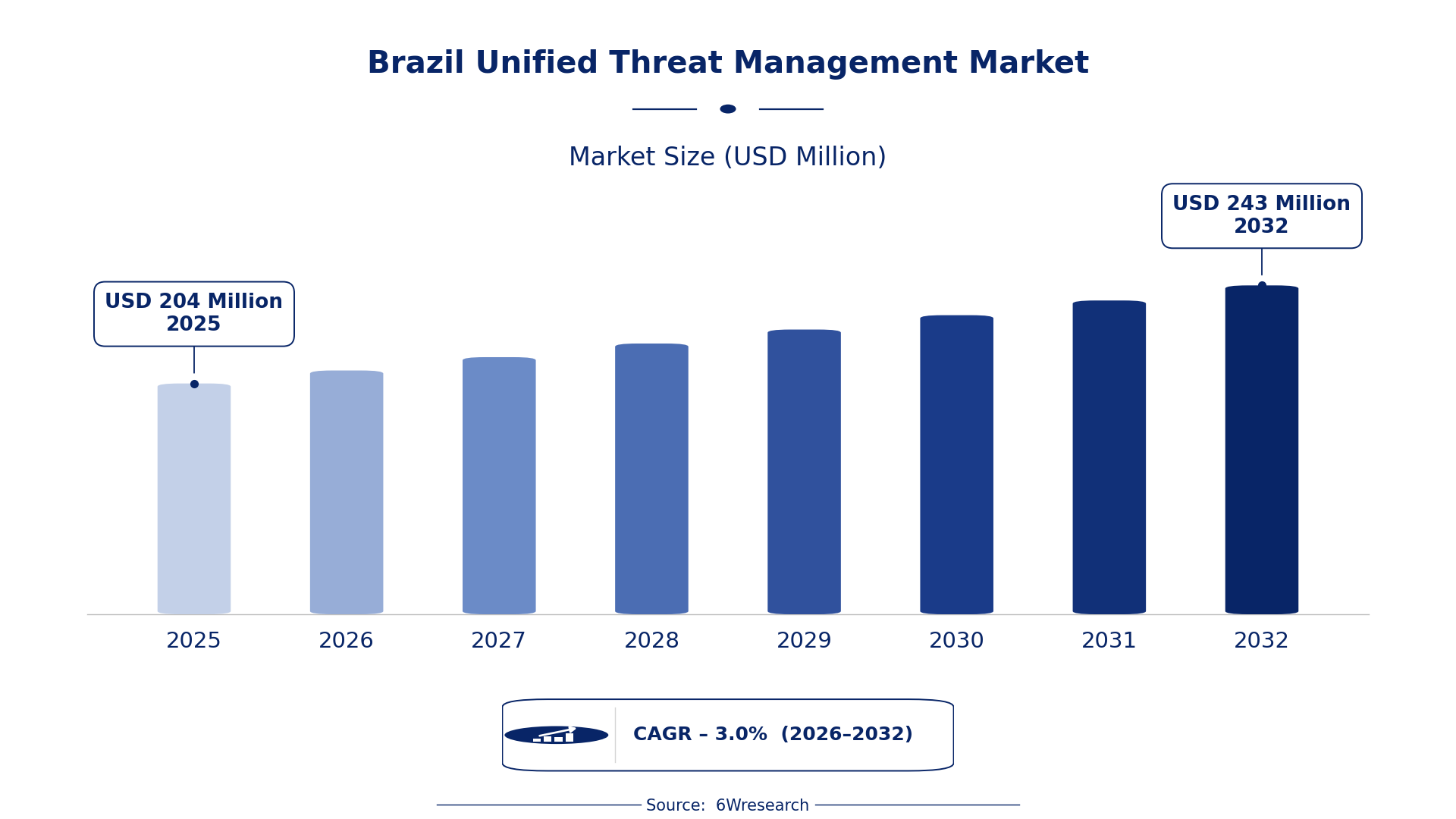
The Brazil Unified Threat Management Market was estimated at USD 204 Million in 2025 and is projected to reach USD 243 Million by 2032, growing at a CAGR of 3.0% from 2026 to 2032.
Brazil Unified Threat Management Market Synopsis
The Brazil Unified Threat Management (UTM) market is currently experiencing a phase of increased adoption as businesses confront escalating cybersecurity threats. This demand surge reflects a pressing need for comprehensive security solutions that integrate various protective measures into a single interface, allowing for effective management of security challenges.
Looking ahead, the market is expected to evolve further as organizations seek scalable UTM solutions that can adapt to their unique requirements. As cyber threats become more sophisticated, businesses will increasingly prioritize solutions that offer real-time threat intelligence and adaptability, driving innovation within the sector.
Brazil Unified Threat Management Market Year-wise Growth Rate and Key Drivers
This graph illustrates the annual growth rates of the Brazil Unified Threat Management Market from 2021 to 2032, highlighting a steady upward trajectory and projected expansion over the forecast period.
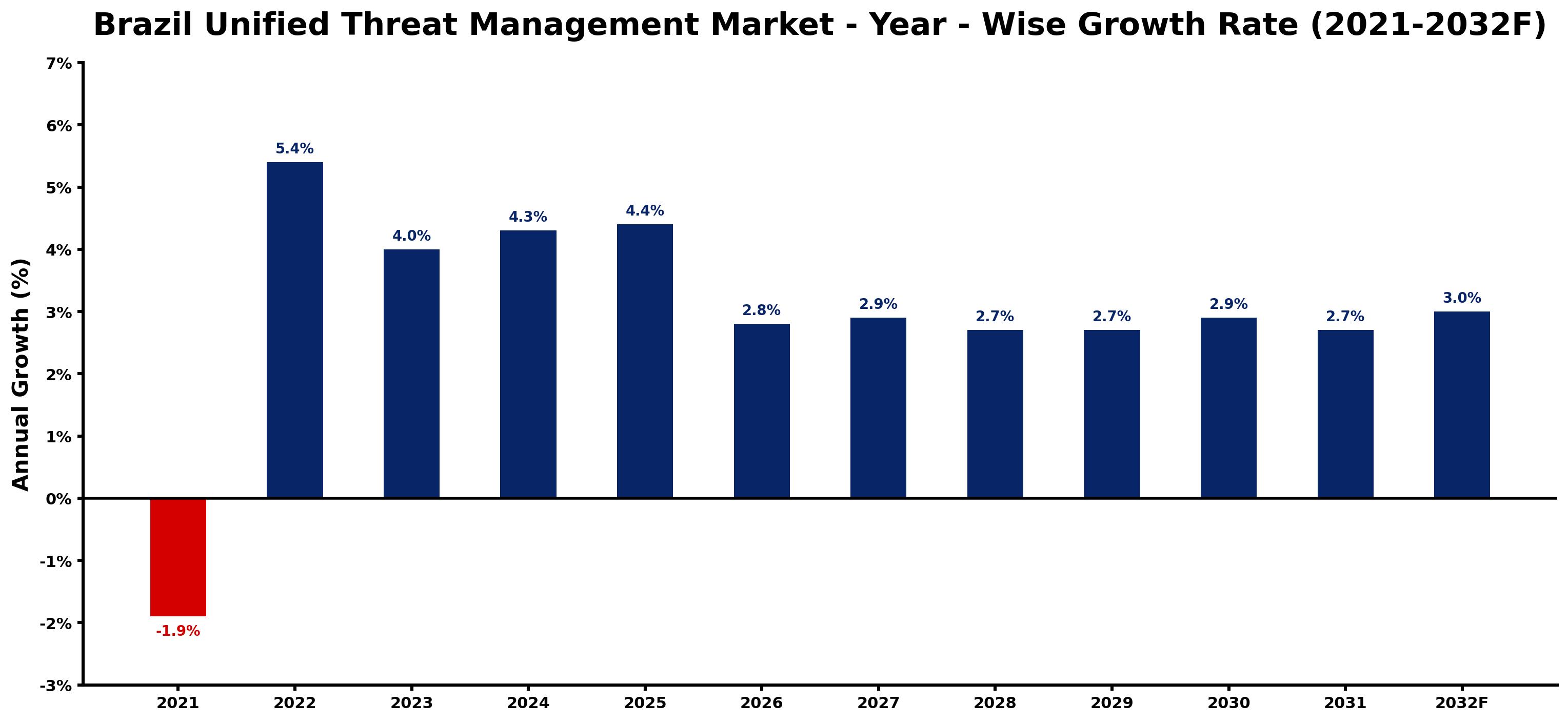
The table below presents the year‑wise growth rates along with the key drivers influencing the market
| Year | Growth Rate | Major Drivers |
| 2021 | -1.9% | Cybersecurity regulations delayed by Brazilian government policy changes. |
| 2022 | 5.4% | Growing prevalence of cyber threats in Brazilian businesses. |
| 2023 | 4.0% | Strengthened cybersecurity regulations by Brazil's Central Bank. |
| 2024 | 4.3% | Increased investment in digital banking security technologies. |
| 2025 | 4.4% | Surge in online banking services driving security demand. |
| 2026 | 2.8% | Rising e-commerce activity necessitating advanced threat protection. |
| 2027 | 2.9% | Widespread adoption of IoT devices fueling security needs. |
| 2028 | 2.7% | Higher awareness of cybersecurity risks among Brazilian SMEs. |
| 2029 | 2.7% | Compliance deadlines for data breach notifications approaching. |
| 2030 | 2.9% | Increased cross-border data sharing demanding robust security. |
| 2031 | 2.7% | Emerging fintech industry requiring comprehensive security solutions. |
| 2032 | 3.0% | Growing digital identity verification needs in e-commerce. |
Note: Market size estimations and growth projections presented in this report are based on 6Wresearch's proprietary forecasting methodology, utilizing the latest available industry data, government publications, and primary research inputs.
Brazil Unified Threat Management Market Key Takeaways
Below are some of the specific key takeaways from the market, including:
- UTM solutions are gaining traction due to their ability to consolidate multiple security functions into one platform.
- Integration challenges remain a barrier, particularly for organizations with diverse operational needs.
- The demand for real-time threat intelligence is increasingly shaping UTM features and capabilities.
- Compliance with evolving government regulations is driving the adoption of UTM solutions across sectors.
- Investments in UTM technologies are being guided by the need for both performance and flexibility.
Evaluation of Restraints in Brazil Unified Threat Management Market
Despite positive momentum, the Brazil Unified Threat Management market faces several constraints. A major issue is the integration of diverse security functions, which complicates deployment and management for many organizations. Smaller enterprises often struggle with scalability, as their security needs can vary widely. Additionally, the rapid pace of evolving cyber threats puts pressure on UTM providers to continuously innovate, which can lead to gaps in effectiveness if not addressed promptly.
Brazil Unified Threat Management Market Trends
Several key trends are currently shaping the UTM market in Brazil. The growing emphasis on integrating advanced threat detection technologies is one notable trend, as organizations look for solutions that not only respond to known threats but also anticipate emerging ones. Cloud-based UTM solutions are increasingly favored due to their scalability and accessibility, allowing organizations to manage security in a flexible manner. on top of that, the use of Artificial Intelligence (AI) and machine learning within UTM solutions is being explored to enhance threat analysis capabilities.
Brazil Unified Threat Management Market Opportunities
As organizations bolster their cybersecurity postures, several opportunities are arising within the UTM market. For starters, the demand for customized solutions is growing, particularly in niche sectors such as healthcare and finance, where regulatory compliance is paramount. There’s also a notable opportunity for partnerships between UTM providers and technology firms to drive innovation. Additionally, the increasing focus on employee training and awareness programs presents a complementary avenue for businesses to enhance their overall security frameworks.
Government Initiatives in the Brazil Unified Threat Management Market
Government policies in Brazil are becoming increasingly pivotal in shaping the Unified Threat Management market. The emphasis on integrated cybersecurity strategies reflects a growing recognition of the need for comprehensive solutions as cyber threats become more complex. Compliance with new regulations is not just an obligation but a catalyst for the adoption of UTM solutions across various sectors.
- A recent regulatory framework was introduced mandating enhanced cybersecurity measures for critical infrastructure sectors.
- Currently ongoing initiatives include a national cybersecurity awareness campaign aimed at educating businesses on the importance of integrated security solutions.
- Planned government support programs are expected to encourage innovation in UTM technology, set to launch in late 2025.
- The establishment of a cybersecurity compliance task force is underway, focusing on aligning private sector strategies with national security goals.
- A proposed public-private partnership aims to develop cloud-based UTM solutions tailored for small to medium-sized enterprises, anticipated to begin by mid-2026.
Future Insights of the Brazil Unified Threat Management Market
Looking towards 2026-2032, the Brazil Unified Threat Management market is expected to undergo significant transformation. A shift towards increasingly sophisticated, AI-driven security solutions will likely become commonplace as organizations strive to stay ahead of evolving threats. Scalability will be a critical focus, with UTM offerings that cater specifically to various business sizes. on top of that, enhanced collaboration between government and industry will shape the future of cybersecurity strategy, promoting shared responsibility for threat management.
Brazil Unified Threat Management Market Latest Developments
Recent developments in the Brazil Unified Threat Management market signal a growing focus on innovation and customer-centric solutions. Over the past year, several initiatives have emerged aimed at enhancing security capabilities while addressing unique market needs.
- In early 2025, a major technology vendor launched a new UTM platform that integrates AI-powered threat detection, receiving positive feedback for its advanced capabilities.
- An ongoing initiative aims to develop a national cybersecurity certification program for UTM solutions, promoting standardized security measures across the industry.
- A planned collaboration between local cybersecurity firms is expected to produce specialized UTM solutions for the financial sector, with rollout anticipated in late 2026.
- In mid-2025, a leading regional operator announced the implementation of a comprehensive security framework that includes UTM solutions, enhancing its service offerings.
- A technology pilot program exploring cloud-based UTM capabilities is currently underway, with preliminary results expected by Q3 2026.
Brazil Unified Threat Management Market - Key Attractiveness of the Report
- 10 Years of Market Numbers
- Historical Data Starting from 2022 to 2025
- Base Year: 2025
- Forecast Data until 2032
- Key Performance Indicators Impacting the Market
- Major Upcoming Developments and Projects
Key Highlights of the Report:
- Brazil Unified Threat Management Market Outlook
- Market Size of Brazil Unified Threat Management Market, 2025
- Forecast of Brazil Unified Threat Management Market, 2032
- Historical Data and Forecast of Brazil Unified Threat Management Revenues & Volume for the Period 2022-2032F
- Brazil Unified Threat Management Market Trend Evolution
- Brazil Unified Threat Management Market Drivers and Challenges
- Brazil Unified Threat Management Price Trends
- Brazil Unified Threat Management Porter's Five Forces
- Brazil Unified Threat Management Industry Life Cycle
- Historical Data and Forecast of Brazil Unified Threat Management Market Revenues & Volume By Appliance for the Period 2022-2032F
- Historical Data and Forecast of Brazil Unified Threat Management Market Revenues & Volume By Hardware for the Period 2022-2032F
- Historical Data and Forecast of Brazil Unified Threat Management Market Revenues & Volume By Software for the Period 2022-2032F
- Historical Data and Forecast of Brazil Unified Threat Management Market Revenues & Volume By Virtual for the Period 2022-2032F
- Historical Data and Forecast of Brazil Unified Threat Management Market Revenues & Volume By Distribution Channel for the Period 2022-2032F
- Historical Data and Forecast of Brazil Unified Threat Management Market Revenues & Volume By Direct for the Period 2022-2032F
- Historical Data and Forecast of Brazil Unified Threat Management Market Revenues & Volume By VAR??s for the Period 2022-2032F
- Historical Data and Forecast of Brazil Unified Threat Management Market Revenues & Volume By Distributors for the Period 2022-2032F
- Historical Data and Forecast of Brazil Unified Threat Management Market Revenues & Volume By Organization Size for the Period 2022-2032F
- Historical Data and Forecast of Brazil Unified Threat Management Market Revenues & Volume By SOHO for the Period 2022-2032F
- Historical Data and Forecast of Brazil Unified Threat Management Market Revenues & Volume By SMB for the Period 2022-2032F
- Historical Data and Forecast of Brazil Unified Threat Management Market Revenues & Volume By Enterprises for the Period 2022-2032F
- Historical Data and Forecast of Brazil Unified Threat Management Market Revenues & Volume By Services for the Period 2022-2032F
- Historical Data and Forecast of Brazil Unified Threat Management Market Revenues & Volume By Support and Maintenance for the Period 2022-2032F
- Historical Data and Forecast of Brazil Unified Threat Management Market Revenues & Volume By Managed UTM for the Period 2022-2032F
- Brazil Unified Threat Management Import Export Trade Statistics
- Market Opportunity Assessment By Appliance
- Market Opportunity Assessment By Distribution Channel
- Market Opportunity Assessment By Organization Size
- Market Opportunity Assessment By Services
- Brazil Unified Threat Management Top Companies Market Share
- Brazil Unified Threat Management Competitive Benchmarking By Technical and Operational Parameters
- Brazil Unified Threat Management Company Profiles
- Brazil Unified Threat Management Key Strategic Recommendations






































