Brazil Vegetable oils Market Summary
The brazil vegetable oils market was estimated at USD 283 Million in 2025 and is projected to reach USD 338 Million by 2032, growing at a CAGR of 2.5% from 2026 to 2032.
Brazil Vegetable oils Market Year-wise Growth Rate and Key Drivers
This graph highlights how the Brazil Vegetable oils Market has steadily grown over the past five years, supported by major growth factors.
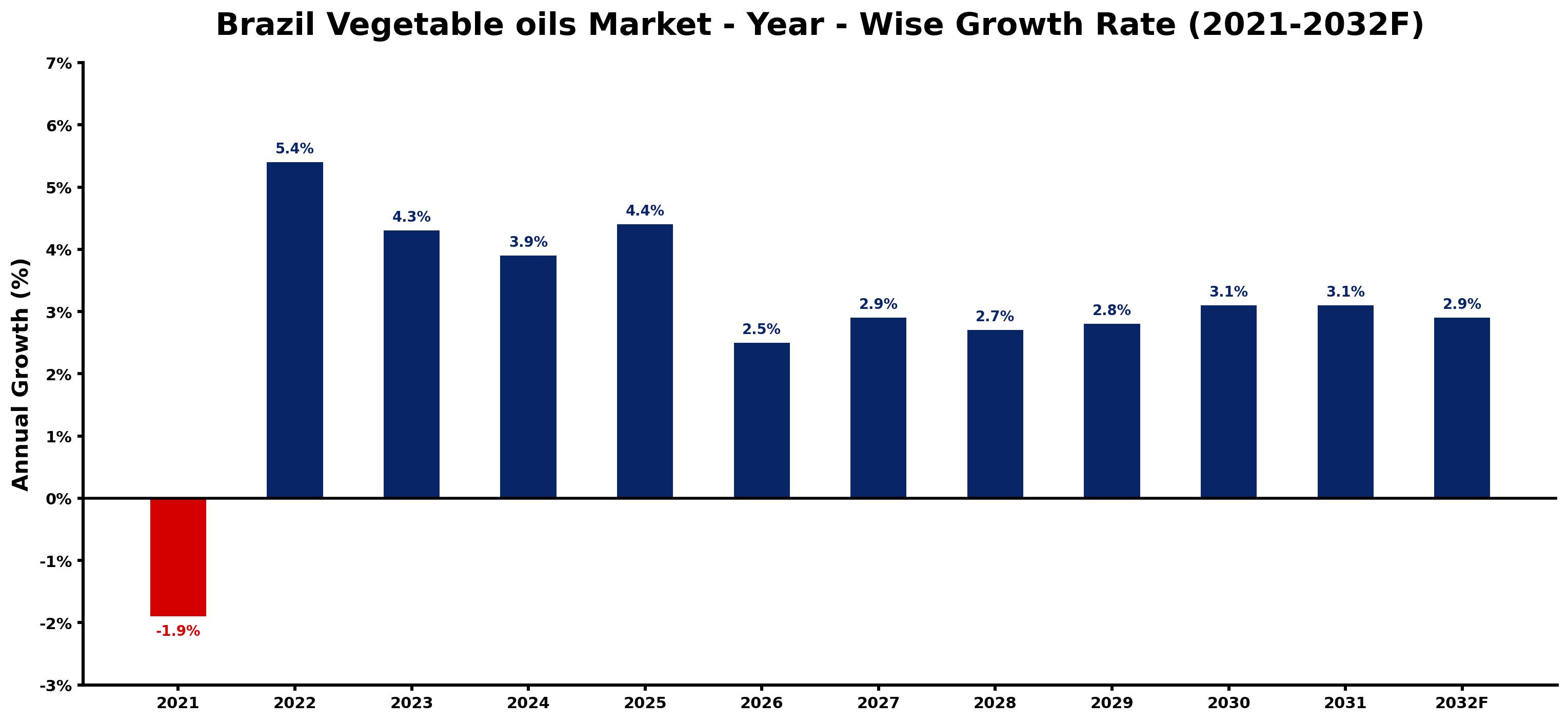
The table below presents the year wise growth rates along with the key drivers influencing the market
| Year | Growth Rate | Major Drivers |
| 2021 | -1.9% | Diminished international trade due to stringent export restrictions significantly impacted supply chain stability in the vegetable oils market. |
| 2022 | 5.4% | Consumer preferences shifted towards plant-based diets, enhancing vegetable oil appeal significantly. |
| 2023 | 4.3% | Increased health awareness encouraged olive and coconut oil purchases among urban consumers. |
| 2024 | 3.9% | Major grocery chains expanded organic product lines, boosting sales of premium oil brands. |
| 2025 | 4.4% | E-commerce platforms optimized home delivery, creating new market niches for vegetable oils. |
| 2026 | 2.5% | Competitive pricing strategies emerged as local producers enhanced production efficiencies. |
| 2027 | 2.9% | Sustainability trends prompted brands to highlight eco-friendly sourcing and packaging options. |
| 2028 | 2.7% | Emerging culinary trends, including veganism, drove innovation in vegetable oil formulations. |
| 2029 | 2.8% | Local agricultural investments improved supply chain resilience and product quality significantly. |
| 2030 | 3.1% | Consumer education campaigns illustrated the health benefits of diverse vegetable oils. |
| 2031 | 3.1% | Partnerships between chefs and brands elevated vegetable oil's status in gourmet cooking. |
| 2032 | 2.9% | Cultural shifts toward home cooking cultivated sustained growth for premium vegetable oils. |
Note - Market size estimations and growth projections presented in this report are based on 6Wresearch's advanced forecasting approach, validated with industry datasets as of June 2026.
Brazil Vegetable oils Market Synopsis
The Brazil Vegetable oils Market is projected to reach 2.5% and witness significant growth during the forecast period (2026-2032). This market is integral to both the culinary landscape and the industrial sector of Brazil, wherein the production and export of vegetable oils such as soybean oil, palm oil, and sunflower oil are paramount. The dynamics of the market are shaped by evolving dietary habits, the expansion of the food processing industry, and the increasing global demand for healthy and sustainable cooking oils.
Brazil Vegetable oils Market Growth Drivers
Multiple factors are fuelling the growth of the Brazil Vegetable oils Market. Firstly, the country's agricultural sector is robust, focusing heavily on the cultivation of soybeans and palm oil, which are vital to oil production. Secondly, there has been a marked shift in dietary preferences among consumers, who are increasingly inclined towards health-conscious options that include vegetable oils. Thirdly, the versatility of vegetable oils in culinary applications enhances their appeal, further driving market expansion. Fourthly, the food processing industry's growth has resulted in a surge in demand for vegetable oils, as they are crucial in various formulations and recipes. Lastly, the rising global demand for sustainable and non-GMO vegetable oils pushes manufacturers to innovate and adopt eco-friendly practices in their production processes.
Brazil Vegetable oils Market Challenges and Restraints
Despite the positive growth trajectory, the Brazil Vegetable oils Market faces significant challenges. One of the foremost concerns is the balance between oil production and environmental sustainability. The agricultural practices associated with vegetable oil production, particularly in relation to deforestation and biodiversity loss, necessitate careful management. Additionally, the market must adjust to swiftly changing consumer preferences, which increasingly emphasize health and environmental impacts. Competition from alternative oils poses another challenge, as consumers explore options that may offer perceived health benefits or sustainability. Lastly, market participants need to navigate fluctuating raw material prices, which can affect profitability and pricing strategies in the industry.
Brazil Vegetable oils Market Government Investment and Initiatives
The Brazilian government plays a crucial role in shaping the future of the vegetable oils market through various policies and initiatives aimed at promoting sustainability and quality. Government investment focuses on the development of programs that encourage farmers to adopt sustainable practices in oil production. Public spending is directed towards research and development to explore alternative sources of vegetable oils and enhance extraction and processing methods. Additionally, regulations establish health standards to ensure that vegetable oils are nutritious and meet specific quality benchmarks. Trade policies are aligned with fostering fair competition within the industry while promoting exports. Through these initiatives, the government seeks to bolster the Brazil Vegetable oils Market, ensuring that it remains competitive on a global scale.
Brazil Vegetable oils Market Latest Developments (May 2025 - June 2026)
In the period between May 2025 and June 2026, the Brazil Vegetable oils Market has seen notable developments reflecting the latest industry trends. The expansion of domestic production capabilities has been a focal point, with increased investment in technologies aimed at enhancing efficiency in extraction and processing. Additionally, efforts to address sustainability challenges have gained momentum, with stakeholders collaborating to minimize environmental impacts while meeting growing consumer demand. Regulatory discussions have also intensified around labeling standards for health-conscious products. Furthermore, consumer education initiatives have increased, fostering greater awareness about the benefits of utilizing vegetable oils in daily cooking. These developments are expected to position the Brazil Vegetable oils Market favorably as it moves towards the forecast period ending in 2032.
Brazil Vegetable oils Market - Key Attractiveness of the Report
- 10 Years of Market Numbers
- Historical Data Starting from 2022 to 2025
- Base Year: 2025
- Forecast Data until 2032
- Key Performance Indicators Impacting the Market
- Major Upcoming Developments and Projects
Key Highlights of the Report:
- Brazil Vegetable oils Market Outlook
- Market Size of Brazil Vegetable oils Market, 2025
- Forecast of Brazil Vegetable oils Market, 2032
- Historical Data and Forecast of Brazil Vegetable oils Revenues & Volume for the Period 2022-2032F
- Brazil Vegetable oils Market Trend Evolution
- Brazil Vegetable oils Market Drivers and Challenges
- Brazil Vegetable oils Price Trends
- Brazil Vegetable oils Porter's Five Forces
- Brazil Vegetable oils Industry Life Cycle
- Historical Data and Forecast of Brazil Vegetable oils Market Revenues & Volume By Types for the Period 2022-2032F
- Historical Data and Forecast of Brazil Vegetable oils Market Revenues & Volume By Palm Oil for the Period 2022-2032F
- Historical Data and Forecast of Brazil Vegetable oils Market Revenues & Volume By Soybean Oil for the Period 2022-2032F
- Historical Data and Forecast of Brazil Vegetable oils Market Revenues & Volume By Rapeseed Oil for the Period 2022-2032F
- Historical Data and Forecast of Brazil Vegetable oils Market Revenues & Volume By Sunflower Oil for the Period 2022-2032F
- Historical Data and Forecast of Brazil Vegetable oils Market Revenues & Volume By Olive Oil for the Period 2022-2032F
- Historical Data and Forecast of Brazil Vegetable oils Market Revenues & Volume By Others for the Period 2022-2032F
- Historical Data and Forecast of Brazil Vegetable oils Market Revenues & Volume By Applications for the Period 2022-2032F
- Historical Data and Forecast of Brazil Vegetable oils Market Revenues & Volume By Food for the Period 2022-2032F
- Historical Data and Forecast of Brazil Vegetable oils Market Revenues & Volume By Feed for the Period 2022-2032F
- Historical Data and Forecast of Brazil Vegetable oils Market Revenues & Volume By Industrial for the Period 2022-2032F
- Brazil Vegetable oils Import Export Trade Statistics
- Market Opportunity Assessment By Types
- Market Opportunity Assessment By Applications
- Brazil Vegetable oils Top Companies Market Share
- Brazil Vegetable oils Competitive Benchmarking By Technical and Operational Parameters
- Brazil Vegetable oils Company Profiles
- Brazil Vegetable oils Key Strategic Recommendations






































