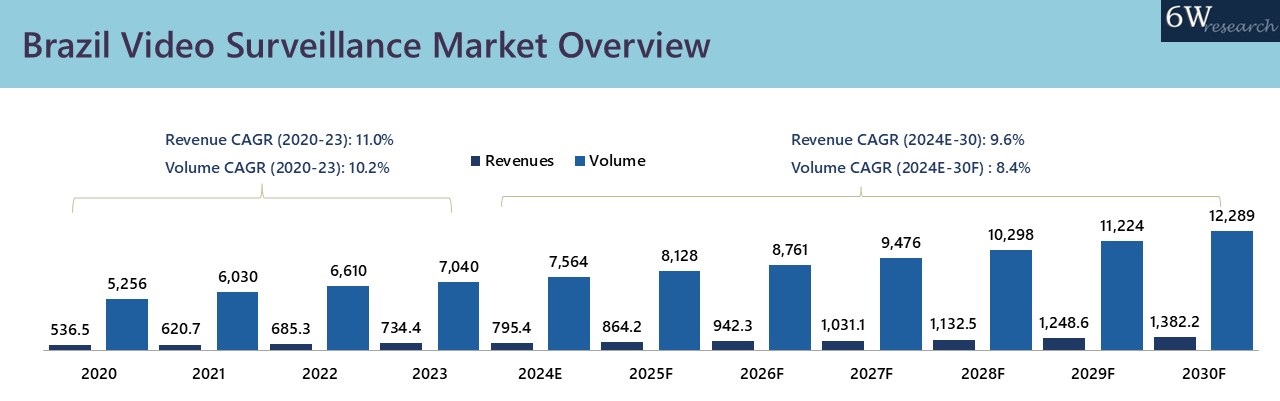
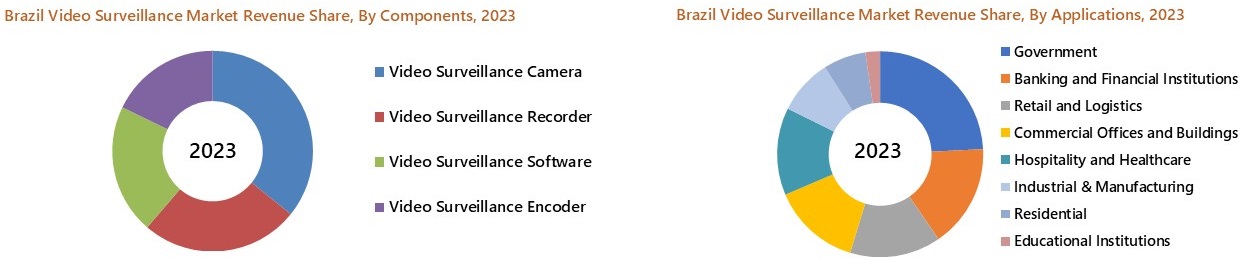
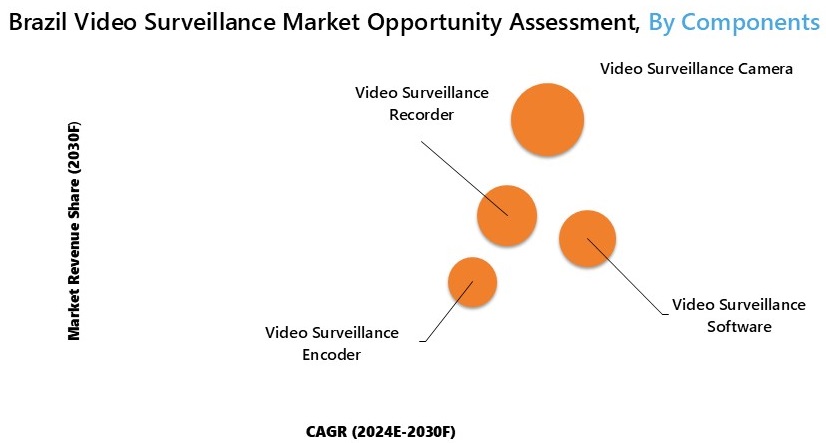
Brazil Video Surveillance Market Size & Growth Rate
According to 6Wresearch internal database and industry insights, the Brazil Video Surveillance Market was valued at USD 1.5 Billion in 2025 and is projected to reach USD 2.33 Billion by 2032, growing at a CAGR of approximately 6.5% during 2026–2032.
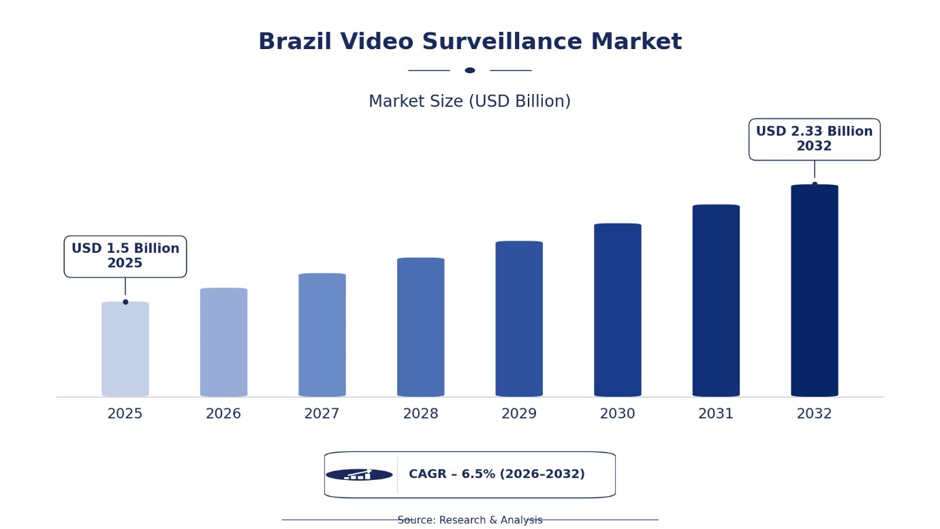
Brazil Video Surveillance Market Highlights
|
Report Metric |
Details |
|
Report Name |
Brazil Video Surveillance Market (2026-2032) |
|
Market Size 2025 |
USD 1.5 Billion |
|
Market Size 2032 |
USD 2.33 Billion |
|
Absolute Growth 2025–2032 |
USD 0.83 Billion |
|
CAGR 2026–2032 |
6.5% |
|
Peak Annual Growth |
7.3% in 2029 |
|
Forecast Period |
2026–2032 |
|
Historical Data |
2022–2025 |
|
Base Year |
2025 |
|
Leading Components, 2025 |
Video Surveillance Cameras (58% share) |
|
Leading Applications, 2025 |
Government & Transportation (24% share) |
|
Fastest-Growing Components |
Video Management Software (10.2% CAGR) |
|
Fastest-Growing Applications |
Residential (8.4% CAGR) |
|
Growing Sector |
Residential and Retail & Logistics |
|
Key End Users |
Banks and financial institutions, federal, state and municipal agencies, transport operators, retailers and logistics operators, commercial building owners, manufacturers, households, hospitality and healthcare providers, schools and universities |
Brazil Video Surveillance Market Year-wise Growth Rate and Key Drivers (2022–2032)
This graph illustrates the annual growth rates of the market from 2022 to 2032, highlighting a steady upward trajectory and projected market expansion over the forecast period.
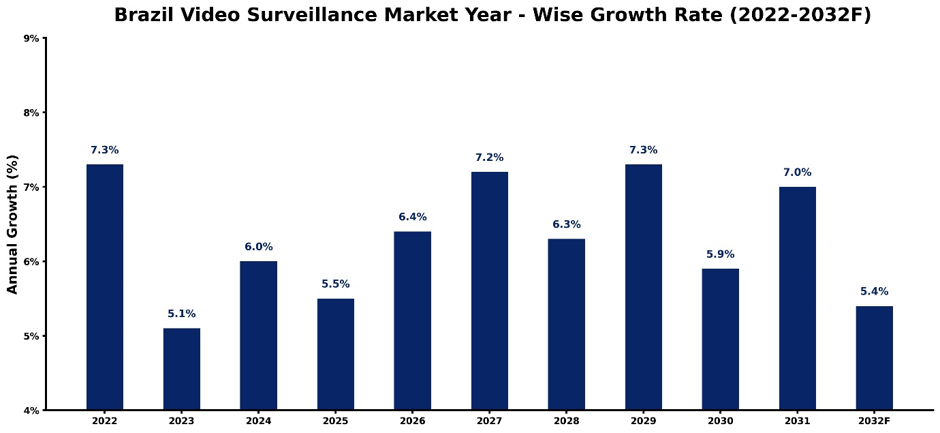
The following table presents the estimated annual growth rate for each year together with the principal factor influencing market performance.
| Year | Estimated Annual Growth (%) | Market Rationale |
| 2022 | 7.3% | Post-pandemic reopening of commercial premises and public venues restored deferred security upgrade budgets and project activity across the country. |
| 2023 | 5.1% | Inventory correction of imported equipment and normalisation of post-recovery spending moderated demand after the strong rebound of the previous year. |
| 2024 | 6% | Monetary easing through May 2024 and the enactment of the Private Security Statute in September 2024 supported renewed investment. |
| 2025 | 5.5% | The Selic rate reaching 15% in mid-2025 raised financing costs and delayed large multi-site projects, moderating growth. |
| 2026 | 6.4% | Rollout of AI-enabled cameras with built-in analytics is expected to stimulate upgrade purchases among enterprise and municipal buyers. |
| 2027 | 7.2% | Expanded state and municipal command centre programmes funded through federal public safety transfers are expected to accelerate large tender awards. |
| 2028 | 6.3% | Completion of first-phase city monitoring rollouts is expected to moderate new public tender volumes. |
| 2029 | 7.3% | Replacement of first-generation systems installed around the 2014 FIFA World Cup and 2016 Olympics is expected to peak. |
| 2030 | 5.9% | Price erosion in standard IP cameras and intensified competition from imported brands are expected to reduce growth in value terms. |
| 2031 | 7% | Wider adoption of cloud-managed platforms and subscription-based monitoring services is expected to raise recurring software and service revenue. |
| 2032 | 5.4% | A maturing installed base and fewer greenfield installations are expected to moderate annual growth towards a more stable level. |
Note: Market size estimations and growth projections presented in this report are based on 6Wresearch’s proprietary forecasting methodology, utilizing the latest available industry data, government publications, and primary research inputs.
Brazil Video Surveillance Market Synopsis
The Brazil Video Surveillance Systems Market is driven by the expansion of municipal security initiatives, the increasing adoption of AI-enabled video analytics, and the growing demand for advanced monitoring solutions across commercial and public infrastructure. The market comprises cameras, recorders, encoders, and management software used to monitor, record, and analyse activities across public and private premises. Furthermore, domestic manufacturing by Intelbras supports market growth. However, reliance on imported components and high financing costs constrain investment and delay large-scale and multi-site deployments.
Market Dynamics Impact Analysis (2026–2032)
| Factor | Type | Impact | Primary Segment Affected |
| Expansion of municipal and state command centres | Driver | High | Government & Transportation |
| Adoption of AI-based video analytics | Driver | High | Video Management Software |
| Growth of app-managed wireless cameras for homes and small businesses | Opportunity | High | Wireless Camera |
| Replacement of ageing analogue installations with IP systems | Opportunity | High | Analog Camera |
| High interest rates and currency volatility raising equipment costs | Restraint | High | IP/Network Camera |
| Data protection compliance requirements for image processing | Restraint | Medium | Video Management Software |
| Shortage of skilled integrators and analytics specialists | Challenge | Medium | Industrial & Manufacturing |
| Cybersecurity vulnerabilities of networked devices | Challenge | High | IP/Network Camera |
Evaluation of Drivers in Brazil Video Surveillance Market (2026–2032)
Below mentioned are some major drivers and their influence on market dynamics.
| Drivers | Primary Segment Affected | Why It Matters (Evidence) |
| Expansion of municipal and state command centres | Government & Transportation | Cities link public cameras to integrated operations centres, which increases demand for cameras and management software, and the Centro de Operações Rio has integrated municipal camera feeds with traffic and emergency services since 2010. |
| Security upgrades in distribution and fulfilment facilities | Retail & Logistics | Cargo theft and inventory loss encourage operators to add perimeter, dock and yard coverage, and Brazil records more than 10,000 cargo theft incidents annually. |
| Adoption of AI-based video analytics | Video Management Software | Analytics converts footage into automated alerts, which reduces monitoring staff requirements and increases software licences per site, and Salvador introduced facial recognition on its camera network during Carnival in 2019. |
| Growth of wireless home and small-business cameras | Wireless Camera | Low-cost app-managed cameras remove wiring and installation costs, which widens the buyer base, and internet access now reaches more than 85% of Brazilian households. |
| Replacement of ageing analogue installations | Analog Camera | Systems installed around the 2014 FIFA World Cup and 2016 Olympics are approaching end of service life, which creates replacement demand for IP cameras and network recorders in the 12 host cities. |
Growth in the Brazil Video Surveillance Market is supported by rapid urbanisation, with more than 85% of the population living in cities, thereby increasing the concentration of assets and public spaces that require continuous monitoring. In addition, fibre broadband provides higher bandwidth for high-definition streaming and remote access, while fifth-generation network coverage continues to expand. Falling hardware costs and improved edge processing are also reducing the cost per monitored point, enabling broader deployment across customer segments. Furthermore, stable foreign direct investment, which has exceeded USD 60 billion in several recent years, is supporting new construction projects with security systems incorporated at the design stage. Moreover, the expansion of the professional security services industry is increasing demand for remote monitoring capabilities.
Evaluation of Restraints in Brazil Video Surveillance Market
Below mentioned are some major restraints and their influence on market dynamics.
| Market Restraint | Primary Segment Affected | Why It Matters (Evidence) |
| High interest rates and financing costs | Video Surveillance Cameras | Elevated borrowing costs raise the cost of financing multi-site projects and lengthen approval cycles, and the Selic rate reached 15% in 2025. |
| Import dependence and currency volatility | IP/Network Camera | Image sensors, chips and many finished devices are imported and priced in US dollars, which passes depreciation into equipment prices, and the real lost more than 20% of its value against the dollar in 2024. |
| Data protection compliance requirements | Video Management Software | The General Data Protection Law of 2018 requires a lawful basis and defined retention limits for image processing, and fines can reach 2% of revenue up to BRL 50 million per infraction. |
| Circulation of uncertified and informally imported devices | Wireless Camera | Low-priced unbranded products reduce margins for certified suppliers, and Anatel certification is mandatory for wireless equipment sold in Brazil although uncertified products remain available through online marketplaces. |
| Complex tax structure and high landed costs | Digital Video Recorder | Layered federal and state taxes and logistics costs raise the landed price of imported equipment, and ICMS rules differ across 27 federative units. |
Brazil Video Surveillance Market Challenges
The Brazil Video Surveillance Industry faces several operational challenges. A shortage of qualified integrators and analytics specialists, with demand for approximately 797,000 technology professionals over a five-year period exceeding graduate output, delays complex installations and increases service costs for buyers. In addition, networked devices face persistent cyber threats, with Brazil recording more than 100 billion attempted cyberattacks in a single recent year, requiring operators to invest in system hardening and firmware management. Furthermore, mixed installations of analogue and proprietary IP equipment from multiple vendors complicate integration and extend project timelines. Public procurement adds further pressure, as tenders under the procurement law enacted in 2021 often favour the lowest-price bids, thereby compressing supplier margins and discouraging investment in higher-specification solutions.
Trends in the Brazil Video Surveillance Market
- Shift from Analogue to IP-Based and Hybrid Systems: Brazilian buyers are increasingly moving from coaxial analogue installations to network cameras, often using hybrid recorders and existing cabling during the transition. Systems installed more than a decade ago in major cities are among the first to require replacement. Consequently, this shift favours suppliers offering migration kits, Power over Ethernet (PoE) switches, and recorders that support both formats.
- Transition from Passive Recording to AI-Enabled Analytics: Video analytics is increasingly replacing manual footage review as operators demand automated alerts. For instance, the Smart Sampa programme in São Paulo integrates facial recognition and other analytics across a network targeting approximately 40,000 cameras. Therefore, suppliers capable of embedding analytics in cameras or recorders can reduce operator workloads and generate higher software revenue per site.
- Residential Security Shifting from Professional Installation to Self-Installed Devices: Wi-Fi cameras managed through mobile applications, such as Intelbras’ Mibo range, are increasingly sold through retail chains and online marketplaces and require no wiring. This growing sales channel favours brands offering local support, Anatel certification, and competitive pricing amid competition from imported products.
Investment Opportunities in the Brazil Video Surveillance Market
Some of the investment opportunities in the Brazil Video Surveillance Market are mentioned below.
- AI Analytics and Video Management Software for City Operations Centres: Expanding municipal command centres require platforms that integrate video feeds, licence plate recognition, and dispatch data. Accordingly, investors can develop or localise management and analytics software with audit trails and retention controls aligned with the data protection law. Market entry is feasible through partnerships with local systems integrators and participation in municipal tenders in São Paulo, Rio de Janeiro, and Salvador.
- Local Assembly of IP Cameras and Network Video Recorders: Exchange rate volatility and import taxation favour equipment assembled within Brazil. Therefore, capital can be directed towards assembly lines in the Manaus Free Trade Zone or the electronics cluster of Santa Rita do Sapucaí, preferably through a joint venture or contract manufacturing agreement with an established brand. Furthermore, Anatel certification of connected products is a prerequisite for market entry.
- Cargo and Facility Protection for Logistics Networks: Persistent cargo theft and the expansion of fulfilment centres have increased demand for integrated security solutions. Consequently, suppliers can offer perimeter cameras, licence plate recognition at gates and truck terminals, and recorders with cloud backup. Market entry can be pursued through service contracts with logistics operators, insurers, and security firms serving the São Paulo, Minas Gerais, and Rio de Janeiro corridors.
Leading Players in Brazil Video Surveillance Market
Stated below are some of the leading companies contributing significantly to the Brazil Video Surveillance Market share.
1. Intelbras
|
Company Name |
Intelbras |
|
Established Year |
1976 |
|
Headquarters |
São José, Brazil |
|
Official Website |
Intelbras is a Brazilian technology company that designs and manufactures security, telecommunications and connectivity products, including cameras and recorders. It is a leading domestic supplier with extensive distribution through integrators and retail channels.
2. Hikvision
|
Company Name |
Hikvision |
|
Established Year |
2001 |
|
Headquarters |
Hangzhou, China |
|
Official Website |
Hikvision is a global manufacturer of video surveillance cameras, recorders and management software. It serves Brazilian integrators and distributors with a broad portfolio and a local commercial and assembly presence.
3. Dahua Technology
|
Company Name |
Dahua Technology |
|
Established Year |
2001 |
|
Headquarters |
Hangzhou, China |
|
Official Website |
Dahua Technology supplies video surveillance products and solutions, including IP cameras, recorders and analytics platforms. It supports Brazilian channel partners through a local subsidiary and a wide range of cost-competitive devices.
4. Axis Communications
|
Company Name |
Axis Communications |
|
Established Year |
1984 |
|
Headquarters |
Lund, Sweden |
|
Official Website |
Axis Communications is a provider of network video, audio and access solutions. It is positioned in Brazil as a supplier of premium network cameras for enterprise, infrastructure and public safety projects delivered through certified partners.
Government Initiatives in the Brazil Video Surveillance Market
The Fundo Nacional de Segurança Pública, established under Law 13,756 of 2018, channels federal funding towards state and municipal public safety projects, including video surveillance. Similarly, Pronasci II, relaunched in 2023, prioritises coordinated prevention initiatives and intelligence systems. Industrial policy also supports domestic production through the Nova Indústria Brasil programme, introduced in 2024, which mobilises BRL 300 billion up to 2026, alongside Manaus Free Trade Zone benefits extended until 2073.
The Ministry of Justice and Public Security, through the Secretaria Nacional de Segurança Pública, administers federal transfers and coordinates integrated command centres across all 26 states and the Federal District. Meanwhile, São Paulo’s Smart Sampa programme targets approximately 40,000 connected cameras, while Anatel certification and the data protection authority ANPD, which began enforcing sanctions in 2021, regulate device compliance and image processing.
Future Insight of the Brazil Video Surveillance Market
The Brazil Video Surveillance Market is expected to benefit from the continued maturation of edge-based artificial intelligence, which will enable devices to process footage locally and reduce bandwidth requirements. Furthermore, the national plan allocates BRL 23 billion over 2024–2028 for public investment in artificial intelligence, which is expected to support domestic research and deployment. As standalone fifth-generation networks become more widespread, they will facilitate low-latency video transmission from mobile and temporary locations. In addition, ongoing smart city initiatives and the development of regional data centres are expected to extend integrated monitoring capabilities beyond the largest metropolitan areas.
Market Segmentation Analysis
The report offers a comprehensive study of the following market segments and their leading categories in the market.
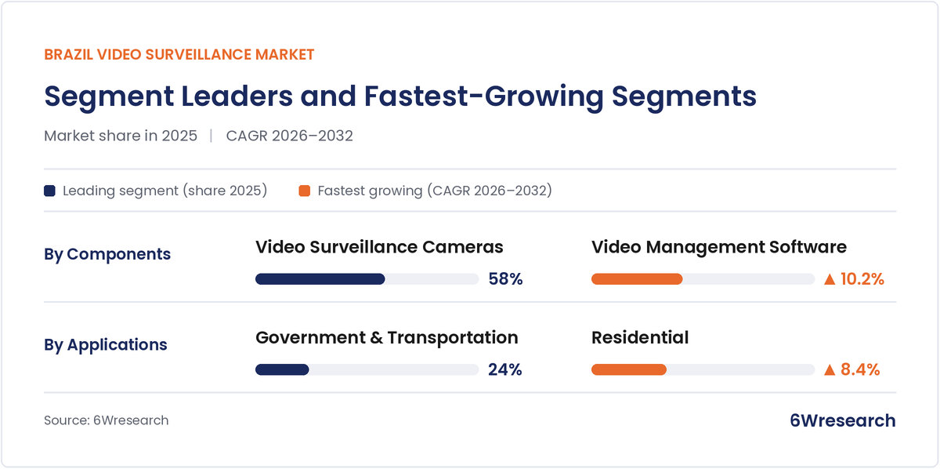
By Components – Video Surveillance Cameras Led, While Video Management Software Is Expected to Grow Fastest
According to Ravi Bhandari, Research Head at 6Wresearch, Video Surveillance Cameras accounted for 58% of the market in 2025, supported by large-scale municipal deployments and the widespread availability of affordable IP models from both domestic and imported brands. Meanwhile, Video Management Software is expected to record the fastest growth, with a CAGR of 10.2% during 2026 to 2032, driven by demand from city operations centres for platforms that integrate video, analytics, and dispatch data.
By Applications – Government & Transportation Led, While Residential Is Expected to Grow Fastest
In 2025, Government & Transportation commanded the largest market share at 24%, reflecting federal public safety transfers, state police programmes, and monitoring requirements across metro systems and airports in Brazil major cities. Meanwhile, the Residential segment is projected to expand at the highest CAGR of 8.4% during 2026 to 2032, supported by rising urban crime concerns, wider home internet access, and the growing availability of affordable Wi-Fi cameras through e-commerce channels.
Key Attractiveness of the Report
- 10 Years of Market Numbers
- Historical Data Starting from 2022 to 2025
- Base Year 2025
- Forecast Data until 2032
- Key Performance Indicators Impacting the Market
- Major Upcoming Developments and Projects
Key Highlights of the Report:
- Brazil Video Surveillance Market Outlook
- Market Size of Brazil Video Surveillance Market, 2025
- Forecast of Brazil Video Surveillance Market, 2032
- Historical Data and Forecast of Brazil Video Surveillance Revenues & Volume for the Period 2022-2032
- Brazil Video Surveillance Market Trend Evolution
- Brazil Video Surveillance Market Drivers and Challenges
- Brazil Video Surveillance Price Trends
- Brazil Video Surveillance Porter's Five Forces
- Brazil Video Surveillance Industry Life Cycle
- Historical Data and Forecast of Brazil Video Surveillance Market Revenues & Volume By Components for the Period 2022-2032
- Historical Data and Forecast of Brazil Video Surveillance Market Revenues & Volume By Video Surveillance Cameras for the Period 2022-2032
- Historical Data and Forecast of Brazil Video Surveillance Market Revenues & Volume By Analog Camera for the Period 2022-2032
- Historical Data and Forecast of Brazil Video Surveillance Market Revenues & Volume By IP/Network Camera for the Period 2022-2032
- Historical Data and Forecast of Brazil Video Surveillance Market Revenues & Volume By Wired Camera for the Period 2022-2032
- Historical Data and Forecast of Brazil Video Surveillance Market Revenues & Volume By Wireless Camera for the Period 2022-2032
- Historical Data and Forecast of Brazil Video Surveillance Market Revenues & Volume By Video Surveillance Recorder for the Period 2022-2032
- Historical Data and Forecast of Brazil Video Surveillance Market Revenues & Volume By Network Video Recorder for the Period 2022-2032
- Historical Data and Forecast of Brazil Video Surveillance Market Revenues & Volume By Digital Video Recorder for the Period 2022-2032
- Historical Data and Forecast of Brazil Video Surveillance Market Revenues & Volume By Video Surveillance Encoder for the Period 2022-2032
- Historical Data and Forecast of Brazil Video Surveillance Market Revenues & Volume By Video Management Software for the Period 2022-2032
- Historical Data and Forecast of Brazil Video Surveillance Market Revenues & Volume By Applications for the Period 2022-2032
- Historical Data and Forecast of Brazil Video Surveillance Market Revenues & Volume By Banking & Financial for the Period 2022-2032
- Historical Data and Forecast of Brazil Video Surveillance Market Revenues & Volume By Government & Transportation for the Period 2022-2032
- Historical Data and Forecast of Brazil Video Surveillance Market Revenues & Volume By Retail & Logistics for the Period 2022-2032
- Historical Data and Forecast of Brazil Video Surveillance Market Revenues & Volume By Commercial Offices for the Period 2022-2032
- Historical Data and Forecast of Brazil Video Surveillance Market Revenues & Volume By Industrial & Manufacturing for the Period 2022-2032
- Historical Data and Forecast of Brazil Video Surveillance Market Revenues & Volume By Residential for the Period 2022-2032
- Historical Data and Forecast of Brazil Video Surveillance Market Revenues & Volume By Hospitality & Healthcare for the Period 2022-2032
- Historical Data and Forecast of Brazil Video Surveillance Market Revenues & Volume By Educational Institutions for the Period 2022-2032
- Brazil Video Surveillance Import Export Trade Statistics
- Market Opportunity Assessment By Components
- Market Opportunity Assessment By Applications
- Brazil Video Surveillance Top Companies Market Share
- Brazil Video Surveillance Competitive Benchmarking By Technical and Operational Parameters
- Brazil Video Surveillance Company Profiles
- Brazil Video Surveillance Key Strategic Recommendations
Market Covered
The report offers an extensive study of the following market segments.
By Components
- Video Surveillance Cameras
- Analog Camera
- IP/Network Camera
- Wired Camera
- Wireless Camera
- Video Surveillance Recorder
- Network Video Recorder
- Digital Video Recorder
- Video Surveillance Encoder
- Video Management Software
By Applications
- Banking & Financial
- Government & Transportation
- Retail & Logistics
- Commercial Offices
- Industrial & Manufacturing
- Residential
- Hospitality & Healthcar
- Educational Institutions