Brazil Warehousing and Storage Market Size, Share & Growth Rate
The Brazil Warehousing and Storage Market was estimated at USD 359 Million in 2025 and is projected to reach USD 429 Million by 2032, growing at a CAGR of 2.6% from 2026 to 2032. This growth trajectory is fueled primarily by the booming e-commerce sector, which demands more sophisticated warehousing solutions to handle increased inventory and customer expectations for rapid delivery. Additionally, industries such as manufacturing and retail are increasingly prioritizing supply chain optimization, driving the need for modern, efficient storage systems throughout Brazil.
Brazil Warehousing and Storage Market Year-wise Growth Rate and Key Drivers
This graph highlights how the Brazil Warehousing and Storage Market has steadily grown over the years, supported by major growth factors.
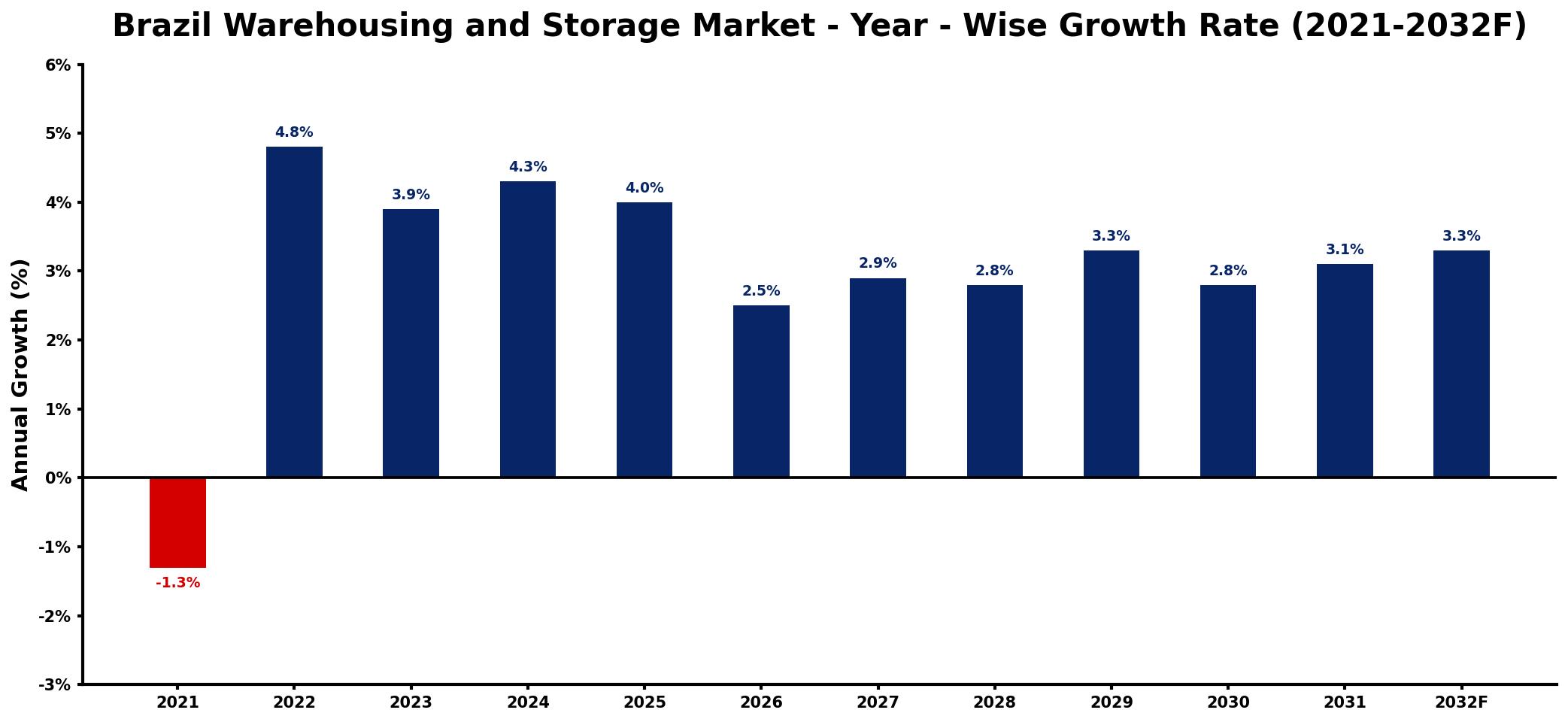
The table below presents the year‑wise growth rates along with the key drivers influencing the market
| Year | Growth Rate | Major Drivers |
| 2021 | -1.3% | decreased retail sector activity |
| 2022 | 4.8% | e-commerce market expansion surge |
| 2023 | 3.9% | increased logistics infrastructure investments |
| 2024 | 4.3% | growing demand for automation solutions |
| 2025 | 4.0% | rising need for cold chain |
| 2026 | 2.5% | enhanced supply chain efficiency focus |
| 2027 | 2.9% | expansion of last mile delivery |
| 2028 | 2.8% | increased foreign direct investments |
| 2029 | 3.3% | rising procurement volume requirements |
| 2030 | 2.8% | rise in cross-border trade activities |
| 2031 | 3.1% | increased focus on sustainability practices |
| 2032 | 3.3% | growing technology integration trends |
Note: Market size estimations and growth projections presented in this report are based on 6Wresearch's proprietary forecasting methodology, utilizing the latest available industry data, government publications, and primary research inputs.
Brazil Warehousing and Storage Market Synopsis
The rise of e-commerce in Brazil has prompted a surge in demand for innovative warehousing solutions, allowing businesses to meet consumer expectations for fast and reliable delivery. The implementation of advanced storage technologies, including automation, is becoming essential for companies aiming to enhance their inventory management processes.
Moreover, a shift in consumer behavior, particularly favoring online shopping, is reshaping logistics and distribution strategies. As a result, companies are investing more in warehousing capabilities that provide flexible and scalable solutions to accommodate fluctuating demand.
Brazil Warehousing and Storage Market Key Takeaways
- The market is characterized by a strong demand from e-commerce and retail sectors.
- Adoption of advanced technologies is vital for improving efficiency and inventory management.
- Inadequate infrastructure remains a significant challenge in remote areas.
- Government incentives are supporting the modernization of warehousing facilities.
- Economic fluctuations can impact investment decisions and operational costs.
Evaluation of Restraints in Brazil Warehousing and Storage Market
One of the primary restraints hampering the Brazil Warehousing and Storage Market is the inadequate infrastructure, particularly in remote regions. This deficiency leads to logistics bottlenecks, resulting in increased shipping costs and extended delivery times. Furthermore, economic uncertainties pose challenges for businesses when making investment decisions regarding warehouse facilities. Compliance with regulatory standards and safety regulations can also add layers of complexity to operations, ultimately hindering market growth.
Brazil Warehousing and Storage Market Trends
The Brazil Warehousing and Storage Market is increasingly shaped by several trends. The integration of automated systems, such as robotics and AI, is enhancing operational efficiency and accuracy in inventory management. Additionally, sustainable warehousing practices are gaining traction as companies seek to reduce their carbon footprint, leading to the adoption of eco-friendly materials and energy-efficient systems. Finally, data analytics is playing a crucial role in optimizing warehouse operations and enhancing decision-making processes.
Brazil Warehousing and Storage Market Opportunities
Emerging growth opportunities within the Brazil Warehousing and Storage Market lie in the development of specialized warehousing facilities tailored to industry-specific needs. Additionally, with the rapid expansion of e-commerce, there is a strong demand for fulfillment centers that can handle high volumes of orders. Investing in technology-driven solutions such as Internet of Things (IoT) applications can also enhance operational visibility and efficiency, representing a lucrative area for investment.
Government Initiatives in the Brazil Warehousing and Storage Market
In response to the growing demand for logistics efficiency, the Brazilian government has implemented several initiatives aimed at modernizing and expanding warehousing facilities. These include tax incentives for investments in infrastructure, regulatory reforms intended to streamline operations, and programs designed to support technology adoption within the warehousing sector. By facilitating these advancements, the government aims to enhance Brazil's logistics capabilities, ultimately benefitting the economy.
Future Insights of the Brazil Warehousing and Storage Market
Looking ahead to 2026-2032, the Brazil Warehousing and Storage Market is expected to experience sustained growth, driven by the relentless rise of e-commerce and the need for advanced supply chain solutions. The increasing focus on technology adoption, particularly in automation and data analytics, will further transform operational frameworks. As businesses seek to adapt to consumer demands and enhance efficiency, innovation will remain a core element of growth strategies in this sector.
Brazil Warehousing and Storage Market Latest Developments (2025 - 2026)
Recent developments in the Brazil Warehousing and Storage Market indicate a growing emphasis on technological integration. Many operators are exploring partnerships with tech firms to adopt smart warehousing solutions. Additionally, there has been an increase in the establishment of fulfillment centers aimed at meeting the demands of the burgeoning e-commerce sector. As companies continue to pivot towards more efficient logistics practices, the market is poised for significant transformation.
Brazil Warehousing and Storage Market - Key Attractiveness of the Report
- 10 Years of Market Numbers
- Historical Data Starting from 2022 to 2025
- Base Year: 2025
- Forecast Data until 2032
- Key Performance Indicators Impacting the Market
- Major Upcoming Developments and Projects
Key Highlights of the Report:
- Brazil Warehousing and Storage Market Outlook
- Market Size of Brazil Warehousing and Storage Market, 2025
- Forecast of Brazil Warehousing and Storage Market, 2032
- Historical Data and Forecast of Brazil Warehousing and Storage Revenues & Volume for the Period 2022-2032F
- Brazil Warehousing and Storage Market Trend Evolution
- Brazil Warehousing and Storage Market Drivers and Challenges
- Brazil Warehousing and Storage Price Trends
- Brazil Warehousing and Storage Porter's Five Forces
- Brazil Warehousing and Storage Industry Life Cycle
- Historical Data and Forecast of Brazil Warehousing and Storage Market Revenues & Volume By Type for the Period 2022-2032F
- Historical Data and Forecast of Brazil Warehousing and Storage Market Revenues & Volume By General Warehousing and Storage for the Period 2022-2032F
- Historical Data and Forecast of Brazil Warehousing and Storage Market Revenues & Volume By Refrigerated Warehousing and Storage for the Period 2022-2032F
- Historical Data and Forecast of Brazil Warehousing and Storage Market Revenues & Volume By Farm Product Warehousing and Storage for the Period 2022-2032F
- Historical Data and Forecast of Brazil Warehousing and Storage Market Revenues & Volume By Ownership for the Period 2022-2032F
- Historical Data and Forecast of Brazil Warehousing and Storage Market Revenues & Volume By Private Warehouses for the Period 2022-2032F
- Historical Data and Forecast of Brazil Warehousing and Storage Market Revenues & Volume By Public Warehouses for the Period 2022-2032F
- Historical Data and Forecast of Brazil Warehousing and Storage Market Revenues & Volume By Bonded Warehouses for the Period 2022-2032F
- Historical Data and Forecast of Brazil Warehousing and Storage Market Revenues & Volume By End-Use for the Period 2022-2032F
- Historical Data and Forecast of Brazil Warehousing and Storage Market Revenues & Volume By Manufacturing for the Period 2022-2032F
- Historical Data and Forecast of Brazil Warehousing and Storage Market Revenues & Volume By Consumer Goods for the Period 2022-2032F
- Historical Data and Forecast of Brazil Warehousing and Storage Market Revenues & Volume By Retail for the Period 2022-2032F
- Historical Data and Forecast of Brazil Warehousing and Storage Market Revenues & Volume By Food and Beverage for the Period 2022-2032F
- Historical Data and Forecast of Brazil Warehousing and Storage Market Revenues & Volume By IT Hardware for the Period 2022-2032F
- Historical Data and Forecast of Brazil Warehousing and Storage Market Revenues & Volume By Healthcare for the Period 2022-2032F
- Historical Data and Forecast of Brazil Warehousing and Storage Market Revenues & Volume By Chemicals for the Period 2022-2032F
- Historical Data and Forecast of Brazil Warehousing and Storage Market Revenues & Volume By Others for the Period 2022-2032F
- Brazil Warehousing and Storage Import Export Trade Statistics
- Market Opportunity Assessment By Type
- Market Opportunity Assessment By Ownership
- Market Opportunity Assessment By End-Use
- Brazil Warehousing and Storage Top Companies Market Share
- Brazil Warehousing and Storage Competitive Benchmarking By Technical and Operational Parameters
- Brazil Warehousing and Storage Company Profiles
- Brazil Warehousing and Storage Key Strategic Recommendations






































