Brazil Waste Management Market Summary
The brazil waste management market was estimated at USD 284 Million in 2025 and is projected to reach USD 340 Million by 2032, growing at a CAGR of 2.9% from 2026 to 2032.
Brazil Waste Management Market Year-wise Growth Rate and Key Drivers
This graph highlights how the Brazil Waste Management Market has steadily grown over the past five years, supported by major growth factors.
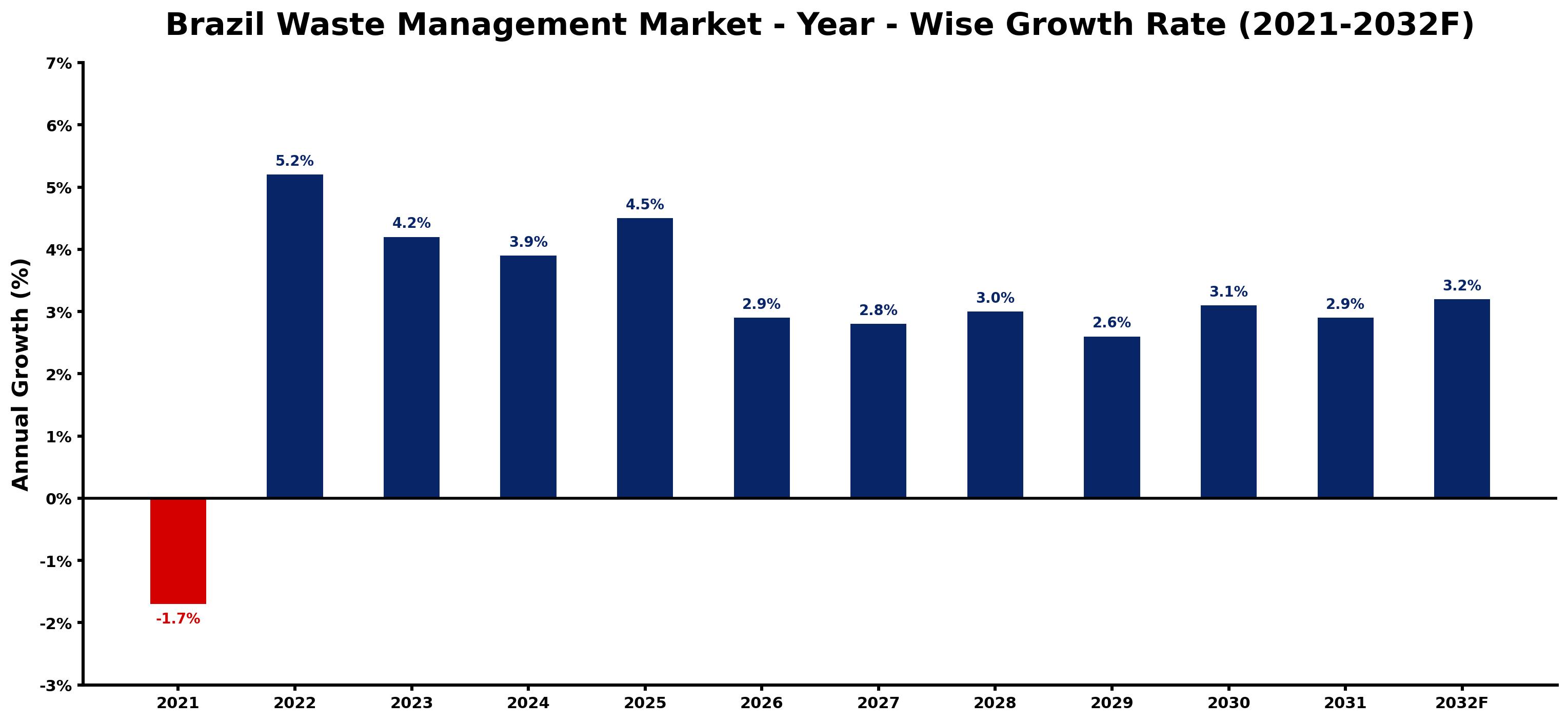
The table below presents the year wise growth rates along with the key drivers influencing the market
| Year | Growth Rate | Major Drivers |
| 2021 | -1.7% | Increased environmental regulations led to higher operational costs, discouraging investment in waste management services. |
| 2022 | 5.2% | Local partnerships emerge, enhancing waste collection efficiency in densely populated areas. |
| 2023 | 4.2% | Investment in recycling technologies gains traction, addressing environmental concerns and waste reduction. |
| 2024 | 3.9% | Increased public awareness about sustainability spurs community participation in waste segregation programs. |
| 2025 | 4.5% | Corporate responsibility initiatives lead to higher demand for sustainable waste management practices. |
| 2026 | 2.9% | Emerging competition in the waste sector drives innovation and improved service delivery standards. |
| 2027 | 2.8% | Adoption of digital tools streamlines waste management operations, optimizing resource allocation efficiently. |
| 2028 | 3.0% | Climate change impacts prompt new waste disposal regulations, pushing companies to adapt quickly. |
| 2029 | 2.6% | Collaboration between municipalities and private firms enhances infrastructure for waste processing capabilities. |
| 2030 | 3.1% | Technological advancements in composting and waste-to-energy solutions attract significant investments. |
| 2031 | 2.9% | Changing consumer behavior favors eco-friendly products, influencing waste generation patterns positively. |
| 2032 | 3.2% | The cumulative effects of decades-long efforts yield a cleaner urban landscape and thriving economy. |
Note - Market size estimations and growth projections presented in this report are based on 6Wresearch's advanced forecasting approach, validated with industry datasets as of June 2026.
Brazil Waste Management Market Synopsis
The Brazil Waste Management Market is projected to reach USD 10.03 billion and witness significant growth during the forecast period (2026-2032). As urbanization and industrialization advance, Brazil faces increasingly complex waste management challenges. The nation's infrastructure for the collection, transportation, segregation, treatment, and disposal of solid waste is insufficient to meet the heightened demands. Coupled with government efforts to improve waste management practices, these factors contribute to the market's growth trajectory.
Brazil Waste Management Market Growth Drivers
The Brazil Waste Management Market is expanding due to several compelling growth drivers. Firstly, rapid urbanization leads to heightened municipal waste generation, requiring efficient management and disposal strategies. Secondly, government initiatives aimed at enhancing waste management infrastructure are crucial. These initiatives focus on creating better collection routes and effective treatment facilities to minimize environmental impact. Thirdly, the increasing public awareness surrounding waste segregation and recycling drives a cultural shift towards more sustainable practices. Fourthly, the push for eco-friendly technologies offers manufacturers opportunities to develop innovative solutions that meet environmental standards and reduce waste. Finally, investments in public-private partnerships facilitate the development of sustainable waste management systems, further propelling market growth.
Brazil Waste Management Market Challenges and Restraints
Despite positive growth prospects, the Brazil Waste Management Market faces significant challenges. A notable issue is the inadequate sanitary landfill capacity, which hampers effective waste disposal efforts. The lack of public awareness regarding waste segregation and composting significantly hinders recycling efforts, leading to increased landfill dependency. Additionally, ineffective enforcement of existing regulations exacerbates illegal dumping practices, particularly in underprivileged urban areas. The reliance on outdated waste management processes and technologies also presents a barrier to modernization. Lastly, the financial constraints faced by local governments impede their ability to invest in necessary infrastructure improvements and innovative waste management solutions.
Brazil Waste Management Market Trends and Opportunities
Emerging trends in the Brazil Waste Management Market present numerous opportunities for growth. The increasing demand for innovative waste management technologies reflects a broader recognition of the environmental ramifications of waste disposal. Additionally, the rise of circular economy principles encourages businesses to find value in waste materials, promoting recycling and composting initiatives. The government's focus on sustainability and climate change also paves the way for investments in renewable energy solutions derived from waste, such as biogas production. Furthermore, the establishment of stricter regulations surrounding waste management could catalyze the development of advanced waste processing facilities. Lastly, the demand for environmental, social, and governance (ESG) compliance among corporations creates incentives for the adoption of waste management best practices.
Brazil Waste Management Market Government Investment and Initiatives
The Brazilian government has increasingly recognized the importance of effective waste management in promoting public health and environmental sustainability. Various initiatives have been launched to address the country's waste management challenges. Investments in waste management infrastructure are prioritized, focusing on enhancing collection and treatment systems. Regulatory frameworks are being established to encourage proper disposal methods and minimize illegal dumping practices. In conjunction with these efforts, the government has begun implementing educational programs aimed at improving public awareness regarding waste segregation and recycling. Additionally, various state governments are collaborating with private sector entities to facilitate sustainable waste management projects, providing a conducive environment for investment and development in this crucial sector.
Brazil Waste Management Market Latest Developments (May 2025 - June 2026)
Recent developments in the Brazil Waste Management Market indicate a significant shift towards sustainability and innovation. During this period, several state-funded projects launched aimed at enhancing local waste management systems and technologies. These initiatives have focused on expanding recycling capabilities and minimizing landfill reliance. Additionally, there has been an increase in partnerships between governmental bodies and private companies, aimed at fostering efficient waste collection and processing techniques. Public awareness campaigns have gained momentum, promoting the importance of waste segregation among citizens. Moreover, there is a growing trend of integrating technology into waste management practices, such as smart bins and tracking applications to improve collection efficiencies.
Brazil Waste Management Market - Key Attractiveness of the Report
- 10 Years of Market Numbers
- Historical Data Starting from 2022 to 2025
- Base Year: 2025
- Forecast Data until 2032
- Key Performance Indicators Impacting the Market
- Major Upcoming Developments and Projects
Key Highlights of the Report:
- Brazil Waste Management Market Outlook
- Market Size of Brazil Waste Management Market, 2025
- Forecast of Brazil Waste Management Market, 2032F
- Historical Data and Forecast of Brazil Waste Management Revenues & Volume for the Period 2022-2032F
- Brazil Waste Management Market Trend Evolution
- Brazil Waste Management Market Drivers and Challenges
- Brazil Waste Management Price Trends
- Brazil Waste Management Porter's Five Forces
- Brazil Waste Management Industry Life Cycle
- Historical Data and Forecast of Brazil Waste Management Market Revenues & Volume By Types for the Period 2022-2032F
- Historical Data and Forecast of Brazil Waste Management Market Revenues & Volume By Municipal Waste for the Period 2022-2032F
- Historical Data and Forecast of Brazil Waste Management Market Revenues & Volume By Industrial Waste for the Period 2022-2032F
- Historical Data and Forecast of Brazil Waste Management Market Revenues & Volume By Hazardous Waste for the Period 2022-2032F
- Historical Data and Forecast of Brazil Waste Management Market Revenues & Volume By Services? for the Period 2022-2032F
- Historical Data and Forecast of Brazil Waste Management Market Revenues & Volume By Collection Service for the Period 2022-2032F
- Historical Data and Forecast of Brazil Waste Management Market Revenues & Volume By Collection & transportation for the Period 2022-2032F
- Historical Data and Forecast of Brazil Waste Management Market Revenues & Volume By Storage & handling for the Period 2022-2032F
- Historical Data and Forecast of Brazil Waste Management Market Revenues & Volume By Sorting for the Period 2022-2032F
- Historical Data and Forecast of Brazil Waste Management Market Revenues & Volume By Disposable Service for the Period 2022-2032F
- Historical Data and Forecast of Brazil Waste Management Market Revenues & Volume By Landfills for the Period 2022-2032F
- Historical Data and Forecast of Brazil Waste Management Market Revenues & Volume By Recycling for the Period 2022-2032F
- Historical Data and Forecast of Brazil Waste Management Market Revenues & Volume By Compositing & anaerobic digestion for the Period 2022-2032F
- Brazil Waste Management Import Export Trade Statistics
- Market Opportunity Assessment By Types
- Market Opportunity Assessment By Services?
- Brazil Waste Management Top Companies Market Share
- Brazil Waste Management Competitive Benchmarking By Technical and Operational Parameters
- Brazil Waste Management Company Profiles
- Brazil Waste Management Key Strategic Recommendations






































