Brazil Water & Wastewater Treatment Market Summary
The brazil water & wastewater treatment market was estimated at USD 462 Million in 2025 and is projected to reach USD 551 Million by 2032, growing at a CAGR of 3.0% from 2026 to 2032.
Brazil Water & Wastewater Treatment Market Year-wise Growth Rate and Key Drivers
This graph highlights how the Brazil Water & Wastewater Treatment Market has steadily grown over the past five years, supported by major growth factors.
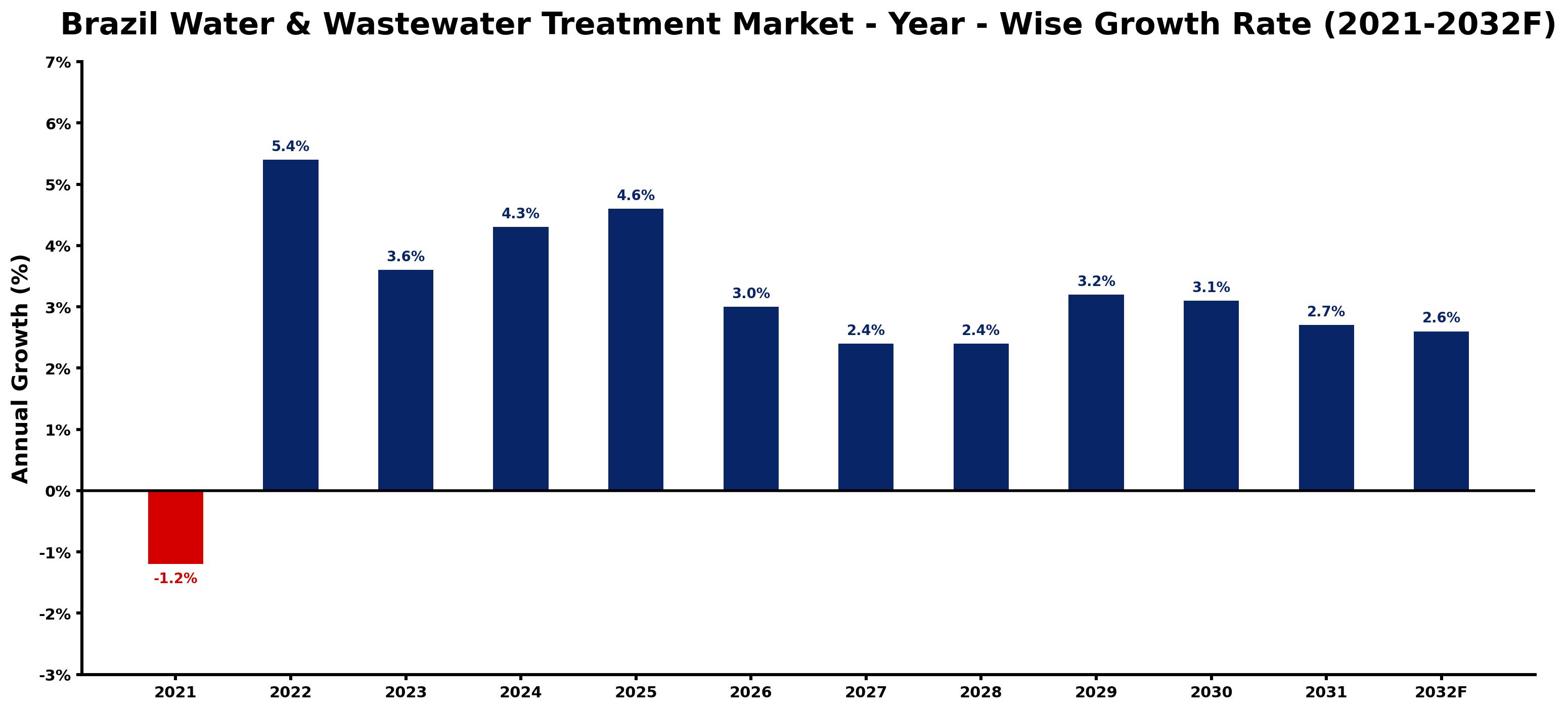
The table below presents the year wise growth rates along with the key drivers influencing the market
| Year | Growth Rate | Major Drivers |
| 2021 | -1.2% | Severe drought conditions limited municipal budgets, restricting investment in water and wastewater infrastructure projects. |
| 2022 | 5.4% | Urbanization trends highlighted the urgent need for advanced wastewater management solutions. |
| 2023 | 3.6% | Heavy rainfall patterns intensified demands for flood control and wastewater systems. |
| 2024 | 4.3% | Private sector partnerships emerged, boosting funding for water treatment projects across Brazil. |
| 2025 | 4.6% | Community awareness campaigns stressed the importance of sustainable water resource management. |
| 2026 | 3.0% | Technological innovations facilitated efficient energy usage in water purification processes. |
| 2027 | 2.4% | International collaborations enhanced Brazil's capacity for tackling pollution through modern solutions. |
| 2028 | 2.4% | Economic recovery post-pandemic spurred infrastructure projects focusing on water sustainability. |
| 2029 | 3.2% | Rural areas saw increased funding to improve access to clean water and sanitation. |
| 2030 | 3.1% | Climate change awareness drove demand for resilient water management systems in cities. |
| 2031 | 2.7% | Emerging regulations on water quality standards prompted upgrades in existing treatment facilities. |
| 2032 | 2.6% | Public-private ventures focused on recycling wastewater for agricultural and industrial use. |
Note - Market size estimations and growth projections presented in this report are based on 6Wresearch's advanced forecasting approach, validated with industry datasets as of June 2026.
Brazil Water & Wastewater Treatment Market Synopsis
The Brazil Water Wastewater Treatment Market is projected to reach 3.0% and witness significant growth during the forecast period (2026-2032). The market, valued at USD 1.9 billion in 2019, aims for an impressive increase to USD 2.89 billion by 2026, translating to a compound annual growth rate (CAGR) of 7.3%. This growth trajectory is primarily driven by the escalating demand for clean water and stringent regulations enforced by environmental authorities regarding wastewater discharge quality standards. Coupled with economic expansion across various industries such as chemicals, food & beverage, and paper & pulp, which collectively consume extensive water resources, the market is poised for extensive evolution.
Brazil Water & Wastewater Treatment Market Growth Drivers
A confluence of factors is propelling the Brazil Water & Wastewater Treatment Market forward. Key growth drivers include:
- Increasing demand for clean and safe drinking water due to rapid urbanization and industrialization, leading to higher pollution levels in surface and groundwater.
- Stringent governmental regulations that require industries to meet specific water quality standards before discharging wastewater, thereby boosting investment in treatment technologies.
- The need for robust sanitation systems to cater to the rising population, which necessitates improved infrastructure for water treatment and wastewater management.
- Technological advancements, particularly in areas such as membrane bioreactors (MBRs) and reverse osmosis (RO), enhancing the efficiency and effectiveness of water treatment processes.
- Economic growth in Brazil driving increased industrial activity, which significantly influences the demand for water resources and, consequently, wastewater treatment capacities.
Brazil Water & Wastewater Treatment Market Challenges and Restraints
Despite the positive growth outlook, the Brazil Water & Wastewater Treatment Market faces certain challenges that could impact its trajectory. These include:
- High initial investment costs associated with the installation of advanced water treatment plants and technologies, which may deter smaller players from entering the market.
- Inconsistent regulatory frameworks across different states, leading to uncertainty and hindering investment in wastewater management projects.
- Limited public awareness regarding water conservation and sustainable practices, which affects the overall effectiveness of treatment systems.
- Infrastructure deficits in many regions, especially rural areas, posing significant challenges in reaching comprehensive wastewater treatment coverage.
- Climate-related issues such as droughts and water shortages that could strain existing treatment facilities and impede the overall market growth.
Brazil Water & Wastewater Treatment Market Investment Opportunities
Investment prospects in the Brazil Water & Wastewater Treatment Market are favorable, driven by several key opportunities:
- Government-led initiatives such as the Programme Water Management Plan (PMGA), aimed at improving waste management and sewage treatment, which create a favorable landscape for increased investments.
- Collaborative projects between private companies and government bodies focusing on infrastructure development for water treatment systems.
- Technological innovations in wastewater treatment processes that enable better efficiency, presenting opportunities for R&D investments.
- Growing focus on sustainability and environmental protection, leading to an increased demand for eco-friendly wastewater treatment solutions.
- Potential for public-private partnerships (PPPs) to enhance funding avenues for large-scale wastewater treatment projects, enhancing overall market performance.
Brazil Water & Wastewater Treatment Market Government Investment and Initiatives
The Brazilian government has recognized the critical importance of water management and wastewater treatment, leading to several key initiatives designed to bolster the sector:
- The implementation of the National Water Resource Management Plan, which sets out clear guidelines for sustainable water use and infrastructure development.
- Investment in modernization of treatment facilities across major urban areas to ensure compliance with environmental regulations and improve service delivery.
- Funding for research and development projects aimed at advancing treatment technologies and methodologies, enhancing the efficiency of current systems.
- Subsidies and tax incentives for corporations implementing eco-friendly practices within their wastewater treatment processes.
- Collaborative efforts with international organizations to secure funding and technical expertise for large-scale water projects, ensuring better resource allocation.
Brazil Water & Wastewater Treatment Market Latest Developments (May 2025 - June 2026)
Recent developments in the Brazil Water & Wastewater Treatment Market indicate a strong commitment to enhancing water management practices. Key trends observed from May 2025 to June 2026 include:
- Renewed focus on public health, leading to increased investments in water quality monitoring systems and advanced treatment technologies.
- Emergence of innovative partnerships between public and private sectors aimed at accelerating infrastructure development and expanding access to treated water across underserved regions.
- Exploration of alternative water sources, such as wastewater recycling and desalination, to meet the growing demand for clean water in urban centers.
- Active participation in international forums focusing on sustainable water practices, demonstrating Brazil's commitment to addressing global water challenges.
- Continuous improvement in training and capacity building initiatives for personnel involved in water treatment and management to enhance operational efficiencies.
Brazil Water & Wastewater Treatment Market - Key Attractiveness of the Report
- 10 Years of Market Numbers
- Historical Data Starting from 2022 to 2025
- Base Year: 2025
- Forecast Data until 2032
- Key Performance Indicators Impacting the Market
- Major Upcoming Developments and Projects
Key Highlights of the Report:
- Brazil Water & Wastewater Treatment Market Outlook
- Market Size of Brazil Water & Wastewater Treatment Market, 2025
- Forecast of Brazil Water & Wastewater Treatment Market, 2032F
- Historical Data and Forecast of Brazil Water & Wastewater Treatment Revenues & Volume for the Period 2022-2032F
- Brazil Water & Wastewater Treatment Market Trend Evolution
- Brazil Water & Wastewater Treatment Market Drivers and Challenges
- Brazil Water & Wastewater Treatment Price Trends
- Brazil Water & Wastewater Treatment Porter's Five Forces
- Brazil Water & Wastewater Treatment Industry Life Cycle
- Historical Data and Forecast of Brazil Water & Wastewater Treatment Market Revenues & Volume By Product Category????????????? for the Period 2022-2032F
- Historical Data and Forecast of Brazil Water & Wastewater Treatment Market Revenues & Volume By Treatment Technologies for the Period 2022-2032F
- Historical Data and Forecast of Brazil Water & Wastewater Treatment Market Revenues & Volume By Delivery Equipment for the Period 2022-2032F
- Historical Data and Forecast of Brazil Water & Wastewater Treatment Market Revenues & Volume By Treatment Chemicals for the Period 2022-2032F
- Historical Data and Forecast of Brazil Water & Wastewater Treatment Market Revenues & Volume By Instrumentation for the Period 2022-2032F
- Historical Data and Forecast of Brazil Water & Wastewater Treatment Market Revenues & Volume By Applications for the Period 2022-2032F
- Historical Data and Forecast of Brazil Water & Wastewater Treatment Market Revenues & Volume By Municipal for the Period 2022-2032F
- Historical Data and Forecast of Brazil Water & Wastewater Treatment Market Revenues & Volume By Industrial for the Period 2022-2032F
- Brazil Water & Wastewater Treatment Import Export Trade Statistics
- Market Opportunity Assessment By Product Category?????????????
- Market Opportunity Assessment By Applications
- Brazil Water & Wastewater Treatment Top Companies Market Share
- Brazil Water & Wastewater Treatment Competitive Benchmarking By Technical and Operational Parameters
- Brazil Water & Wastewater Treatment Company Profiles
- Brazil Water & Wastewater Treatment Key Strategic Recommendations






































