Brazil Wi-Fi Market Size, Share & Growth Rate
The Brazil Wi-Fi Market was estimated at USD 183 Million in 2025 and is projected to reach USD 219 Million by 2032, growing at a CAGR of 2.6% from 2026 to 2032. This growth trajectory is fueled primarily by an increasing number of connected devices, driven by both consumer and commercial demand. As urbanization accelerates and the Internet of Things (IoT) takes root, the need for stable, high-speed wireless connectivity has become more crucial than ever.
Brazil Wi-Fi Market Year-wise Growth Rate and Key Drivers
This graph highlights how the Brazil Wi-Fi Market has steadily grown over the years, supported by major growth factors.
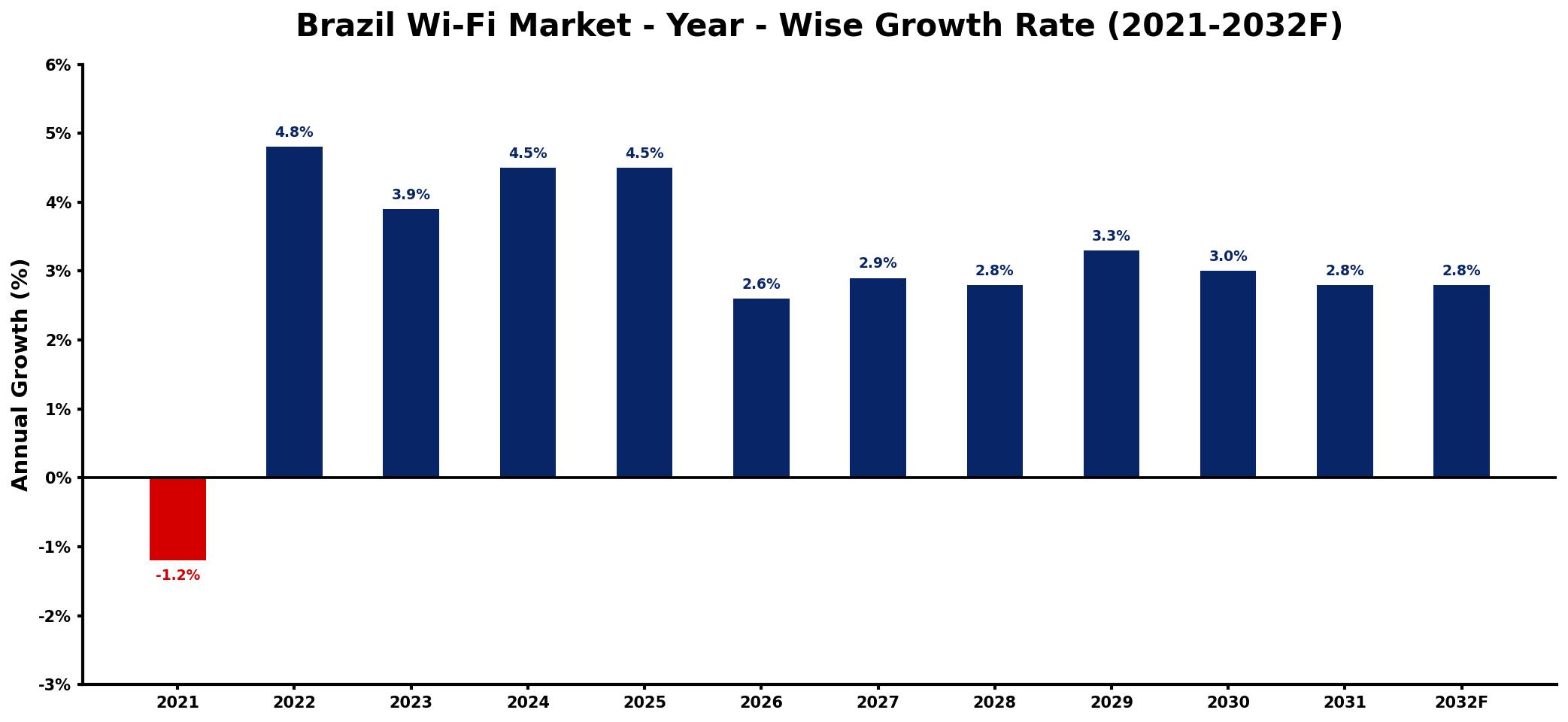
The table below presents the year‑wise growth rates along with the key drivers influencing the market
| Year | Growth Rate | Major Drivers |
| 2021 | -1.2% | decreased investment in infrastructure |
| 2022 | 4.8% | rising demand for connectivity solutions |
| 2023 | 3.9% | expansion of smart home technologies |
| 2024 | 4.5% | increased adoption of IoT devices |
| 2025 | 4.5% | growth in remote work opportunities |
| 2026 | 2.6% | enhanced mobile data consumption trends |
| 2027 | 2.9% | increased government digital initiatives |
| 2028 | 2.8% | surge in online streaming services |
| 2029 | 3.3% | improved processing technologies adoption |
| 2030 | 3.0% | development of urban smart cities |
| 2031 | 2.8% | increased production capacity utilization |
| 2032 | 2.8% | increased integration of cloud services |
Note: Market size estimations and growth projections presented in this report are based on 6Wresearch's proprietary forecasting methodology, utilizing the latest available industry data, government publications, and primary research inputs.
Brazil Wi-Fi Market Synopsis
In Brazil, the Wi-Fi market serves as a vital backbone for both residential and commercial connectivity, facilitating seamless communication across various sectors. The ongoing digital transformation is paving the way for advanced applications, making reliable Wi-Fi not just a luxury but a necessity for everyday life.
Challenges such as spectrum congestion and security vulnerabilities present significant hurdles. However, ongoing investments in infrastructure and an increase in public Wi-Fi initiatives signal a progressive shift towards enhanced connectivity solutions, thereby promising future growth for the market.
Brazil Wi-Fi Market Key Takeaways
- The market is projected to grow steadily at a CAGR of 2.6% between 2026 and 2032.
- The proliferation of smart devices and demand for high-speed internet significantly influence market dynamics.
- Regulatory decisions around spectrum management critically affect the competitive landscape.
- Public Wi-Fi initiatives are becoming increasingly important in enhancing access, particularly in urban areas.
- Security measures are a pressing concern that market participants must continuously address.
Evaluation of Restraints in Brazil Wi-Fi Market
The Brazil Wi-Fi market faces notable constraints that can hinder its growth potential. Spectrum congestion remains a critical issue, as it can lead to reduced performance and reliability of wireless networks. Additionally, security vulnerabilities pose a significant risk to user data and privacy, which can erode consumer confidence. Furthermore, the disparity in infrastructure development between urban and rural areas limits access, challenging efforts to provide equitable and high-quality service nationwide.
Brazil Wi-Fi Market Trends
Currently, the Brazilian Wi-Fi landscape is characterized by several emerging trends. The shift towards Wi-Fi 6 technology represents a notable advancement, offering improved speeds and enhanced performance capabilities. As smart homes and businesses become increasingly prevalent, there is a heightened focus on integrating Wi-Fi with IoT devices. Moreover, public Wi-Fi accessibility is being prioritized by municipal governments, aiming to bridge the digital divide and promote inclusivity across all demographics.
Brazil Wi-Fi Market Opportunities
Investment opportunities abound in the Brazil Wi-Fi market, particularly in expanding public and commercial access points. With an increasing demand for smart solutions, companies that focus on enhancing security and network management are well-positioned for growth. Additionally, partnerships with government bodies to develop nationwide Wi-Fi initiatives can unlock new avenues for revenue while improving connectivity for underserved areas.
Government Initiatives in the Brazil Wi-Fi Market
The Brazilian government is actively implementing policies aimed at enhancing Wi-Fi accessibility. Initiatives to manage spectrum utilization effectively and promote cybersecurity are central to their strategy. Public spending is directed toward expanding Wi-Fi networks in urban and rural areas, aiming to provide equitable access to all citizens. This supportive regulatory framework is crucial for fostering a competitive and innovative Wi-Fi ecosystem.
Future Insights of the Brazil Wi-Fi Market
Looking ahead to 2026-2032, the Brazil Wi-Fi market is poised for sustained growth. As digital connectivity becomes increasingly woven into the fabric of daily life, advancements in technology will likely drive further demand. The market's evolution will be shaped by improved regulatory conditions, investments in robust security frameworks, and the continuous evolution of Wi-Fi standards, paving the way for faster and more reliable connectivity solutions.
Brazil Wi-Fi Market Latest Developments (2025 - 2026)
In recent months, the Brazilian Wi-Fi market has seen significant developments as companies ramp up efforts to comply with evolving regulations. Many are focusing on enhancing security protocols to tackle emerging threats effectively. Simultaneously, collaborations between public and private sectors have led to the establishment of new public Wi-Fi zones, particularly in high-traffic urban areas, enhancing accessibility and user experience.
Brazil Wi-Fi Market - Key Attractiveness of the Report
- 10 Years of Market Numbers
- Historical Data Starting from 2022 to 2025
- Base Year: 2025
- Forecast Data until 2032
- Key Performance Indicators Impacting the Market
- Major Upcoming Developments and Projects
Key Highlights of the Report:
- Brazil Wi-Fi Market Outlook
- Market Size of Brazil Wi-Fi Market, 2025
- Forecast of Brazil Wi-Fi Market, 2032
- Historical Data and Forecast of Brazil Wi-Fi Revenues & Volume for the Period 2022-2032F
- Brazil Wi-Fi Market Trend Evolution
- Brazil Wi-Fi Market Drivers and Challenges
- Brazil Wi-Fi Price Trends
- Brazil Wi-Fi Porter's Five Forces
- Brazil Wi-Fi Industry Life Cycle
- Historical Data and Forecast of Brazil Wi-Fi Market Revenues & Volume By Component for the Period 2022-2032F
- Historical Data and Forecast of Brazil Wi-Fi Market Revenues & Volume By Hardware for the Period 2022-2032F
- Historical Data and Forecast of Brazil Wi-Fi Market Revenues & Volume By Solutions for the Period 2022-2032F
- Historical Data and Forecast of Brazil Wi-Fi Market Revenues & Volume By Services for the Period 2022-2032F
- Historical Data and Forecast of Brazil Wi-Fi Market Revenues & Volume By Density for the Period 2022-2032F
- Historical Data and Forecast of Brazil Wi-Fi Market Revenues & Volume By High-density Wi-Fi for the Period 2022-2032F
- Historical Data and Forecast of Brazil Wi-Fi Market Revenues & Volume By Enterprise-class Wi-Fi for the Period 2022-2032F
- Historical Data and Forecast of Brazil Wi-Fi Market Revenues & Volume By Location Type for the Period 2022-2032F
- Historical Data and Forecast of Brazil Wi-Fi Market Revenues & Volume By Indoor for the Period 2022-2032F
- Historical Data and Forecast of Brazil Wi-Fi Market Revenues & Volume By Outdoor for the Period 2022-2032F
- Historical Data and Forecast of Brazil Wi-Fi Market Revenues & Volume By Organization Size for the Period 2022-2032F
- Historical Data and Forecast of Brazil Wi-Fi Market Revenues & Volume By Large Enterprises for the Period 2022-2032F
- Historical Data and Forecast of Brazil Wi-Fi Market Revenues & Volume By SMEs for the Period 2022-2032F
- Historical Data and Forecast of Brazil Wi-Fi Market Revenues & Volume By Vertical for the Period 2022-2032F
- Historical Data and Forecast of Brazil Wi-Fi Market Revenues & Volume By Education for the Period 2022-2032F
- Historical Data and Forecast of Brazil Wi-Fi Market Revenues & Volume By Healthcare and Life Sciences for the Period 2022-2032F
- Historical Data and Forecast of Brazil Wi-Fi Market Revenues & Volume By Transportation and Logistics for the Period 2022-2032F
- Historical Data and Forecast of Brazil Wi-Fi Market Revenues & Volume By Retail and Ecommerce for the Period 2022-2032F
- Historical Data and Forecast of Brazil Wi-Fi Market Revenues & Volume By Government for the Period 2022-2032F
- Historical Data and Forecast of Brazil Wi-Fi Market Revenues & Volume By Manufacturing for the Period 2022-2032F
- Historical Data and Forecast of Brazil Wi-Fi Market Revenues & Volume By Hospitality for the Period 2022-2032F
- Historical Data and Forecast of Brazil Wi-Fi Market Revenues & Volume By Other Verticals (BFSI, oil and gas, utilities, IT and telecom, and sports and leisure) for the Period 2022-2032F
- Brazil Wi-Fi Import Export Trade Statistics
- Market Opportunity Assessment By Component
- Market Opportunity Assessment By Density
- Market Opportunity Assessment By Location Type
- Market Opportunity Assessment By Organization Size
- Market Opportunity Assessment By Vertical
- Brazil Wi-Fi Top Companies Market Share
- Brazil Wi-Fi Competitive Benchmarking By Technical and Operational Parameters
- Brazil Wi-Fi Company Profiles
- Brazil Wi-Fi Key Strategic Recommendations






































