Brunei Air Traffic Control (Atc) Equipment Market: Top 5 Importing Countries and Market Competition (HHI) Analysis
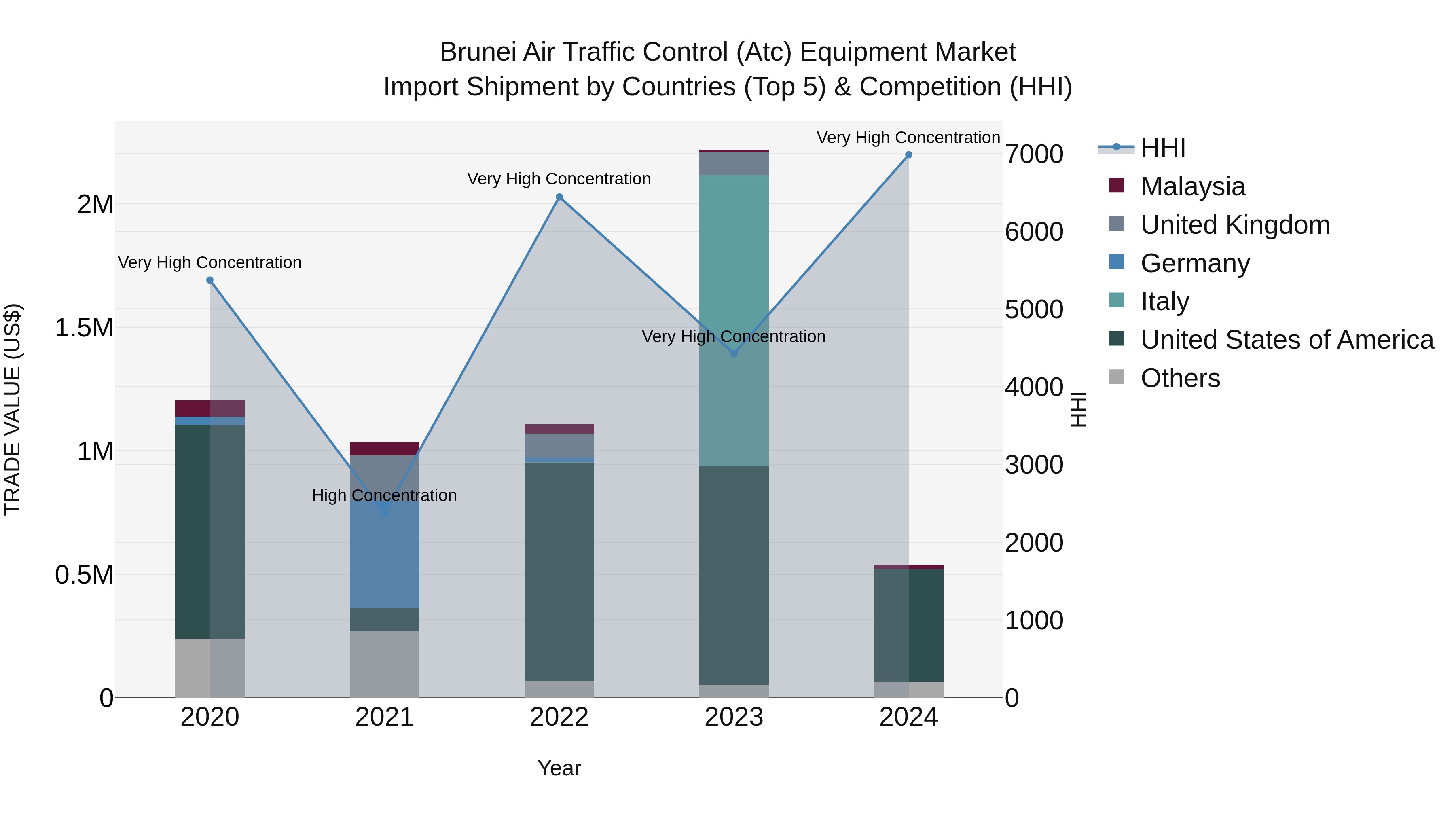
Brunei import shipments of air traffic control equipment in 2024 primarily came from the United States, Malaysia, Japan, Lithuania, and Taiwan. Despite a high concentration in supplier countries, the industry experienced a significant decline with a negative CAGR of -18.23% from 2020 to 2024. The growth rate plummeted even further in 2024, dropping by -75.71% compared to the previous year. This indicates a challenging market environment for ATC equipment imports in Brunei, reflecting potential shifts in technology trends or economic conditions impacting the industry.
Key Highlights of the Report:
- Brunei Air Traffic Control (ATC) Equipment Market Outlook
- Market Size of Brunei Air Traffic Control (ATC) Equipment Market, 2025
- Forecast of Brunei Air Traffic Control (ATC) Equipment Market, 2032
- Historical Data and Forecast of Brunei Air Traffic Control (ATC) Equipment Revenues & Volume for the Period 2022 - 2032F
- Brunei Air Traffic Control (ATC) Equipment Market Trend Evolution
- Brunei Air Traffic Control (ATC) Equipment Market Drivers and Challenges
- Brunei Air Traffic Control (ATC) Equipment Price Trends
- Brunei Air Traffic Control (ATC) Equipment Porter`s Five Forces
- Brunei Air Traffic Control (ATC) Equipment Industry Life Cycle
- Historical Data and Forecast of Brunei Air Traffic Control (ATC) Equipment Market Revenues & Volume By Product for the Period 2022 - 2032F
- Historical Data and Forecast of Brunei Air Traffic Control (ATC) Equipment Market Revenues & Volume By Communications Equipment for the Period 2022 - 2032F
- Historical Data and Forecast of Brunei Air Traffic Control (ATC) Equipment Market Revenues & Volume By Navigation Equipment for the Period 2022 - 2032F
- Historical Data and Forecast of Brunei Air Traffic Control (ATC) Equipment Market Revenues & Volume By Surveillance Equipment for the Period 2022 - 2032F
- Historical Data and Forecast of Brunei Air Traffic Control (ATC) Equipment Market Revenues & Volume By Air Traffic Control Equipment Application Outlook (USD Million, 2022 - 2032) for the Period 2022 - 2032F
- Historical Data and Forecast of Brunei Air Traffic Control (ATC) Equipment Market Revenues & Volume By Commercial Aircraft for the Period 2022 - 2032F
- Historical Data and Forecast of Brunei Air Traffic Control (ATC) Equipment Market Revenues & Volume By Private Aircraft for the Period 2022 - 2032F
- Historical Data and Forecast of Brunei Air Traffic Control (ATC) Equipment Market Revenues & Volume By Military Aircraft for the Period 2022 - 2032F
- Brunei Air Traffic Control (ATC) Equipment Import Export Trade Statistics
- Market Opportunity Assessment By Product
- Brunei Air Traffic Control (ATC) Equipment Top Companies Market Share
- Brunei Air Traffic Control (ATC) Equipment Competitive Benchmarking By Technical and Operational Parameters
- Brunei Air Traffic Control (ATC) Equipment Company Profiles
- Brunei Air Traffic Control (ATC) Equipment Key Strategic Recommendations






































