Brunei Control Valve Market: Top 5 Importing Countries and Market Competition (HHI) Analysis
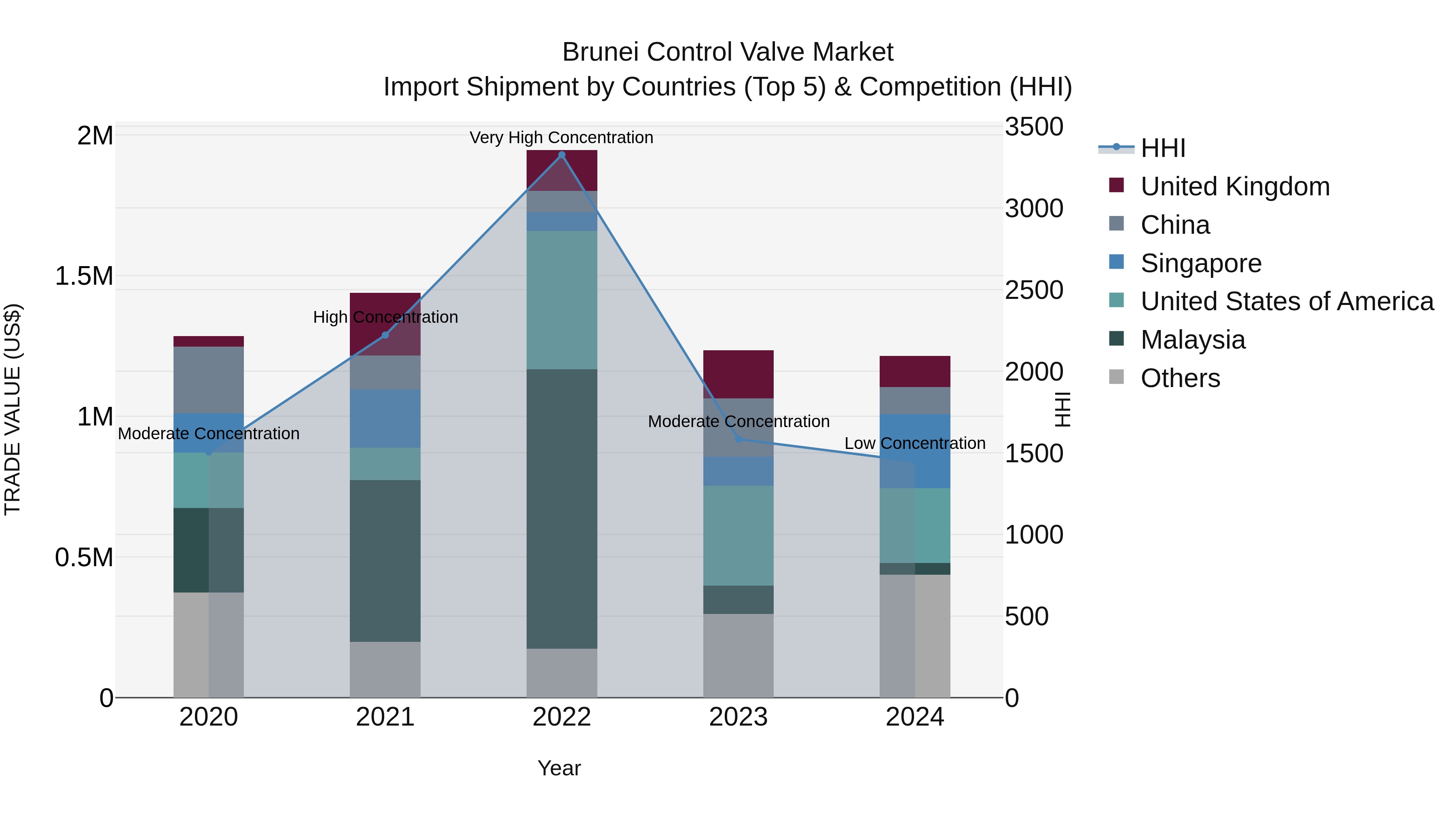
Brunei control valve import market saw a shift in concentration levels from moderate to low in 2024, indicating a more diverse range of suppliers. Despite a negative compound annual growth rate of -1.4% during 2020-2024, the market experienced a slight improvement with a growth rate of -1.63% in 2024 compared to 2023. The top countries exporting control valves to Brunei in 2024 were the United States of America, Singapore, France, Italy, and the United Kingdom, highlighting a mix of both Western and Asian suppliers contributing to the market.
Brunei Control Valve Market Overview
The Control Valve Market in Brunei caters to the demand for precise control of fluid flow in various industrial applications. Control valves are essential for regulating process variables such as pressure, temperature, and flow rate. The market`s growth is driven by infrastructure development and industrial expansion in Brunei.
Drivers of the market
The Brunei control valve market is driven by the increasing demand for efficient fluid control solutions in industrial processes. Control valves play a crucial role in regulating flow and pressure in various applications, including oil and gas, water treatment, and manufacturing. The growth of Bruneis industrial sector and infrastructure development projects is fueling investments in control valve technologies.
Challenges of the market
In Brunei, the control valve market faces challenges such as the high cost of advanced control valve technologies and the need for skilled technicians to install and maintain these systems. There are also issues related to the availability of replacement parts and the need for regular maintenance to ensure optimal performance.
Government Policy of the market
Bruneis policies on industrial development and infrastructure support the control valve market. The government encourages the use of advanced control systems in key sectors such as oil and gas, manufacturing, and utilities. Regulations ensure that control valves meet safety and performance standards, promoting efficient and reliable operations in industrial processes.
Key Highlights of the Report:
- Brunei Control Valve Market Outlook
- Market Size of Brunei Control Valve Market, 2024
- Forecast of Brunei Control Valve Market, 2031
- Historical Data and Forecast of Brunei Control Valve Revenues & Volume for the Period 2021-2031
- Brunei Control Valve Market Trend Evolution
- Brunei Control Valve Market Drivers and Challenges
- Brunei Control Valve Price Trends
- Brunei Control Valve Porter`s Five Forces
- Brunei Control Valve Industry Life Cycle
- Historical Data and Forecast of Brunei Control Valve Market Revenues & Volume By Component for the Period 2021-2031
- Historical Data and Forecast of Brunei Control Valve Market Revenues & Volume By Actuators for the Period 2021-2031
- Historical Data and Forecast of Brunei Control Valve Market Revenues & Volume By Valve Body for the Period 2021-2031
- Historical Data and Forecast of Brunei Control Valve Market Revenues & Volume By Type for the Period 2021-2031
- Historical Data and Forecast of Brunei Control Valve Market Revenues & Volume By Rotary for the Period 2021-2031
- Historical Data and Forecast of Brunei Control Valve Market Revenues & Volume By Linear for the Period 2021-2031
- Historical Data and Forecast of Brunei Control Valve Market Revenues & Volume By Industry for the Period 2021-2031
- Historical Data and Forecast of Brunei Control Valve Market Revenues & Volume By Oil & Gas for the Period 2021-2031
- Historical Data and Forecast of Brunei Control Valve Market Revenues & Volume By Water & Wastewater Treatment for the Period 2021-2031
- Historical Data and Forecast of Brunei Control Valve Market Revenues & Volume By Energy & Power for the Period 2021-2031
- Historical Data and Forecast of Brunei Control Valve Market Revenues & Volume By Chemicals for the Period 2021-2031
- Brunei Control Valve Import Export Trade Statistics
- Market Opportunity Assessment By Component
- Market Opportunity Assessment By Type
- Market Opportunity Assessment By Industry
- Brunei Control Valve Top Companies Market Share
- Brunei Control Valve Competitive Benchmarking By Technical and Operational Parameters
- Brunei Control Valve Company Profiles
- Brunei Control Valve Key Strategic Recommendations






































