Brunei Diesel Exhaust Fluid Market: Top 5 Importing Countries and Market Competition (HHI) Analysis
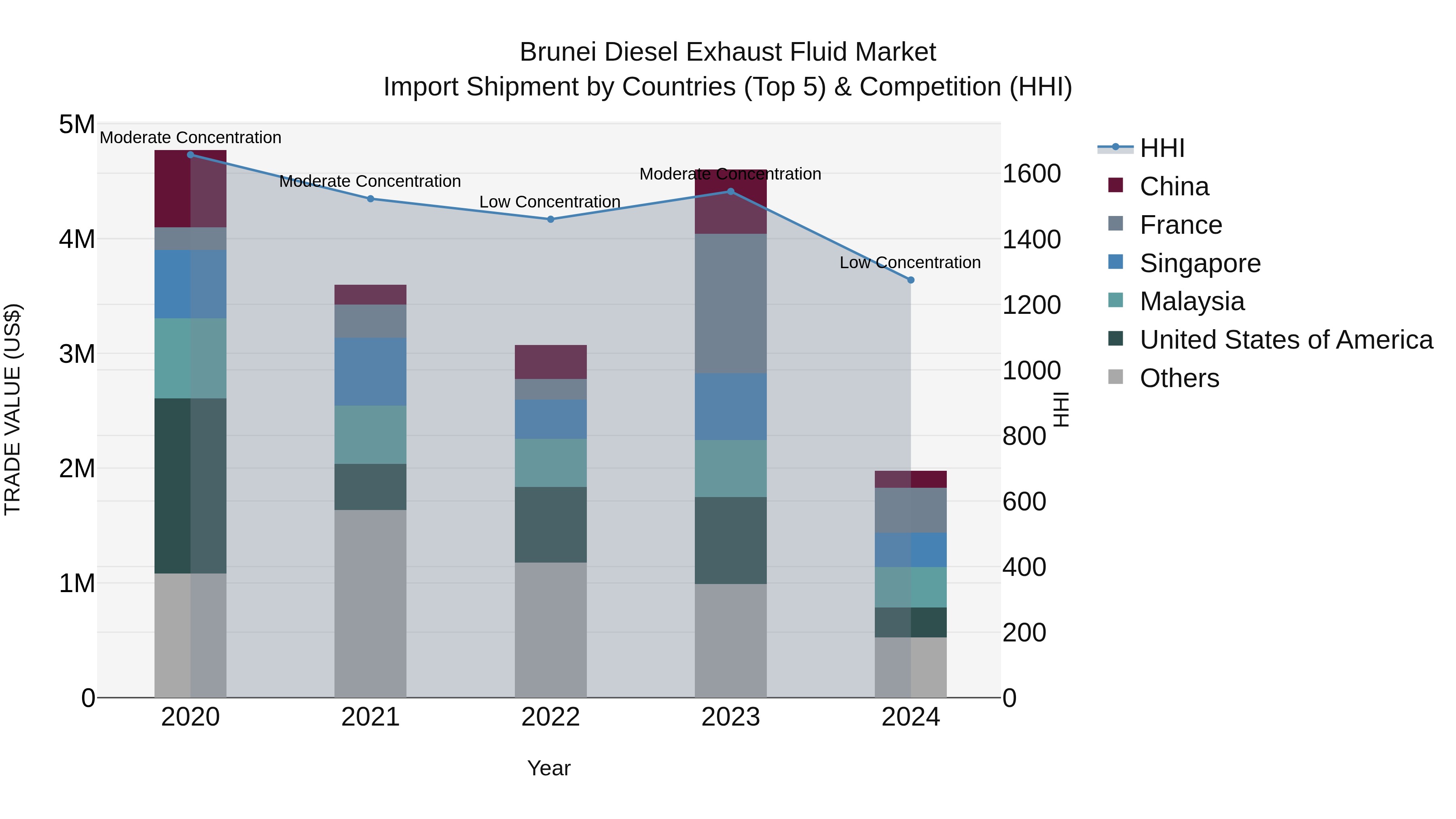
In 2024, Brunei diesel exhaust fluid import market saw a shift in supplier concentration from moderate to low, with key exporters being France, Malaysia, Singapore, the USA, and China. The negative CAGR of -19.75% from 2020 to 2024 indicates a declining trend, with a steep growth rate decline of -57.01% from 2023 to 2024. This suggests a challenging market environment, possibly influenced by factors such as changing regulations or shifts in demand. Monitoring these trends closely will be crucial for stakeholders to adapt and strategize effectively in the evolving Brunei diesel exhaust fluid import market.
Brunei Diesel Exhaust Fluid Market Overview
In Brunei, the Diesel Exhaust Fluid (DEF) market is expanding as environmental regulations and emissions standards become stricter. This market is driven by the need for DEF to reduce nitrogen oxide emissions from diesel engines, improving air quality and meeting regulatory requirements. DEF in Brunei is essential for vehicles and equipment equipped with selective catalytic reduction (SCR) technology, where it helps to minimize the environmental impact of diesel engines.
Drivers of the market
The diesel exhaust fluid (DEF) market in Brunei is growing as diesel vehicle operators increasingly adopt DEF to reduce harmful emissions and comply with environmental regulations. DEF, a urea-based solution, is injected into the exhaust stream of diesel engines to convert harmful nitrogen oxides (NOx) into harmless nitrogen and water vapor. The market is driven by the rising awareness of environmental sustainability, the increasing number of diesel vehicles on the road, and the stringent emissions standards that require the use of DEF in modern diesel engines.
Challenges of the market
The Diesel Exhaust Fluid Market in Brunei faces challenges related to the small size of the diesel vehicle market and the limited awareness of the benefits of using exhaust fluid. Additionally, the market is heavily dependent on regulatory requirements, which can fluctuate and impact demand.
Government Policy of the market
Brunei`s government has introduced policies that support the use of diesel exhaust fluid (DEF) to reduce emissions from diesel engines, particularly in the transportation sector. These policies include regulations that mandate the use of DEF in vehicles with selective catalytic reduction (SCR) systems, ensuring compliance with emission standards. The government also promotes the availability of DEF at fueling stations across the country, making it easier for vehicle owners to comply with these regulations.
Key Highlights of the Report:
- Brunei Diesel Exhaust Fluid Market Outlook
- Market Size of Brunei Diesel Exhaust Fluid Market, 2024
- Forecast of Brunei Diesel Exhaust Fluid Market, 2031
- Historical Data and Forecast of Brunei Diesel Exhaust Fluid Revenues & Volume for the Period 2021-2031
- Brunei Diesel Exhaust Fluid Market Trend Evolution
- Brunei Diesel Exhaust Fluid Market Drivers and Challenges
- Brunei Diesel Exhaust Fluid Price Trends
- Brunei Diesel Exhaust Fluid Porter`s Five Forces
- Brunei Diesel Exhaust Fluid Industry Life Cycle
- Historical Data and Forecast of Brunei Diesel Exhaust Fluid Market Revenues & Volume By Component for the Period 2021-2031
- Historical Data and Forecast of Brunei Diesel Exhaust Fluid Market Revenues & Volume By SCR Catalysts for the Period 2021-2031
- Historical Data and Forecast of Brunei Diesel Exhaust Fluid Market Revenues & Volume By DEF Tanks for the Period 2021-2031
- Historical Data and Forecast of Brunei Diesel Exhaust Fluid Market Revenues & Volume By Injectors for the Period 2021-2031
- Historical Data and Forecast of Brunei Diesel Exhaust Fluid Market Revenues & Volume By Supply Modules for the Period 2021-2031
- Historical Data and Forecast of Brunei Diesel Exhaust Fluid Market Revenues & Volume By Sensors for the Period 2021-2031
- Historical Data and Forecast of Brunei Diesel Exhaust Fluid Market Revenues & Volume By Supply Mode for the Period 2021-2031
- Historical Data and Forecast of Brunei Diesel Exhaust Fluid Market Revenues & Volume By Cans for the Period 2021-2031
- Historical Data and Forecast of Brunei Diesel Exhaust Fluid Market Revenues & Volume By IBCs for the Period 2021-2031
- Historical Data and Forecast of Brunei Diesel Exhaust Fluid Market Revenues & Volume By Bulk & Pumps for the Period 2021-2031
- Brunei Diesel Exhaust Fluid Import Export Trade Statistics
- Market Opportunity Assessment By Component
- Market Opportunity Assessment By Supply Mode
- Brunei Diesel Exhaust Fluid Top Companies Market Share
- Brunei Diesel Exhaust Fluid Competitive Benchmarking By Technical and Operational Parameters
- Brunei Diesel Exhaust Fluid Company Profiles
- Brunei Diesel Exhaust Fluid Key Strategic Recommendations






































