Brunei Edible Oils Market: Top 5 Importing Countries and Market Competition (HHI) Analysis
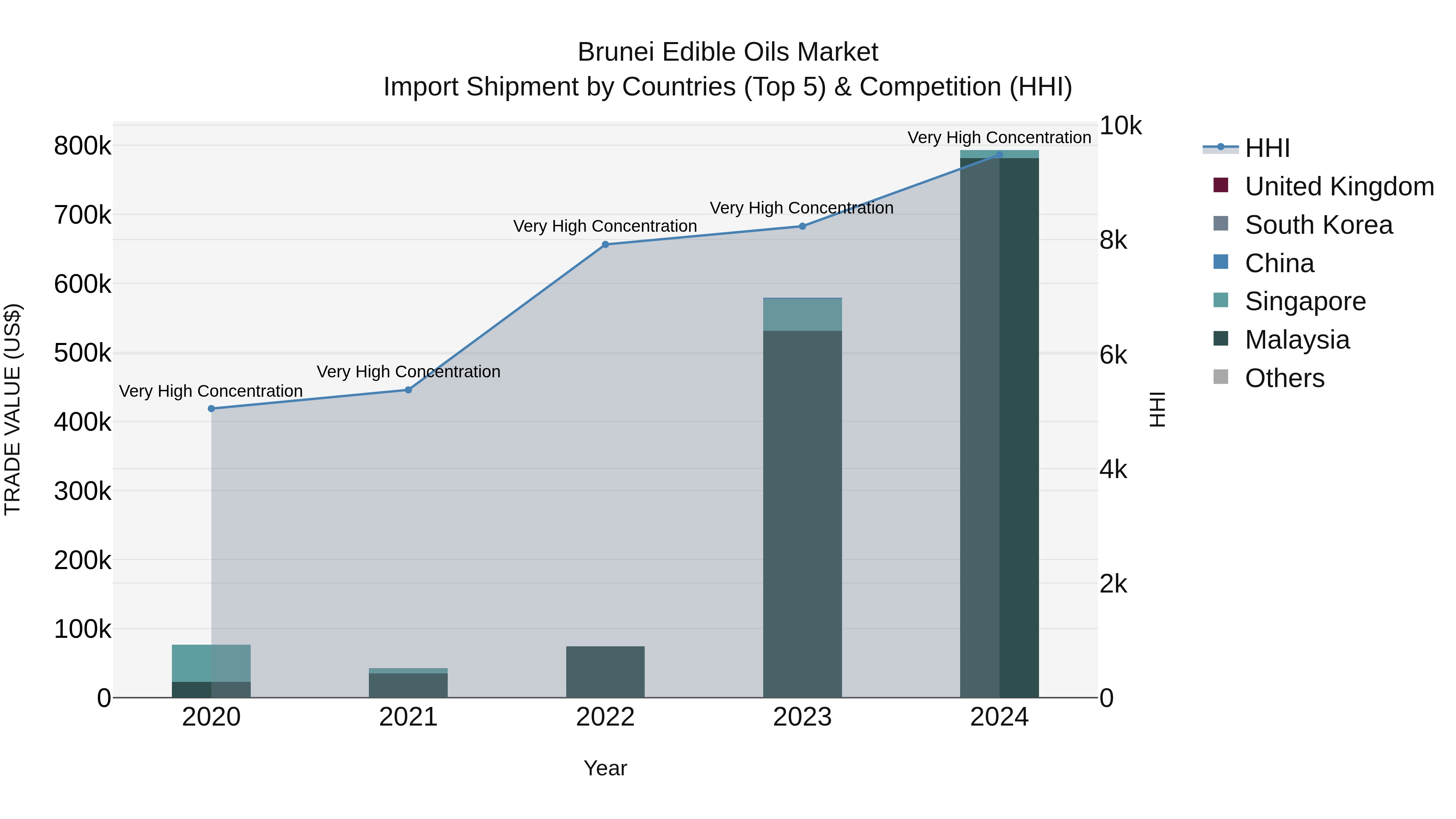
Brunei edible oils import market in 2024 continued to be dominated by key exporters such as Malaysia, Singapore, China, South Korea, and the United Kingdom. The high Herfindahl-Hirschman Index (HHI) indicates a concentrated market. With a remarkable compound annual growth rate (CAGR) of 79.44% from 2020 to 2024 and a significant growth rate of 36.84% from 2023 to 2024, the edible oils sector in Brunei shows strong potential for further expansion and development in the coming years.
Key Highlights of the Report:
- Brunei Edible Oils Market Outlook
- Market Size of Brunei Edible Oils Market, 2025
- Forecast of Brunei Edible Oils Market, 2032
- Historical Data and Forecast of Brunei Edible Oils Revenues & Volume for the Period 2022 - 2032F
- Brunei Edible Oils Market Trend Evolution
- Brunei Edible Oils Market Drivers and Challenges
- Brunei Edible Oils Price Trends
- Brunei Edible Oils Porter`s Five Forces
- Brunei Edible Oils Industry Life Cycle
- Historical Data and Forecast of Brunei Edible Oils Market Revenues & Volume By Type for the Period 2022 - 2032F
- Historical Data and Forecast of Brunei Edible Oils Market Revenues & Volume By Palm Oil for the Period 2022 - 2032F
- Historical Data and Forecast of Brunei Edible Oils Market Revenues & Volume By Soybean Oil for the Period 2022 - 2032F
- Historical Data and Forecast of Brunei Edible Oils Market Revenues & Volume By Sunflower Oil for the Period 2022 - 2032F
- Historical Data and Forecast of Brunei Edible Oils Market Revenues & Volume By Rapeseed Oil for the Period 2022 - 2032F
- Historical Data and Forecast of Brunei Edible Oils Market Revenues & Volume By Olive Oil for the Period 2022 - 2032F
- Historical Data and Forecast of Brunei Edible Oils Market Revenues & Volume By Packaging Type for the Period 2022 - 2032F
- Historical Data and Forecast of Brunei Edible Oils Market Revenues & Volume By Pouches for the Period 2022 - 2032F
- Historical Data and Forecast of Brunei Edible Oils Market Revenues & Volume By Jars for the Period 2022 - 2032F
- Historical Data and Forecast of Brunei Edible Oils Market Revenues & Volume By Cans for the Period 2022 - 2032F
- Historical Data and Forecast of Brunei Edible Oils Market Revenues & Volume By Bottles for the Period 2022 - 2032F
- Historical Data and Forecast of Brunei Edible Oils Market Revenues & Volume By End Use for the Period 2022 - 2032F
- Historical Data and Forecast of Brunei Edible Oils Market Revenues & Volume By Domestic for the Period 2022 - 2032F
- Historical Data and Forecast of Brunei Edible Oils Market Revenues & Volume By Food Service for the Period 2022 - 2032F
- Historical Data and Forecast of Brunei Edible Oils Market Revenues & Volume By Industrial for the Period 2022 - 2032F
- Brunei Edible Oils Import Export Trade Statistics
- Market Opportunity Assessment By Type
- Market Opportunity Assessment By Packaging Type
- Market Opportunity Assessment By End Use
- Brunei Edible Oils Top Companies Market Share
- Brunei Edible Oils Competitive Benchmarking By Technical and Operational Parameters
- Brunei Edible Oils Company Profiles
- Brunei Edible Oils Key Strategic Recommendations






































