Brunei Foam Insulation Market: Top 5 Importing Countries and Market Competition (HHI) Analysis
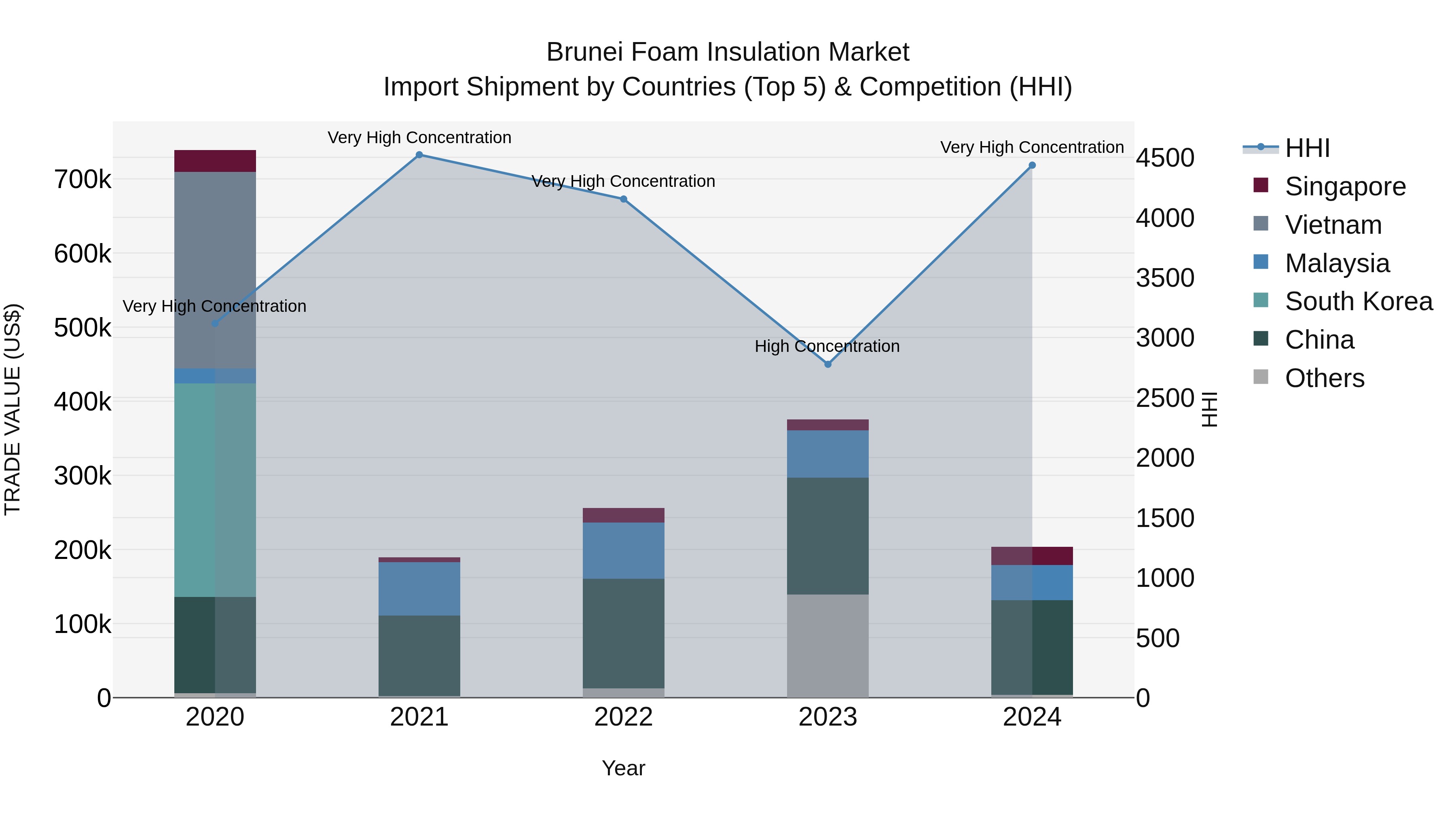
The foam insulation import market in Brunei saw a continued trend of high concentration, with a notable increase in 2024. The top countries exporting to Brunei included China, Malaysia, Singapore, India, and the United Kingdom. However, the market experienced a significant decline in both the compound annual growth rate (CAGR) from 2020 to 2024 at -27.56% and the growth rate from 2023 to 2024 at -45.78%. This indicates a challenging environment for foam insulation imports in Brunei, highlighting the need for strategic planning and adaptation for industry players.
Brunei Foam Insulation Market Overview
The foam insulation market in Brunei is expanding due to the need for effective thermal insulation solutions in construction, refrigeration, and industrial applications. Foam insulation materials provide high thermal resistance and energy efficiency. Market growth is supported by increasing construction activities, advancements in insulation technologies, and the demand for energy-efficient building solutions.
Drivers of the market
The foam insulation market in Brunei is growing as the demand for energy-efficient and effective thermal insulation solutions increases. Foam insulation materials, including polyurethane and polystyrene foams, are used in building construction, HVAC systems, and industrial applications to reduce heat transfer and improve energy efficiency. The market is driven by the rising emphasis on energy conservation, the growth of the construction industry, and advancements in foam insulation technologies that offer improved performance and environmental benefits.
Challenges of the market
The Foam Insulation Market in Brunei is constrained by the limited size of the construction industry, which is the primary consumer of foam insulation materials. The market also faces challenges related to the high cost of advanced insulation technology and the slow adoption of energy-efficient building practices.
Government Policy of the market
Government policy in Brunei affects the foam insulation market through its emphasis on energy efficiency and sustainable building practices. The government promotes the use of high-performance foam insulation materials to improve energy conservation in buildings. Regulations ensure that foam insulation products meet specific standards for performance and environmental impact. By supporting the development and use of advanced insulation technologies, the government aims to enhance building energy efficiency and contribute to market growth.
Key Highlights of the Report:
- Brunei Foam Insulation Market Outlook
- Market Size of Brunei Foam Insulation Market, 2024
- Forecast of Brunei Foam Insulation Market, 2031
- Historical Data and Forecast of Brunei Foam Insulation Revenues & Volume for the Period 2021-2031
- Brunei Foam Insulation Market Trend Evolution
- Brunei Foam Insulation Market Drivers and Challenges
- Brunei Foam Insulation Price Trends
- Brunei Foam Insulation Porter`s Five Forces
- Brunei Foam Insulation Industry Life Cycle
- Historical Data and Forecast of Brunei Foam Insulation Market Revenues & Volume By Product Type for the Period 2021-2031
- Historical Data and Forecast of Brunei Foam Insulation Market Revenues & Volume By Polystyrene for the Period 2021-2031
- Historical Data and Forecast of Brunei Foam Insulation Market Revenues & Volume By Polyurethane & Polyisocyanurate for the Period 2021-2031
- Historical Data and Forecast of Brunei Foam Insulation Market Revenues & Volume By Polyolefin for the Period 2021-2031
- Historical Data and Forecast of Brunei Foam Insulation Market Revenues & Volume By Elastomeric for the Period 2021-2031
- Historical Data and Forecast of Brunei Foam Insulation Market Revenues & Volume By Phenolic for the Period 2021-2031
- Historical Data and Forecast of Brunei Foam Insulation Market Revenues & Volume By End Use Industry for the Period 2021-2031
- Historical Data and Forecast of Brunei Foam Insulation Market Revenues & Volume By Building & Construction for the Period 2021-2031
- Historical Data and Forecast of Brunei Foam Insulation Market Revenues & Volume By Transportation for the Period 2021-2031
- Historical Data and Forecast of Brunei Foam Insulation Market Revenues & Volume By Consumer Appliances for the Period 2021-2031
- Brunei Foam Insulation Import Export Trade Statistics
- Market Opportunity Assessment By Product Type
- Market Opportunity Assessment By End Use Industry
- Brunei Foam Insulation Top Companies Market Share
- Brunei Foam Insulation Competitive Benchmarking By Technical and Operational Parameters
- Brunei Foam Insulation Company Profiles
- Brunei Foam Insulation Key Strategic Recommendations






































