Brunei Darussalam Glass Curtain Wall Market Size Growth Rate
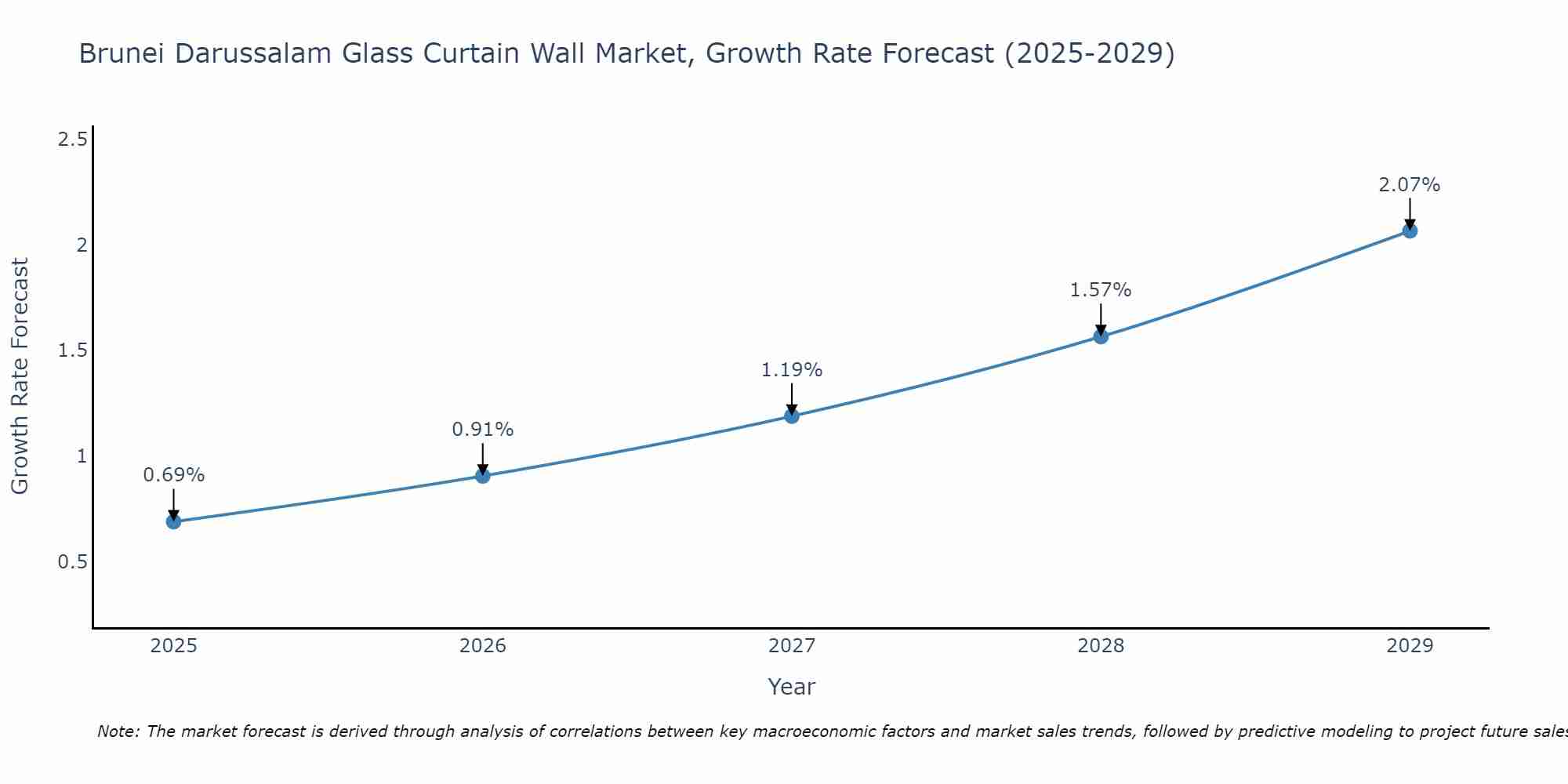
The Brunei Darussalam Glass Curtain Wall Market is likely to experience consistent growth rate gains over the period 2025 to 2029. Commencing at 0.69% in 2025, growth builds up to 2.07% by 2029.
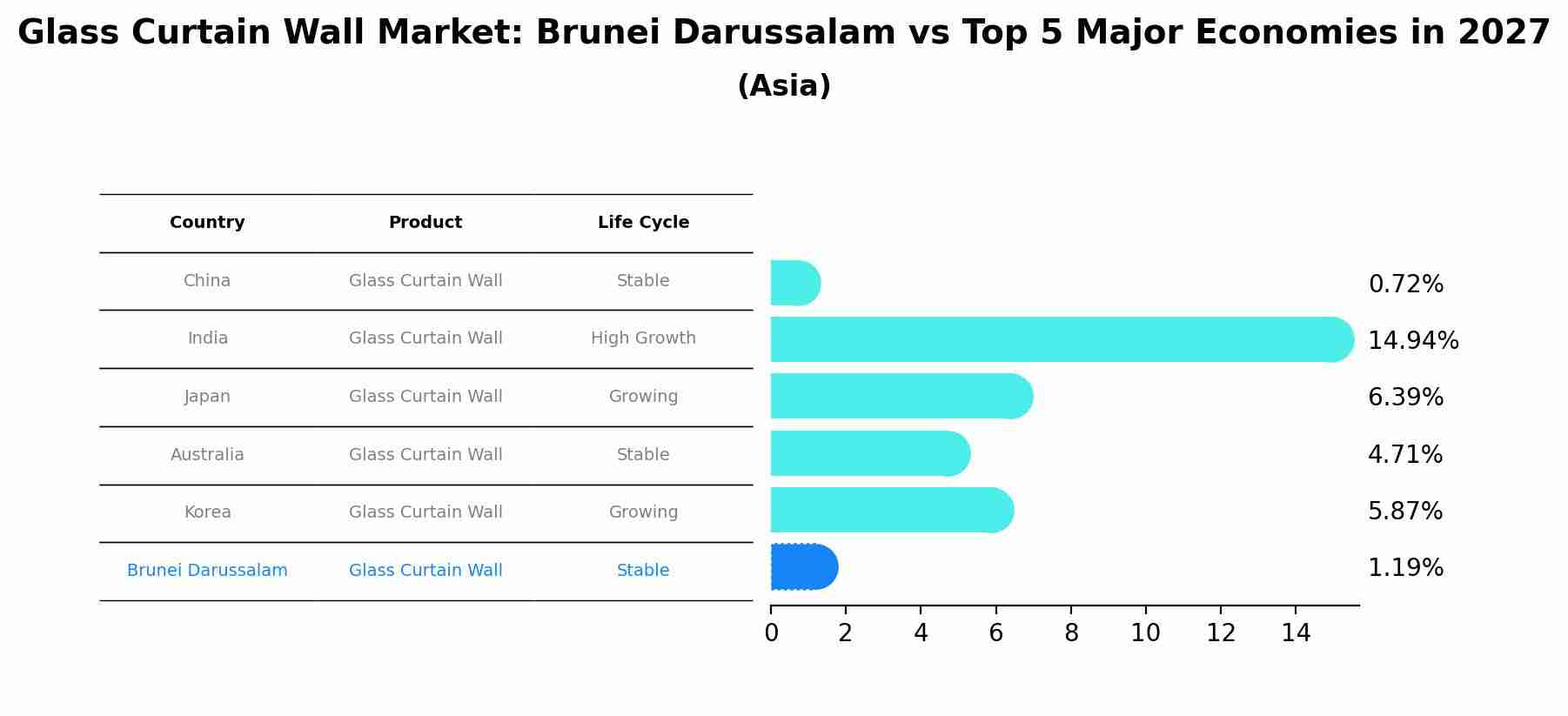
Glass Curtain Wall Market: Brunei Darussalam vs Top 5 Major Economies in 2027 (Asia)
By 2027, the Glass Curtain Wall market in Brunei Darussalam is anticipated to reach a growth rate of 1.19%, as part of an increasingly competitive Asia region, where China remains at the forefront, supported by India, Japan, Australia and South Korea, driving innovations and market adoption across sectors.
Brunei Glass Curtain Wall Market Overview
The glass curtain wall market in Brunei is witnessing growth due to the rise in modern architectural designs and the need for energy-efficient building solutions. Glass curtain walls, which are used as exterior building facades, offer aesthetic appeal and natural light while providing insulation and weather resistance. The market is supported by ongoing construction and renovation projects that prioritize sustainability and contemporary design.
Drivers of the market
The glass curtain wall market in Brunei is experiencing growth due to the increasing adoption of modern architectural designs and the demand for energy-efficient building facades. Glass curtain walls offer aesthetic appeal, natural light, and insulation benefits, making them popular in commercial and residential buildings. The market is driven by the rising focus on sustainable building practices, advancements in glass technology, and the growing trend towards sleek and contemporary building designs.
Challenges of the market
The Glass Curtain Wall Market in Brunei is challenged by the small size of the construction and architectural sectors, which limits the demand for curtain wall systems. High costs associated with the production and installation of glass curtain walls further restrict market growth. Additionally, the market faces competition from alternative facade systems and the limited number of large-scale construction projects in Brunei. The lack of local expertise in curtain wall technology also hampers market development.
Government Policy of the market
In the glass curtain wall market, Bruneis government influences industry practices through building codes and regulations on construction materials. The government enforces standards for the safety, energy efficiency, and durability of glass curtain walls used in commercial and residential buildings. Policies support the use of innovative glazing technologies that enhance building performance and sustainability. By promoting high standards and advanced technologies, the government aims to support the growth of the glass curtain wall market while ensuring the safety and efficiency of building structures.
Key Highlights of the Report:
- Brunei Glass Curtain Wall Market Outlook
- Market Size of Brunei Glass Curtain Wall Market, 2024
- Forecast of Brunei Glass Curtain Wall Market, 2031
- Historical Data and Forecast of Brunei Glass Curtain Wall Revenues & Volume for the Period 2021-2031
- Brunei Glass Curtain Wall Market Trend Evolution
- Brunei Glass Curtain Wall Market Drivers and Challenges
- Brunei Glass Curtain Wall Price Trends
- Brunei Glass Curtain Wall Porter`s Five Forces
- Brunei Glass Curtain Wall Industry Life Cycle
- Historical Data and Forecast of Brunei Glass Curtain Wall Market Revenues & Volume By Types for the Period 2021-2031
- Historical Data and Forecast of Brunei Glass Curtain Wall Market Revenues & Volume By Unitized for the Period 2021-2031
- Historical Data and Forecast of Brunei Glass Curtain Wall Market Revenues & Volume By Stick for the Period 2021-2031
- Historical Data and Forecast of Brunei Glass Curtain Wall Market Revenues & Volume By Glazing Applications for the Period 2021-2031
- Historical Data and Forecast of Brunei Glass Curtain Wall Market Revenues & Volume By Interior for the Period 2021-2031
- Historical Data and Forecast of Brunei Glass Curtain Wall Market Revenues & Volume By Exterior for the Period 2021-2031
- Historical Data and Forecast of Brunei Glass Curtain Wall Market Revenues & Volume By Application for the Period 2021-2031
- Historical Data and Forecast of Brunei Glass Curtain Wall Market Revenues & Volume By Highway and Roadway for the Period 2021-2031
- Historical Data and Forecast of Brunei Glass Curtain Wall Market Revenues & Volume By Industrial for the Period 2021-2031
- Historical Data and Forecast of Brunei Glass Curtain Wall Market Revenues & Volume By Airport Perimeters for the Period 2021-2031
- Historical Data and Forecast of Brunei Glass Curtain Wall Market Revenues & Volume By Parking Lots for the Period 2021-2031
- Historical Data and Forecast of Brunei Glass Curtain Wall Market Revenues & Volume By Sports Stadiums for the Period 2021-2031
- Historical Data and Forecast of Brunei Glass Curtain Wall Market Revenues & Volume By Others for the Period 2021-2031
- Brunei Glass Curtain Wall Import Export Trade Statistics
- Market Opportunity Assessment By Types
- Market Opportunity Assessment By Glazing Applications
- Market Opportunity Assessment By Application
- Brunei Glass Curtain Wall Top Companies Market Share
- Brunei Glass Curtain Wall Competitive Benchmarking By Technical and Operational Parameters
- Brunei Glass Curtain Wall Company Profiles
- Brunei Glass Curtain Wall Key Strategic Recommendations






































