Brunei Integrated Food Ingredients Market: Top 5 Importing Countries and Market Competition (HHI) Analysis
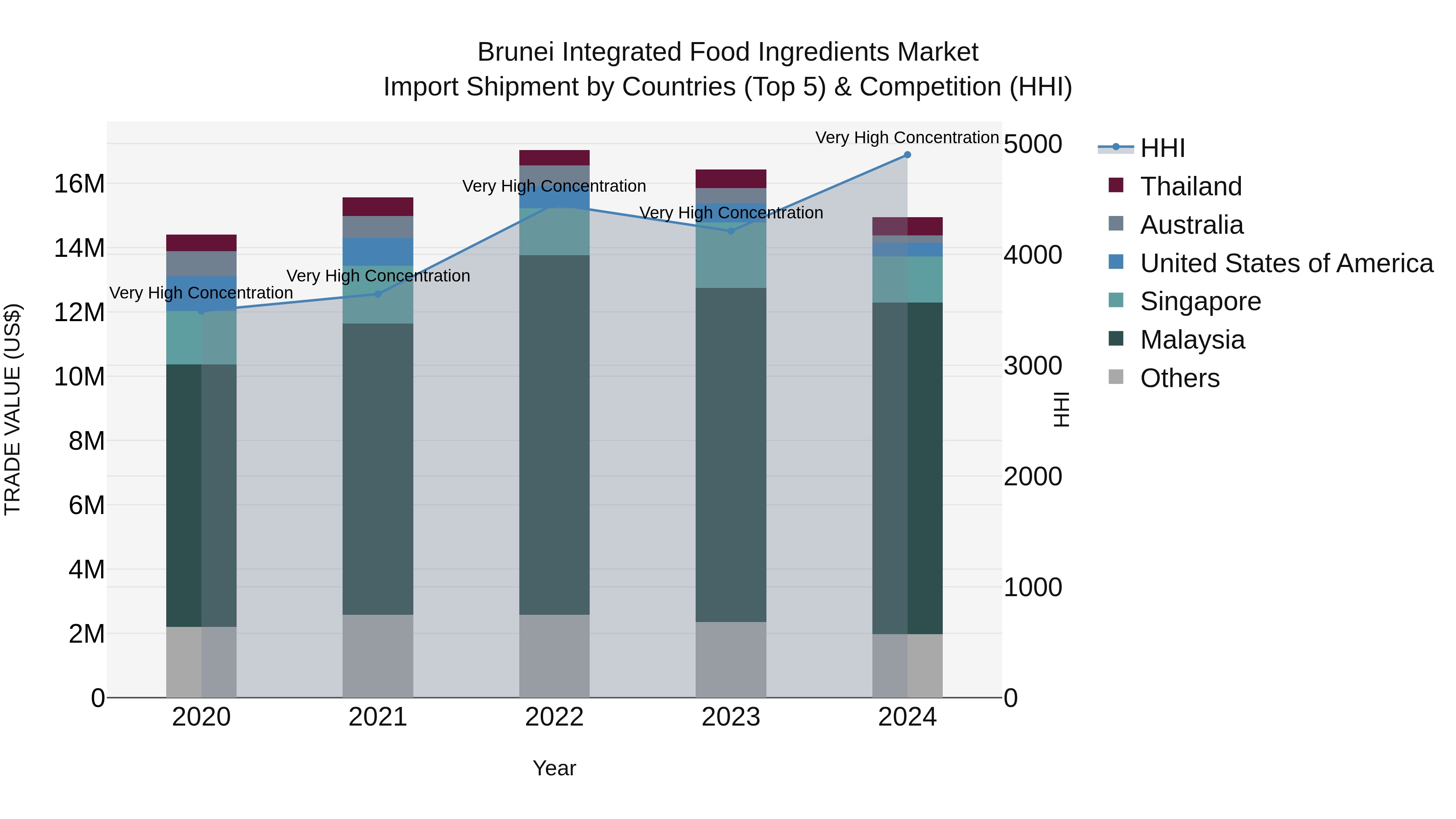
Brunei integrated food ingredients import market in 2024 continues to be dominated by Malaysia, Singapore, Thailand, Taiwan, and the United States of America. The Herfindahl-Hirschman Index (HHI) indicates a very high concentration within the market. Despite a modest compound annual growth rate (CAGR) of 0.91% from 2020 to 2024, there was a noticeable decline in growth from 2023 to 2024 at -9.06%. This data suggests a challenging landscape for importers in the food ingredients sector, potentially impacted by various factors influencing the market dynamics.
Key Highlights of the Report:
- Brunei Integrated Food Ingredients Market Outlook
- Market Size of Brunei Integrated Food Ingredients Market, 2025
- Forecast of Brunei Integrated Food Ingredients Market, 2032
- Historical Data and Forecast of Brunei Integrated Food Ingredients Revenues & Volume for the Period 2022 - 2032F
- Brunei Integrated Food Ingredients Market Trend Evolution
- Brunei Integrated Food Ingredients Market Drivers and Challenges
- Brunei Integrated Food Ingredients Price Trends
- Brunei Integrated Food Ingredients Porter`s Five Forces
- Brunei Integrated Food Ingredients Industry Life Cycle
- Historical Data and Forecast of Brunei Integrated Food Ingredients Market Revenues & Volume By Function for the Period 2022 - 2032F
- Historical Data and Forecast of Brunei Integrated Food Ingredients Market Revenues & Volume By Taste Enhancers for the Period 2022 - 2032F
- Historical Data and Forecast of Brunei Integrated Food Ingredients Market Revenues & Volume By Form for the Period 2022 - 2032F
- Historical Data and Forecast of Brunei Integrated Food Ingredients Market Revenues & Volume By Texture for the Period 2022 - 2032F
- Historical Data and Forecast of Brunei Integrated Food Ingredients Market Revenues & Volume By Preservation for the Period 2022 - 2032F
- Historical Data and Forecast of Brunei Integrated Food Ingredients Market Revenues & Volume By Coloring for the Period 2022 - 2032F
- Historical Data and Forecast of Brunei Integrated Food Ingredients Market Revenues & Volume By Integrated Solutions for the Period 2022 - 2032F
- Historical Data and Forecast of Brunei Integrated Food Ingredients Market Revenues & Volume By Dairy for the Period 2022 - 2032F
- Historical Data and Forecast of Brunei Integrated Food Ingredients Market Revenues & Volume By Beverage for the Period 2022 - 2032F
- Historical Data and Forecast of Brunei Integrated Food Ingredients Market Revenues & Volume By Bakery & confectionary for the Period 2022 - 2032F
- Historical Data and Forecast of Brunei Integrated Food Ingredients Market Revenues & Volume By Snacks & Savory for the Period 2022 - 2032F
- Historical Data and Forecast of Brunei Integrated Food Ingredients Market Revenues & Volume By Meat & Meat Products for the Period 2022 - 2032F
- Brunei Integrated Food Ingredients Import Export Trade Statistics
- Market Opportunity Assessment By Function
- Market Opportunity Assessment By Integrated Solutions
- Brunei Integrated Food Ingredients Top Companies Market Share
- Brunei Integrated Food Ingredients Competitive Benchmarking By Technical and Operational Parameters
- Brunei Integrated Food Ingredients Company Profiles
- Brunei Integrated Food Ingredients Key Strategic Recommendations






































