Brunei Medical Textile Market: Top 5 Importing Countries and Market Competition (HHI) Analysis
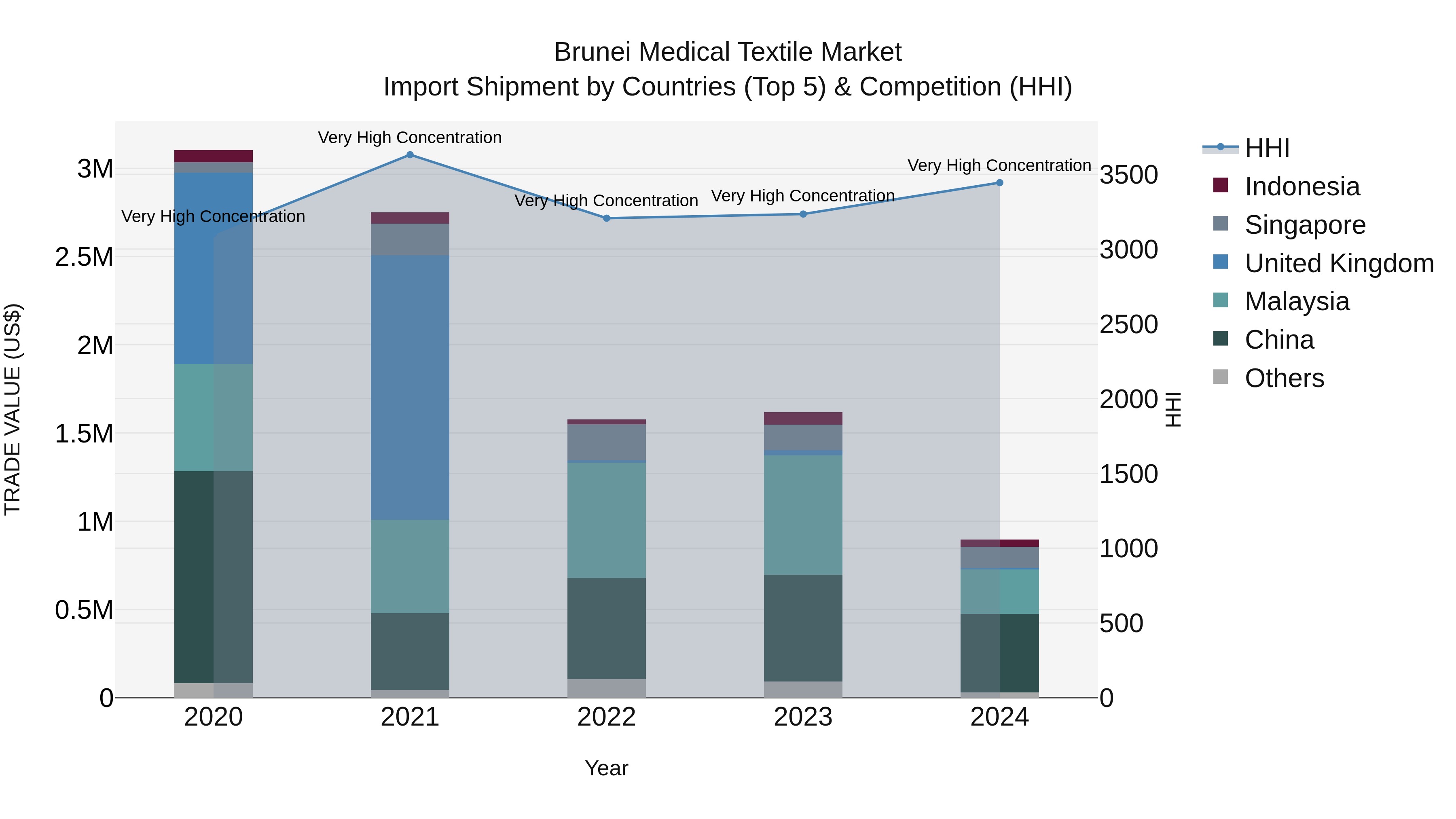
In 2024, Brunei medical textile import market continued to be dominated by key suppliers such as China, Malaysia, Singapore, Indonesia, and the Philippines. Despite a significant negative compound annual growth rate (CAGR) of -26.69% from 2020 to 2024, the high Herfindahl-Hirschman Index (HHI) indicates a strong concentration among these top exporting countries. The sharp decline in growth rate from 2023 to 2024 at -44.64% may suggest challenges or shifts in the market dynamics that could be influencing the import trends in Brunei medical textile sector.
Key Highlights of the Report:
- Brunei Medical Textile Market Outlook
- Market Size of Brunei Medical Textile Market, 2025
- Forecast of Brunei Medical Textile Market, 2032
- Historical Data and Forecast of Brunei Medical Textile Revenues & Volume for the Period 2022 - 2032F
- Brunei Medical Textile Market Trend Evolution
- Brunei Medical Textile Market Drivers and Challenges
- Brunei Medical Textile Price Trends
- Brunei Medical Textile Porter's Five Forces
- Brunei Medical Textile Industry Life Cycle
- Historical Data and Forecast of Brunei Medical Textile Market Revenues & Volume By Product Type for the Period 2022 - 2032F
- Historical Data and Forecast of Brunei Medical Textile Market Revenues & Volume By Non-woven Fabrics for the Period 2022 - 2032F
- Historical Data and Forecast of Brunei Medical Textile Market Revenues & Volume By Woven Fabrics for the Period 2022 - 2032F
- Historical Data and Forecast of Brunei Medical Textile Market Revenues & Volume By Knitted Fabrics for the Period 2022 - 2032F
- Historical Data and Forecast of Brunei Medical Textile Market Revenues & Volume By Application Area for the Period 2022 - 2032F
- Historical Data and Forecast of Brunei Medical Textile Market Revenues & Volume By Implantable Devices for the Period 2022 - 2032F
- Historical Data and Forecast of Brunei Medical Textile Market Revenues & Volume By Non-implantable Products for the Period 2022 - 2032F
- Historical Data and Forecast of Brunei Medical Textile Market Revenues & Volume By Healthcare and Hygiene Products for the Period 2022 - 2032F
- Historical Data and Forecast of Brunei Medical Textile Market Revenues & Volume By Surgical Sutures for the Period 2022 - 2032F
- Historical Data and Forecast of Brunei Medical Textile Market Revenues & Volume By Bandages and Dressings for the Period 2022 - 2032F
- Historical Data and Forecast of Brunei Medical Textile Market Revenues & Volume By End User for the Period 2022 - 2032F
- Historical Data and Forecast of Brunei Medical Textile Market Revenues & Volume By Hospitals for the Period 2022 - 2032F
- Historical Data and Forecast of Brunei Medical Textile Market Revenues & Volume By Clinics for the Period 2022 - 2032F
- Historical Data and Forecast of Brunei Medical Textile Market Revenues & Volume By Ambulatory Centers for the Period 2022 - 2032F
- Historical Data and Forecast of Brunei Medical Textile Market Revenues & Volume By Home Care Settings for the Period 2022 - 2032F
- Historical Data and Forecast of Brunei Medical Textile Market Revenues & Volume By Distribution Channel for the Period 2022 - 2032F
- Historical Data and Forecast of Brunei Medical Textile Market Revenues & Volume By Direct Sales for the Period 2022 - 2032F
- Historical Data and Forecast of Brunei Medical Textile Market Revenues & Volume By Distributors for the Period 2022 - 2032F
- Historical Data and Forecast of Brunei Medical Textile Market Revenues & Volume By Online Retail for the Period 2022 - 2032F
- Brunei Medical Textile Import Export Trade Statistics
- Market Opportunity Assessment By Product Type
- Market Opportunity Assessment By Application Area
- Market Opportunity Assessment By End User
- Market Opportunity Assessment By Distribution Channel
- Brunei Medical Textile Top Companies Market Share
- Brunei Medical Textile Competitive Benchmarking By Technical and Operational Parameters
- Brunei Medical Textile Company Profiles
- Brunei Medical Textile Key Strategic Recommendations






































