Brunei Darussalam Polyurethane Market Growth Rate Analysis (2025 - 2031)
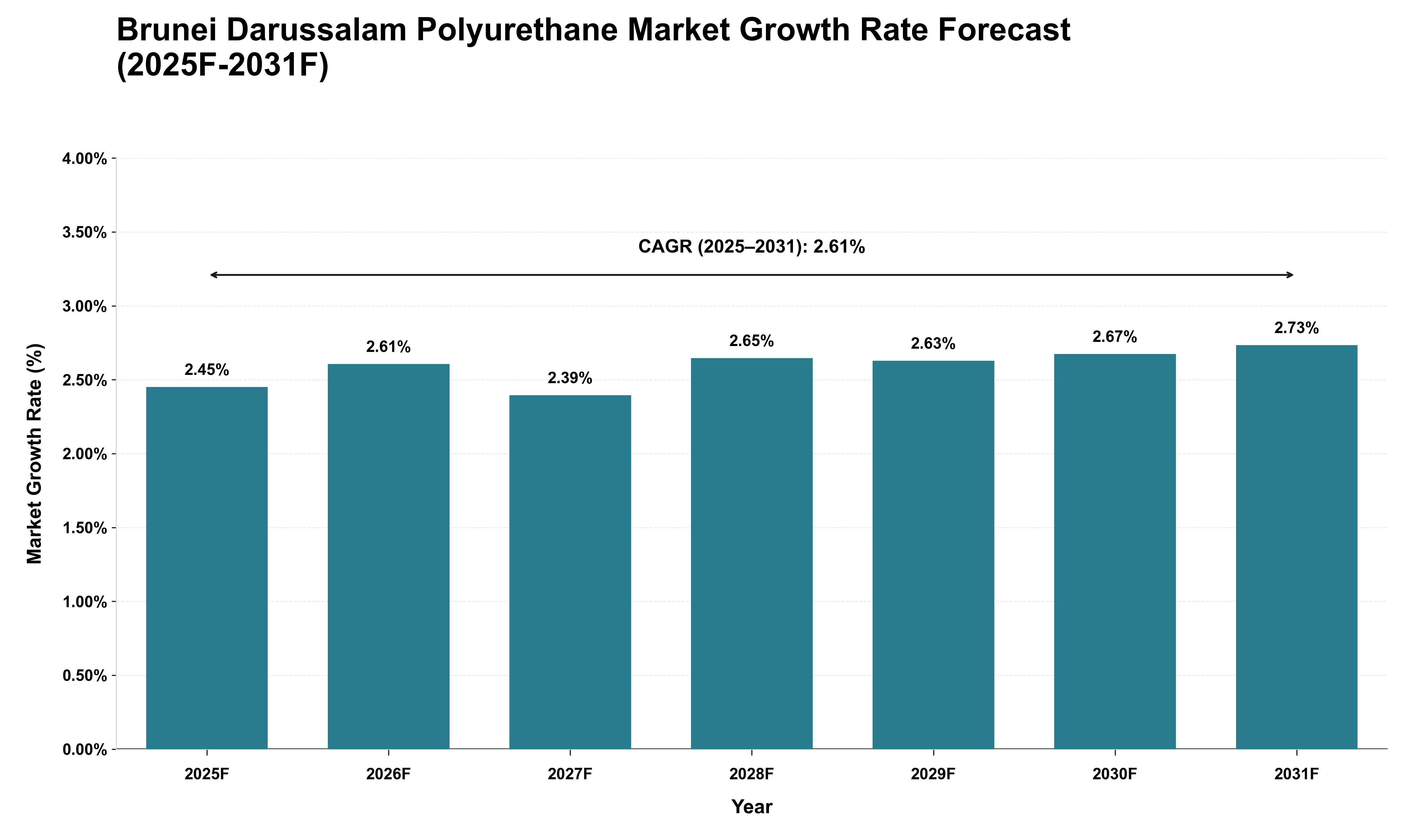
The Brunei Darussalam polyurethane market will experience a steady growth trajectory driven by increasing demand across various sectors, particularly construction and automotive, which are expected to expand due to ongoing infrastructure projects and rising consumer spending. The forecasted CAGR of 2.61% from 2025 to 2031 reflects a consistent annual growth pattern, with rates fluctuating between 2.39% and 2.73%, indicating a resilient market responding to both domestic consumption and import dependencies for raw materials. As global supply chains stabilize post-pandemic, Brunei's reliance on imported polyurethane components will likely influence pricing dynamics and availability, impacting local production capabilities. Additionally, cyclical trends in the broader economy will play a crucial role; as economic conditions improve, investment in durable goods will further bolster demand for polyurethane products, ensuring sustained growth throughout the forecast period.
Key Highlights of the Report:
- Brunei Polyurethane Market Outlook
- Market Size of Brunei Polyurethane Market, 2024
- Forecast of Brunei Polyurethane Market, 2031
- Historical Data and Forecast of Brunei Polyurethane Revenues & Volume for the Period 2021-2031
- Brunei Polyurethane Market Trend Evolution
- Brunei Polyurethane Market Drivers and Challenges
- Brunei Polyurethane Price Trends
- Brunei Polyurethane Porter`s Five Forces
- Brunei Polyurethane Industry Life Cycle
- Historical Data and Forecast of Brunei Polyurethane Market Revenues & Volume By Types for the Period 2021-2031
- Historical Data and Forecast of Brunei Polyurethane Market Revenues & Volume By Flexible Foam for the Period 2021-2031
- Historical Data and Forecast of Brunei Polyurethane Market Revenues & Volume By Rigid Foam for the Period 2021-2031
- Historical Data and Forecast of Brunei Polyurethane Market Revenues & Volume By Coating for the Period 2021-2031
- Historical Data and Forecast of Brunei Polyurethane Market Revenues & Volume By Adhesives & Sealants for the Period 2021-2031
- Historical Data and Forecast of Brunei Polyurethane Market Revenues & Volume By Elastomers for the Period 2021-2031
- Historical Data and Forecast of Brunei Polyurethane Market Revenues & Volume By Others for the Period 2021-2031
- Historical Data and Forecast of Brunei Polyurethane Market Revenues & Volume By End-users for the Period 2021-2031
- Historical Data and Forecast of Brunei Polyurethane Market Revenues & Volume By Automotive & Transportation for the Period 2021-2031
- Historical Data and Forecast of Brunei Polyurethane Market Revenues & Volume By Building & Construction for the Period 2021-2031
- Historical Data and Forecast of Brunei Polyurethane Market Revenues & Volume By Appliances & Whitegoods for the Period 2021-2031
- Historical Data and Forecast of Brunei Polyurethane Market Revenues & Volume By Footwear for the Period 2021-2031
- Historical Data and Forecast of Brunei Polyurethane Market Revenues & Volume By Others for the Period 2021-2031
- Brunei Polyurethane Import Export Trade Statistics
- Market Opportunity Assessment By Types
- Market Opportunity Assessment By End-users
- Brunei Polyurethane Top Companies Market Share
- Brunei Polyurethane Competitive Benchmarking By Technical and Operational Parameters
- Brunei Polyurethane Company Profiles
- Brunei Polyurethane Key Strategic Recommendations






































