Brunei Darussalam Tapioca Market Growth Rate Analysis (2025 - 2031)
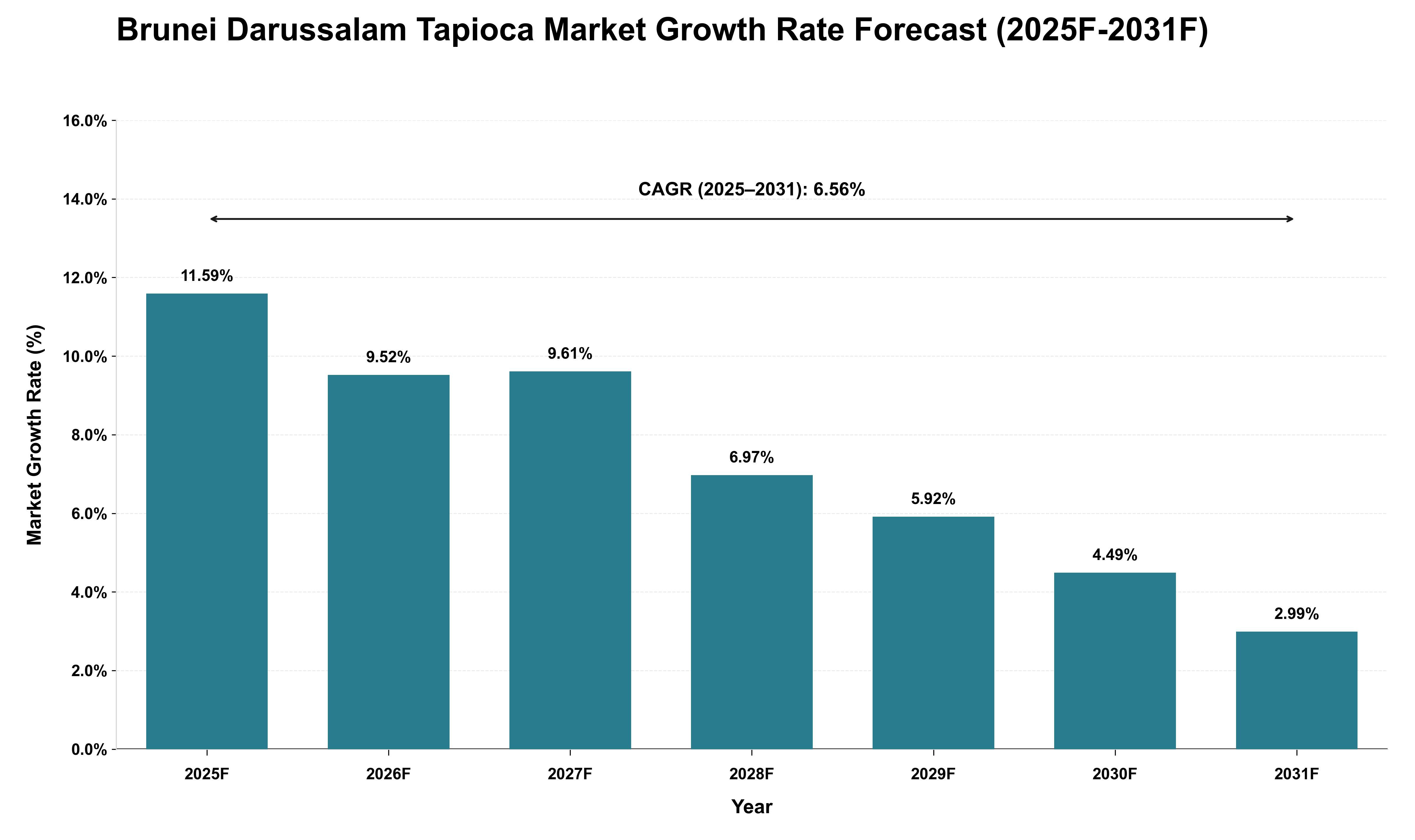
The Brunei Darussalam tapioca market will experience notable growth driven by evolving supply chain dynamics and fluctuating input costs over the forecast period. As demand for tapioca products rises, particularly in food processing and alternative starch applications, the market will likely see an annual growth rate peaking at 11.59% in 2025 before gradually tapering to 2.99% by 2031, reflecting a compound annual growth rate of 6.56%. This trajectory will be influenced by increasing import dependencies as local production may struggle to meet rising consumption needs, leading to heightened competition for raw materials and potential cost pressures. Additionally, cyclical trends in agricultural output and global commodity prices will impact input costs, further shaping the pricing strategies within the market. Consequently, stakeholders must navigate these complexities to optimize supply chain efficiencies while addressing consumer preferences for sustainable sourcing practices.
Key Highlights of the Report:
- Brunei Tapioca Market Outlook
- Market Size of Brunei Tapioca Market, 2024
- Forecast of Brunei Tapioca Market, 2031
- Historical Data and Forecast of Brunei Tapioca Revenues & Volume for the Period 2021-2031
- Brunei Tapioca Market Trend Evolution
- Brunei Tapioca Market Drivers and Challenges
- Brunei Tapioca Price Trends
- Brunei Tapioca Porter`s Five Forces
- Brunei Tapioca Industry Life Cycle
- Historical Data and Forecast of Brunei Tapioca Market Revenues & Volume By Product Type for the Period 2021-2031
- Historical Data and Forecast of Brunei Tapioca Market Revenues & Volume By Tapioca Starch for the Period 2021-2031
- Historical Data and Forecast of Brunei Tapioca Market Revenues & Volume By Tapioca Thippi for the Period 2021-2031
- Historical Data and Forecast of Brunei Tapioca Market Revenues & Volume By Tapioca milk residue for the Period 2021-2031
- Historical Data and Forecast of Brunei Tapioca Market Revenues & Volume By Tapioca Pearl / Sabudana for the Period 2021-2031
- Historical Data and Forecast of Brunei Tapioca Market Revenues & Volume By Tapioca Flour for the Period 2021-2031
- Historical Data and Forecast of Brunei Tapioca Market Revenues & Volume By Black Tapioca Pearl for the Period 2021-2031
- Historical Data and Forecast of Brunei Tapioca Market Revenues & Volume By Function for the Period 2021-2031
- Historical Data and Forecast of Brunei Tapioca Market Revenues & Volume By Bodying for the Period 2021-2031
- Historical Data and Forecast of Brunei Tapioca Market Revenues & Volume By Thickening for the Period 2021-2031
- Historical Data and Forecast of Brunei Tapioca Market Revenues & Volume By Binding for the Period 2021-2031
- Historical Data and Forecast of Brunei Tapioca Market Revenues & Volume By Stabilizer for the Period 2021-2031
- Historical Data and Forecast of Brunei Tapioca Market Revenues & Volume By Form for the Period 2021-2031
- Historical Data and Forecast of Brunei Tapioca Market Revenues & Volume By Fresh for the Period 2021-2031
- Historical Data and Forecast of Brunei Tapioca Market Revenues & Volume By Dried for the Period 2021-2031
- Historical Data and Forecast of Brunei Tapioca Market Revenues & Volume By End-use for the Period 2021-2031
- Historical Data and Forecast of Brunei Tapioca Market Revenues & Volume By Food & beverages for the Period 2021-2031
- Historical Data and Forecast of Brunei Tapioca Market Revenues & Volume By Pharmaceutical for the Period 2021-2031
- Historical Data and Forecast of Brunei Tapioca Market Revenues & Volume By Animal Feed for the Period 2021-2031
- Historical Data and Forecast of Brunei Tapioca Market Revenues & Volume By Textiles Industry for the Period 2021-2031
- Historical Data and Forecast of Brunei Tapioca Market Revenues & Volume By Industrial for the Period 2021-2031
- Brunei Tapioca Import Export Trade Statistics
- Market Opportunity Assessment By Product Type
- Market Opportunity Assessment By Function
- Market Opportunity Assessment By Form
- Market Opportunity Assessment By End-use
- Brunei Tapioca Top Companies Market Share
- Brunei Tapioca Competitive Benchmarking By Technical and Operational Parameters
- Brunei Tapioca Company Profiles
- Brunei Tapioca Key Strategic Recommendations






































