Brunei Darussalam Textile Market Growth Rate Analysis (2025 - 2031)
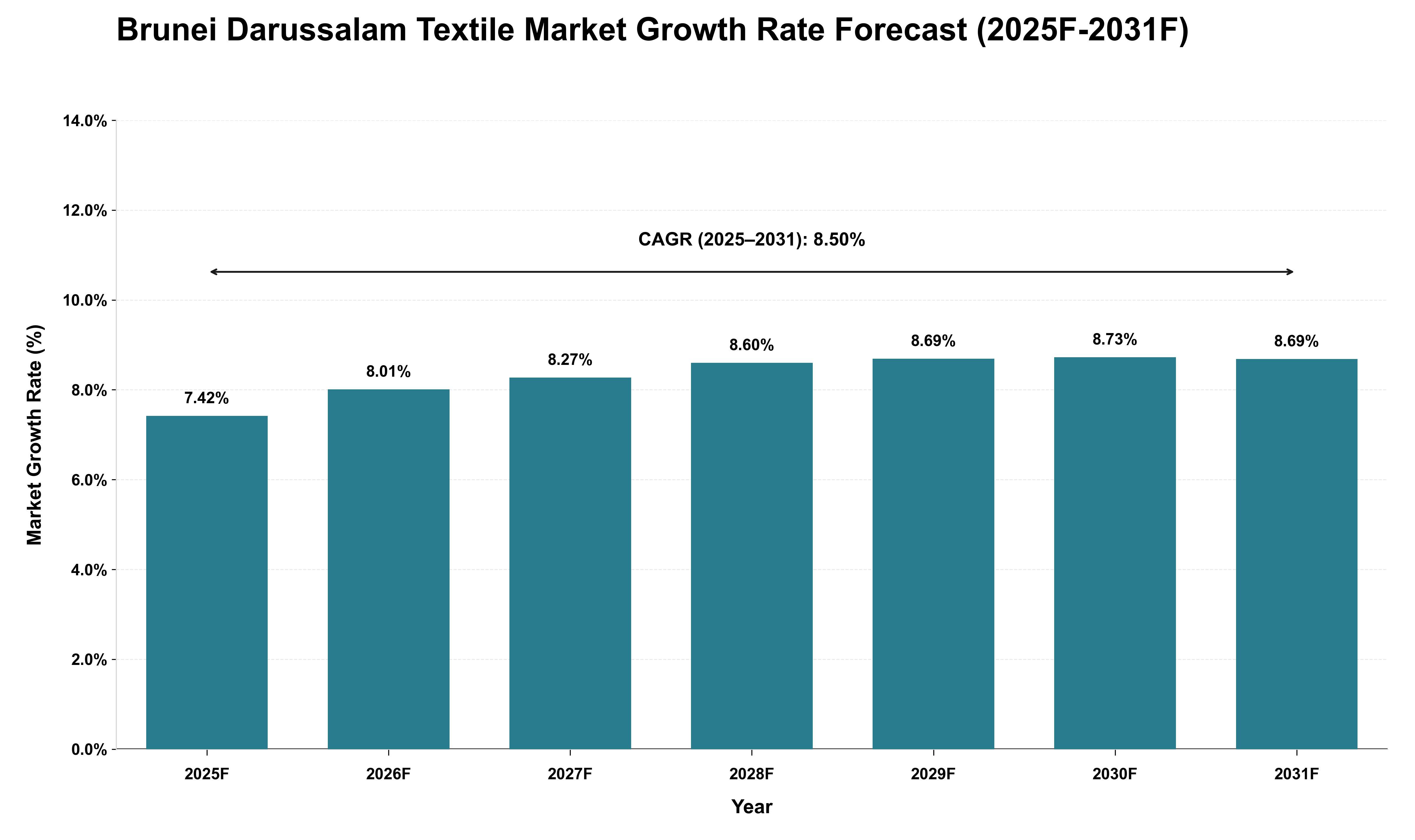
The Brunei Darussalam textile market is poised to experience robust growth driven by several macroeconomic factors, including rising disposable incomes and increasing consumer demand for diverse textile products. The forecasted CAGR of 8.50% from 2025 to 2031 reflects a consistent upward trajectory, with annual growth rates beginning at 7.42% in 2025 and peaking at 8.73% in 2030 before slightly adjusting to 8.69% in the final forecast year. This trend will likely be supported by Brunei's strategic import dependencies, as the nation sources a significant portion of its textiles from international markets, which will enhance product variety and quality. Additionally, cyclical trends such as global fashion shifts and sustainability initiatives are expected to further stimulate local consumption patterns, reinforcing the market's resilience and adaptability within the broader economic landscape during this period.
Key Highlights of the Report:
- Brunei Textile Market Outlook
- Market Size of Brunei Textile Market, 2024
- Forecast of Brunei Textile Market, 2031
- Historical Data and Forecast of Brunei Textile Revenues & Volume for the Period 2021-2031
- Brunei Textile Market Trend Evolution
- Brunei Textile Market Drivers and Challenges
- Brunei Textile Price Trends
- Brunei Textile Porter`s Five Forces
- Brunei Textile Industry Life Cycle
- Historical Data and Forecast of Brunei Textile Market Revenues & Volume By Raw Material Types for the Period 2021-2031
- Historical Data and Forecast of Brunei Textile Market Revenues & Volume By Cotton for the Period 2021-2031
- Historical Data and Forecast of Brunei Textile Market Revenues & Volume By Chemical for the Period 2021-2031
- Historical Data and Forecast of Brunei Textile Market Revenues & Volume By Wool for the Period 2021-2031
- Historical Data and Forecast of Brunei Textile Market Revenues & Volume By Silk for the Period 2021-2031
- Historical Data and Forecast of Brunei Textile Market Revenues & Volume By Others for the Period 2021-2031
- Historical Data and Forecast of Brunei Textile Market Revenues & Volume By Product Types for the Period 2021-2031
- Historical Data and Forecast of Brunei Textile Market Revenues & Volume By Natural Fibers for the Period 2021-2031
- Historical Data and Forecast of Brunei Textile Market Revenues & Volume By Polyesters for the Period 2021-2031
- Historical Data and Forecast of Brunei Textile Market Revenues & Volume By Nylon for the Period 2021-2031
- Historical Data and Forecast of Brunei Textile Market Revenues & Volume By Others for the Period 2021-2031
- Historical Data and Forecast of Brunei Textile Market Revenues & Volume By Applications for the Period 2021-2031
- Historical Data and Forecast of Brunei Textile Market Revenues & Volume By Household for the Period 2021-2031
- Historical Data and Forecast of Brunei Textile Market Revenues & Volume By Technical for the Period 2021-2031
- Historical Data and Forecast of Brunei Textile Market Revenues & Volume By Fashion & Clothing for the Period 2021-2031
- Historical Data and Forecast of Brunei Textile Market Revenues & Volume By Others for the Period 2021-2031
- Brunei Textile Import Export Trade Statistics
- Market Opportunity Assessment By Raw Material Types
- Market Opportunity Assessment By Product Types
- Market Opportunity Assessment By Applications
- Brunei Textile Top Companies Market Share
- Brunei Textile Competitive Benchmarking By Technical and Operational Parameters
- Brunei Textile Company Profiles
- Brunei Textile Key Strategic Recommendations






































