Bulgaria Adipic Acid Market Size (2020-2030)
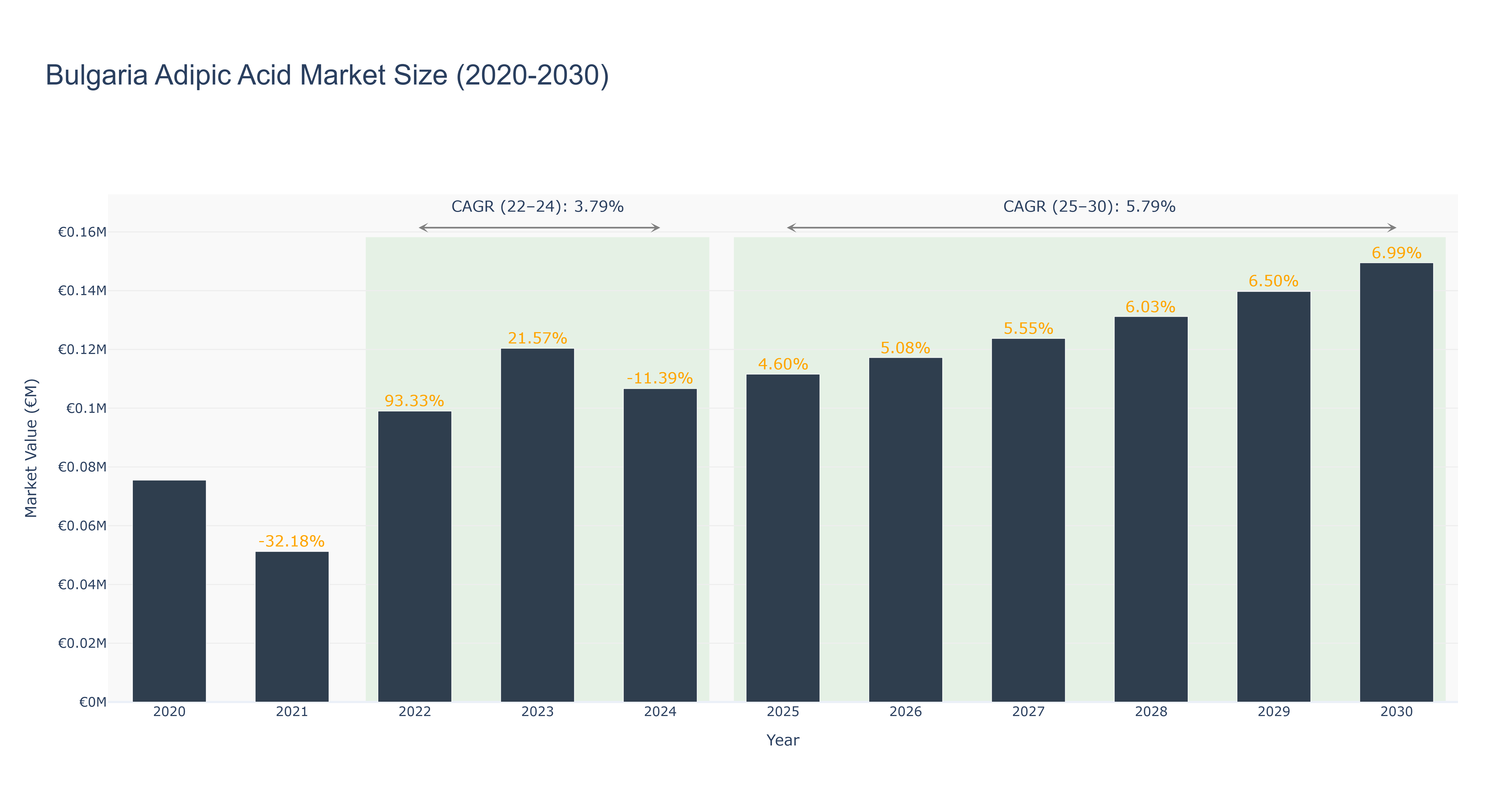
Bulgaria Adipic Acid Market has shown a fluctuating trend over the past decade. The peak market size of €0.15 million is forecasted for 2030, with a steady growth trajectory. Actual market size saw a decrease from €0.08 million in 2020 to €0.11 million in 2024, followed by a gradual increase to €0.12 million in 2026. The market is expected to continue its growth momentum, with a CAGR of 3.79% from 2022 to 2024 and a higher CAGR of 5.79% from 2025 to 2030. Industry drivers such as increasing demand for adipic acid in various applications like nylon production and automotive sector are propelling this growth. Recent developments in Bulgaria's chemical industry, including investments in sustainable production processes, are set to further boost the market in the near future.
Bulgaria Adipic Acid Market: Production & Trade Performance (2019-2025)
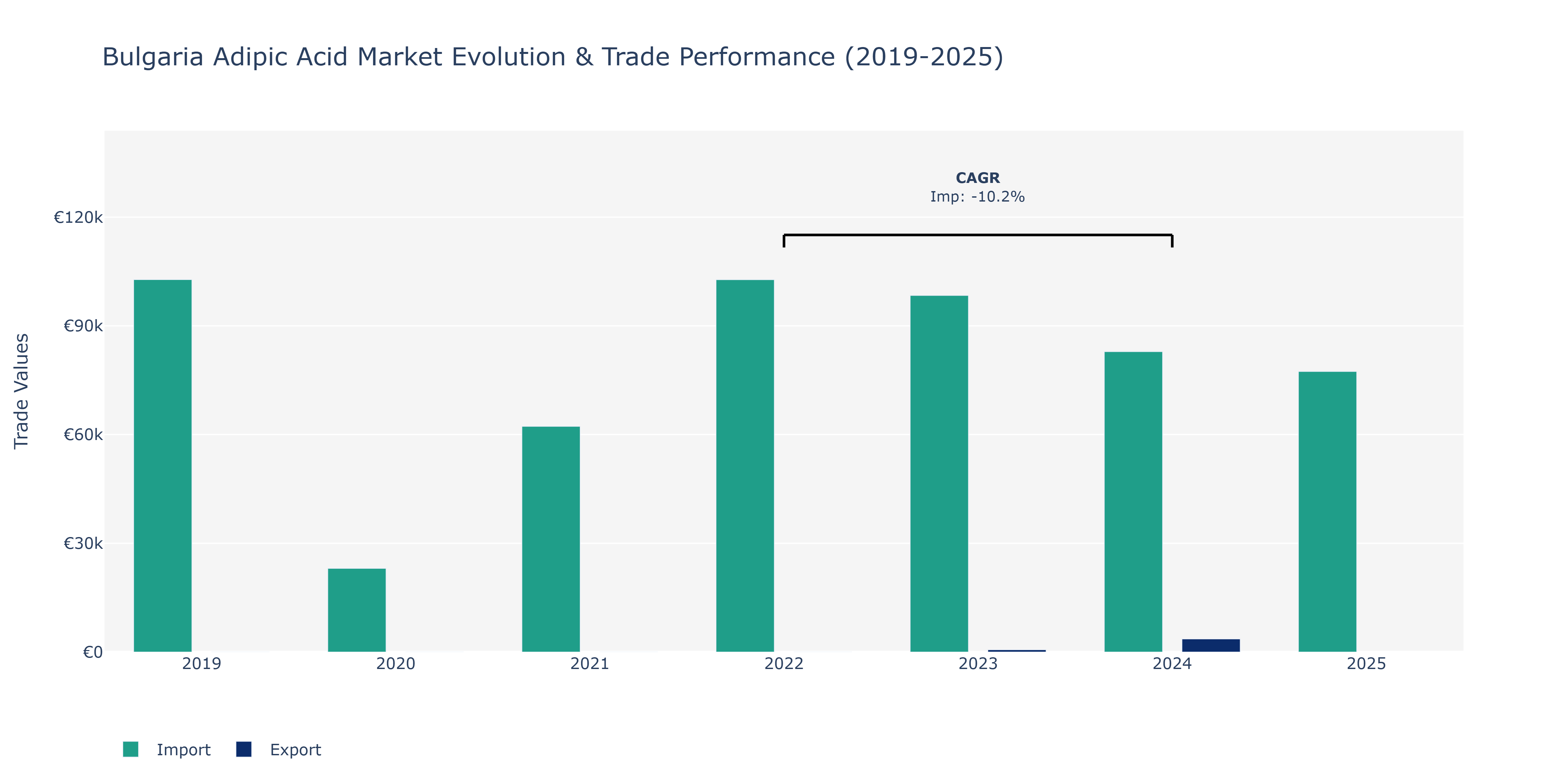
Between 2019 and 2025, Bulgaria's Adipic Acid Market witnessed notable fluctuations in imports and exports. In 2019, imports peaked at €102.76 thousand before sharply declining in 2020 to €23.08 thousand, possibly influenced by global economic uncertainties. The trend reversed in 2021 with imports rebounding to €62.27 thousand, signaling a potential recovery. Interestingly, 2023 saw exports beginning at €0.64 thousand and rising significantly to €3.60 thousand in 2024, showcasing an emerging market for Bulgarian Adipic Acid products abroad. The market's imports reached €77.41 thousand in 2025, indicating a steady demand for this chemical compound. The fluctuating Import value possibly reflect changing domestic consumption patterns and evolving trade relations with key partners. To sustain market growth, stakeholders may need to focus on enhancing production capacities and exploring new export opportunities to maintain competitiveness in the global Adipic Acid market.
Key Highlights of the Report:
- Bulgaria Adipic acid Market Outlook
- Market Size of Bulgaria Adipic acid Market, 2025
- Forecast of Bulgaria Adipic acid Market, 2032
- Historical Data and Forecast of Bulgaria Adipic acid Revenues & Volume for the Period 2022 - 2032F
- Bulgaria Adipic acid Market Trend Evolution
- Bulgaria Adipic acid Market Drivers and Challenges
- Bulgaria Adipic acid Price Trends
- Bulgaria Adipic acid Porter`s Five Forces
- Bulgaria Adipic acid Industry Life Cycle
- Historical Data and Forecast of Bulgaria Adipic acid Market Revenues & Volume By Application for the Period 2022 - 2032F
- Historical Data and Forecast of Bulgaria Adipic acid Market Revenues & Volume By Nylon 6,6 Fiber for the Period 2022 - 2032F
- Historical Data and Forecast of Bulgaria Adipic acid Market Revenues & Volume By Nylon 6,6 Resin for the Period 2022 - 2032F
- Historical Data and Forecast of Bulgaria Adipic acid Market Revenues & Volume By Polyurethane for the Period 2022 - 2032F
- Historical Data and Forecast of Bulgaria Adipic acid Market Revenues & Volume By Adipate Esters for the Period 2022 - 2032F
- Historical Data and Forecast of Bulgaria Adipic acid Market Revenues & Volume By Others for the Period 2022 - 2032F
- Historical Data and Forecast of Bulgaria Adipic acid Market Revenues & Volume By Raw Material for the Period 2022 - 2032F
- Historical Data and Forecast of Bulgaria Adipic acid Market Revenues & Volume By Cyclohexanol for the Period 2022 - 2032F
- Historical Data and Forecast of Bulgaria Adipic acid Market Revenues & Volume By Cyclohexanone for the Period 2022 - 2032F
- Bulgaria Adipic acid Import Export Trade Statistics
- Market Opportunity Assessment By Application
- Market Opportunity Assessment By Raw Material
- Bulgaria Adipic acid Top Companies Market Share
- Bulgaria Adipic acid Competitive Benchmarking By Technical and Operational Parameters
- Bulgaria Adipic acid Company Profiles
- Bulgaria Adipic acid Key Strategic Recommendations






































