Bulgaria Chlorine Market - Import Trends (2019-2025)
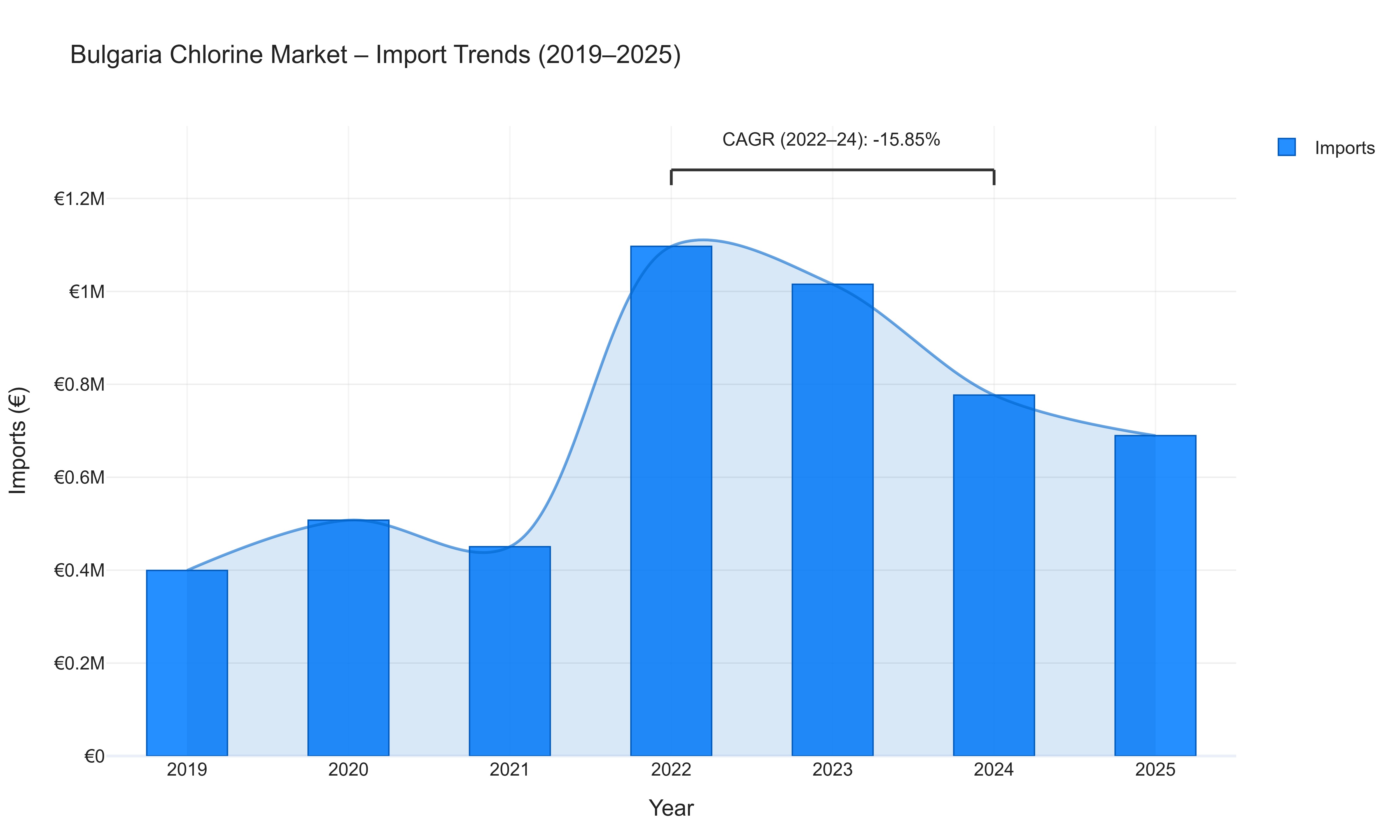
In the Bulgaria Chlorine Market, import values have shown significant fluctuations in recent years. The import value increased by 27.08% in 2020, reaching €507.56 thousand, followed by a sharp decline of -11.25% in 2021 to €450.47 thousand. The trend reversed in 2022 with a substantial growth of 143.52% to €1.10 million, indicating peak import activity. However, this growth was not sustained, as import values decreased by -7.44% in 2023 and further dropped by -23.49% in 2024 to €776.84 thousand. The declining trend continued in 2025 with a -11.24% decrease to €689.52 thousand. The calculated CAGR of -15.85% from 2022 to 2024 reflects the overall negative trend in import values during this period. These fluctuations could be attributed to factors such as shifting supply chains, changing demand dynamics, or global market conditions impacting import volumes in the Bulgaria Chlorine Market.
Bulgaria Chlorine Market Overview
The chlorine market in Bulgaria includes the production and use of chlorine gas, a vital chemical in water treatment, disinfection, and chemical synthesis. The market is influenced by factors such as water safety regulations, demand for chlorine-based products, and developments in production technologies. Chlorine plays a critical role in maintaining public health and industrial processes.
Drivers of the market
The Bulgarian chlorine market is primarily driven by its applications in water purification, disinfectants, and the production of various chemicals. The rising need for safe and clean water, coupled with increasing industrial applications of chlorine, supports market growth. Additionally, the expansion of the chemical industry and advancements in chlorine production technologies play crucial roles. Environmental regulations and safety standards also influence the market dynamics.
Challenges of the market
In the chlorine market in Bulgaria, challenges include environmental and safety regulations that impose strict controls on chlorine production and handling. The industry also faces competition from alternative disinfectants and chemicals. Moreover, fluctuations in raw material prices and the need for significant infrastructure investment for chlorine production can affect market dynamics and profitability.
Government Policy of the market
The chlorine market in Bulgaria is subject to regulations aimed at ensuring the safety and quality of chlorine used in industrial and municipal applications. The government enforces guidelines for the production, handling, and use of chlorine to ensure it meets safety and environmental standards.
Key Highlights of the Report:
- Bulgaria Chlorine Market Outlook
- Market Size of Bulgaria Chlorine Market, 2024
- Forecast of Bulgaria Chlorine Market, 2031
- Historical Data and Forecast of Bulgaria Chlorine Revenues & Volume for the Period 2021-2031
- Bulgaria Chlorine Market Trend Evolution
- Bulgaria Chlorine Market Drivers and Challenges
- Bulgaria Chlorine Price Trends
- Bulgaria Chlorine Porter`s Five Forces
- Bulgaria Chlorine Industry Life Cycle
- Historical Data and Forecast of Bulgaria Chlorine Market Revenues & Volume By Application for the Period 2021-2031
- Historical Data and Forecast of Bulgaria Chlorine Market Revenues & Volume By EDC/PVC for the Period 2021-2031
- Historical Data and Forecast of Bulgaria Chlorine Market Revenues & Volume By Isocyanates and Oxygenates for the Period 2021-2031
- Historical Data and Forecast of Bulgaria Chlorine Market Revenues & Volume By Chloromethanes for the Period 2021-2031
- Historical Data and Forecast of Bulgaria Chlorine Market Revenues & Volume By Solvents and Epichlorohydrin for the Period 2021-2031
- Historical Data and Forecast of Bulgaria Chlorine Market Revenues & Volume By Inorganic Chemicals for the Period 2021-2031
- Historical Data and Forecast of Bulgaria Chlorine Market Revenues & Volume By Other Applications for the Period 2021-2031
- Historical Data and Forecast of Bulgaria Chlorine Market Revenues & Volume By End-user for the Period 2021-2031
- Historical Data and Forecast of Bulgaria Chlorine Market Revenues & Volume By Water Treatment for the Period 2021-2031
- Historical Data and Forecast of Bulgaria Chlorine Market Revenues & Volume By Pharmaceutical for the Period 2021-2031
- Historical Data and Forecast of Bulgaria Chlorine Market Revenues & Volume By Chemicals for the Period 2021-2031
- Historical Data and Forecast of Bulgaria Chlorine Market Revenues & Volume By Paper and Pulp for the Period 2021-2031
- Historical Data and Forecast of Bulgaria Chlorine Market Revenues & Volume By Plastic for the Period 2021-2031
- Historical Data and Forecast of Bulgaria Chlorine Market Revenues & Volume By Pesticides for the Period 2021-2031
- Historical Data and Forecast of Bulgaria Chlorine Market Revenues & Volume By Other for the Period 2021-2031
- Bulgaria Chlorine Import Export Trade Statistics
- Market Opportunity Assessment By Application
- Market Opportunity Assessment By End-user
- Bulgaria Chlorine Top Companies Market Share
- Bulgaria Chlorine Competitive Benchmarking By Technical and Operational Parameters
- Bulgaria Chlorine Company Profiles
- Bulgaria Chlorine Key Strategic Recommendations






































