Bulgaria Cyclohexane Market Size (2020-2030)
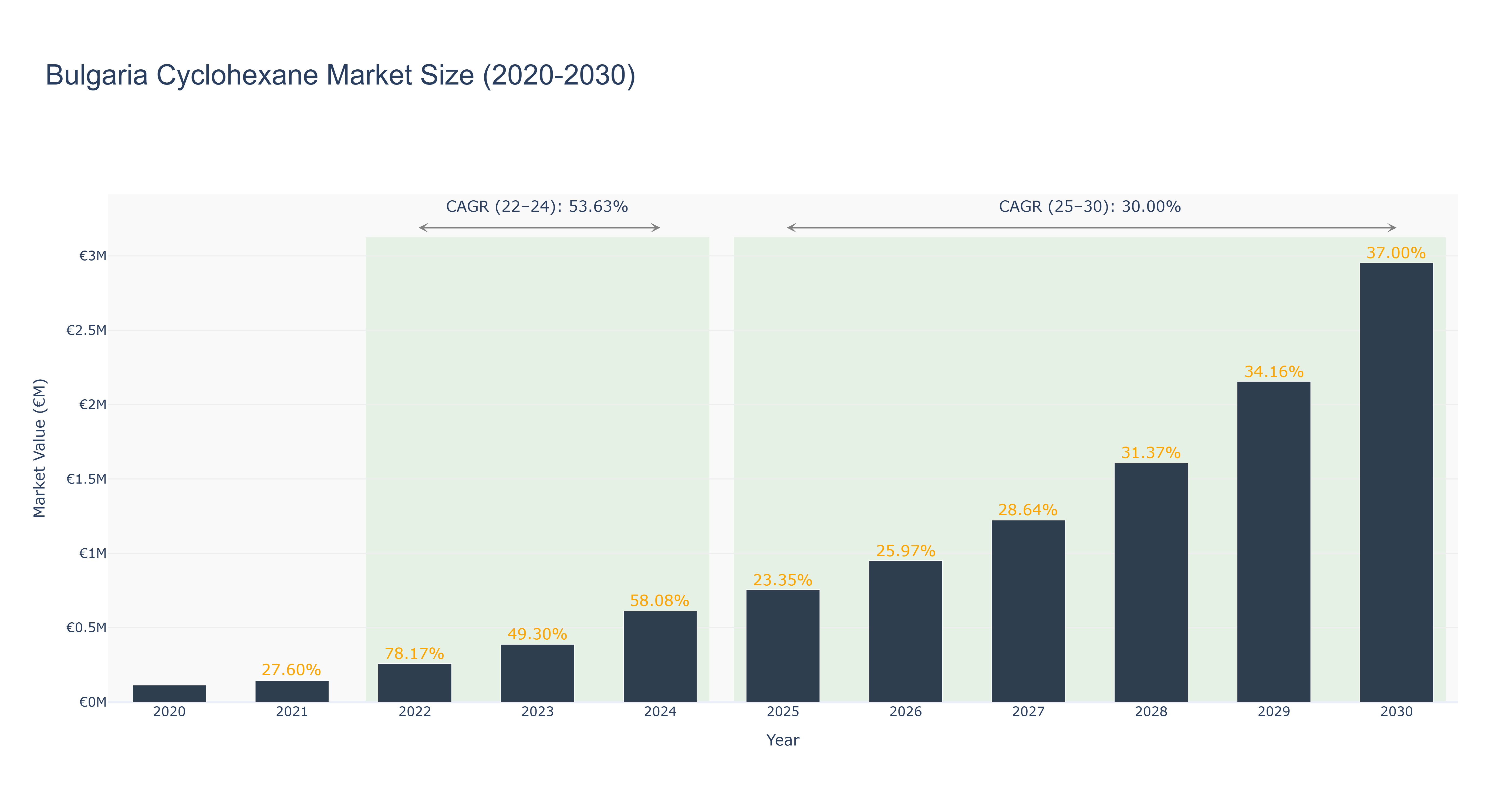
The Bulgaria Cyclohexane Market has demonstrated remarkable growth, peaking in 2024 with a market size of €611.81 thousand, following a robust increase from €259.22 thousand in 2022 and an impressive CAGR of 53.63% during the actual period from 2022 to 2024. This significant expansion can be attributed to rising demand in various sectors, including chemicals and pharmaceuticals, as well as increased production capacities. Looking ahead, the market is projected to continue its upward trajectory, with forecasted values reaching €754.70 thousand in 2025 and €2.95 million by 2030, supported by a CAGR of 30.00% for the forecasted period. Key drivers for this growth include advancements in production technologies and a strengthening industrial base in Bulgaria. Continued investment in infrastructure and regulatory support will likely bolster the market further, positioning Bulgaria as a pivotal player in the regional cyclohexane industry.
Bulgaria Cyclohexane Market: Production & Trade Performance (2019-2025)
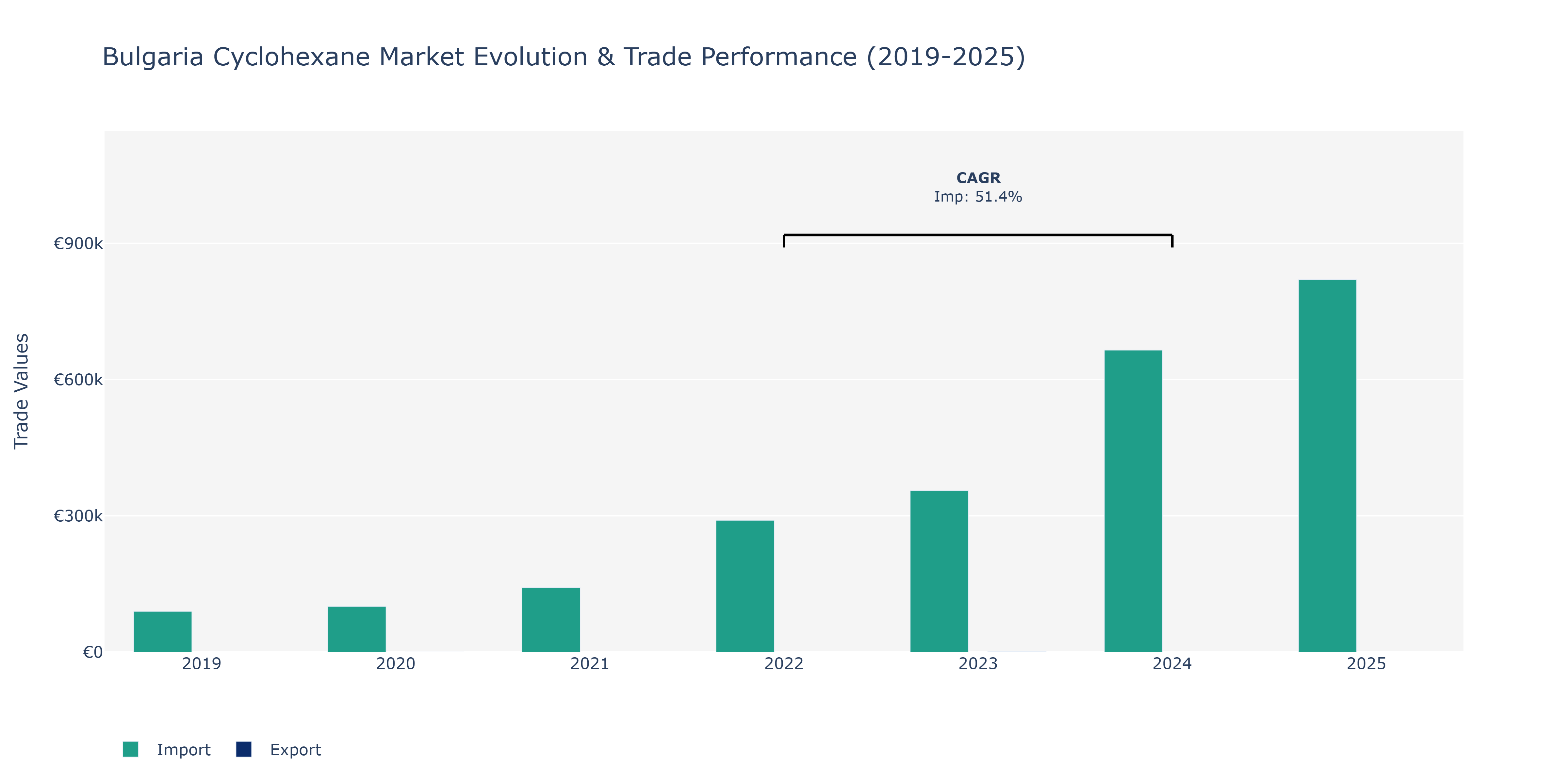
The Bulgaria Cyclohexane Market experienced fluctuations in both exports and imports over the specified years. In 2019, imports stood at €89.51 thousand, showcasing the initial market size. The following year, exports amounted to €0.24 billion, while imports surged to €100.72 thousand, reflecting a substantial increase. However, in 2021, imports rose sharply to €141.96 thousand, indicating growing demand for cyclohexane in Bulgaria. The trend continued in 2022, with imports skyrocketing to €290.08 thousand, marking a peak point driven by increased industrial activities and production processes reliant on cyclohexane. Furthermore, by 2023, exports increased to €0.88 billion, highlighting the market's export potential. Notably, in 2024, imports surged to €664.74 thousand, representing a significant growth rate of 51.38% from 2022 to 2024. This upsurge can be attributed to expanding end-user industries like automotive, textiles, and construction, which require cyclohexane as a key raw material. The positive trajectory continued in 2025, with imports reaching €819.98 thousand, indicating a sustained demand for cyclohexane in Bulgaria's industrial sector. The market's performance underscores the country's position as a notable player in the cyclohexane market, supported by its growing industrial base and economic activities.
Bulgaria Cyclohexane Market Overview
The cyclohexane market in Bulgaria is influenced by its use as a solvent and intermediate in the production of chemicals such as nylon and adipic acid. Cyclohexane is an important compound in the chemical industry, and its demand is driven by applications in textiles, plastics, and other industrial products. Market growth is supported by developments in the chemical manufacturing sector.
Drivers of the market
The Cyclohexane market in Bulgaria is driven by its use as a key raw material in the production of nylon, adipic acid, and caprolactam, which are essential for the manufacturing of synthetic fibers, plastics, and resins. The growth of the textile and automotive industries, coupled with the increasing demand for nylon-based products, contributes to the expansion of the cyclohexane market.
Challenges of the market
The cyclohexane market contends with challenges such as fluctuations in raw material prices and the need to adhere to stringent environmental and safety regulations. Companies must also address competition from alternative chemicals and manage the complexities of production and distribution. Additionally, the market faces pressure to innovate and adapt to changing industry demands and regulatory requirements while ensuring product quality and cost-effectiveness.
Government Policy of the market
Regulations for the cyclohexane market in Bulgaria focus on ensuring that cyclohexane products meet safety, quality, and environmental standards. The government enforces guidelines related to the production, handling, and use of cyclohexane to protect public health and minimize environmental impact.
Key Highlights of the Report:
- Bulgaria Cyclohexane Market Outlook
- Market Size of Bulgaria Cyclohexane Market, 2024
- Forecast of Bulgaria Cyclohexane Market, 2031
- Historical Data and Forecast of Bulgaria Cyclohexane Revenues & Volume for the Period 2021-2031
- Bulgaria Cyclohexane Market Trend Evolution
- Bulgaria Cyclohexane Market Drivers and Challenges
- Bulgaria Cyclohexane Price Trends
- Bulgaria Cyclohexane Porter`s Five Forces
- Bulgaria Cyclohexane Industry Life Cycle
- Historical Data and Forecast of Bulgaria Cyclohexane Market Revenues & Volume By Application for the Period 2021-2031
- Historical Data and Forecast of Bulgaria Cyclohexane Market Revenues & Volume By Adipic acid for the Period 2021-2031
- Historical Data and Forecast of Bulgaria Cyclohexane Market Revenues & Volume By Caprolactam for the Period 2021-2031
- Historical Data and Forecast of Bulgaria Cyclohexane Market Revenues & Volume By Others for the Period 2021-2031
- Historical Data and Forecast of Bulgaria Cyclohexane Market Revenues & Volume By End-use for the Period 2021-2031
- Historical Data and Forecast of Bulgaria Cyclohexane Market Revenues & Volume By Nylon 6 for the Period 2021-2031
- Historical Data and Forecast of Bulgaria Cyclohexane Market Revenues & Volume By Nylon 66 for the Period 2021-2031
- Historical Data and Forecast of Bulgaria Cyclohexane Market Revenues & Volume By Others for the Period 2021-2031
- Bulgaria Cyclohexane Import Export Trade Statistics
- Market Opportunity Assessment By Application
- Market Opportunity Assessment By End-use
- Bulgaria Cyclohexane Top Companies Market Share
- Bulgaria Cyclohexane Competitive Benchmarking By Technical and Operational Parameters
- Bulgaria Cyclohexane Company Profiles
- Bulgaria Cyclohexane Key Strategic Recommendations






































