Bulgaria Ethylene Vinyl Acetate Market Size (2020-2030)
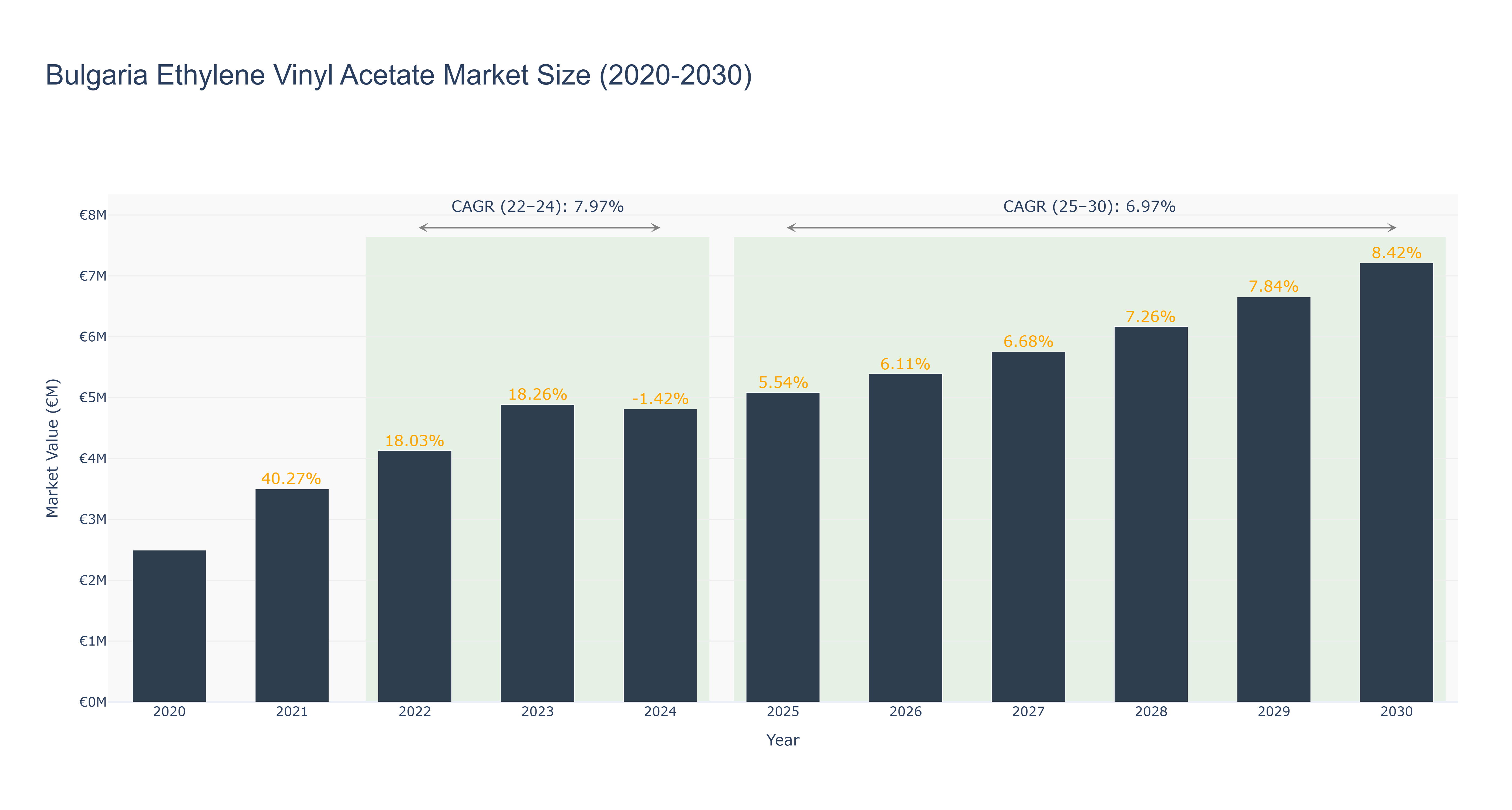
Bulgaria's Ethylene Vinyl Acetate Market has shown a positive growth trend over the years. The peak market size of €7.21 million in 2030 is forecasted, with a steady increase from €2.49 million in 2020. Notably, the market experienced a slight decline in 2024, attributed to a -1.42% growth rate. However, the market rebounded swiftly, with consistent growth rates ranging from 5.54% to 8.42% from 2025 to 2030. Industry drivers such as increasing demand for sustainable materials and technological advancements have propelled this growth. Looking ahead, Bulgaria's Ethylene Vinyl Acetate Market is set to witness further expansion with upcoming projects focusing on enhancing production efficiency and meeting environmental regulations. These developments are expected to drive market growth and solidify Bulgaria's position in the global EVA market.
Bulgaria Ethylene Vinyl Acetate Market: Production & Trade Performance (2019-2025)
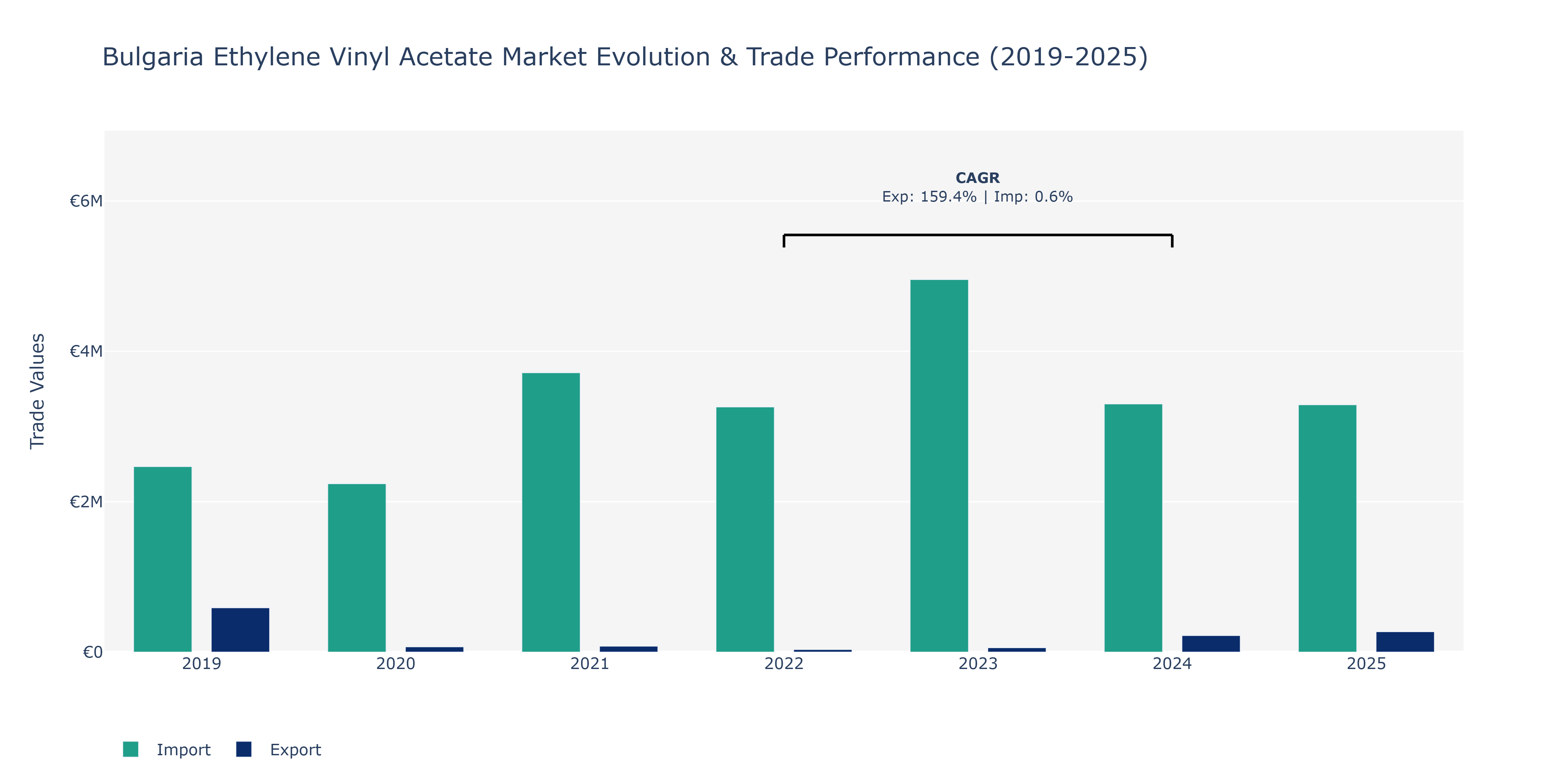
The Bulgaria Ethylene Vinyl Acetate Market witnessed fluctuations in both Exports and Imports over the years. In 2019, Imports stood at €2.47 million, significantly higher than Exports at €588.19 thousand. The following year, Exports dropped to €68.39 thousand while Imports decreased to €2.24 million, reflecting a general decline in trade volume. However, in 2021, both Exports and Imports surged, with Exports reaching €76.88 thousand and Imports peaking at €3.71 million, showcasing a sudden upward trend. The market saw a reversal in 2022 with Exports falling to €32.47 thousand, whereas Imports remained relatively stable at €3.26 million. Notably, in 2023, Exports rebounded to €56.9 thousand, while Imports hit a peak of €4.95 million, signifying a robust demand for ethylene vinyl acetate in Bulgaria. The year 2024 marked a significant surge in Exports to €218.46 thousand, surpassing the previous years, while Imports decreased slightly to €3.3 million. By 2025, Exports increased further to around €269.48 thousand, remaining on an upward trajectory, whereas Imports remained stable close to €3.29 million. These fluctuations can be attributed to market demand, global economic conditions, raw material availability, and technological advancements in the ethylene vinyl acetate industry. The market's resilience in the face of varying trade volumes underscores its importance in Bulgaria's economy, with potential growth opportunities in the coming years driven by factors such as increasing construction activities, rising automotive production, and the expanding packaging sector.
Key Highlights of the Report:
- Bulgaria Ethylene Vinyl Acetate Market Outlook
- Market Size of Bulgaria Ethylene Vinyl Acetate Market, 2025
- Forecast of Bulgaria Ethylene Vinyl Acetate Market, 2032
- Historical Data and Forecast of Bulgaria Ethylene Vinyl Acetate Revenues & Volume for the Period 2022 - 2032F
- Bulgaria Ethylene Vinyl Acetate Market Trend Evolution
- Bulgaria Ethylene Vinyl Acetate Market Drivers and Challenges
- Bulgaria Ethylene Vinyl Acetate Price Trends
- Bulgaria Ethylene Vinyl Acetate Porter`s Five Forces
- Bulgaria Ethylene Vinyl Acetate Industry Life Cycle
- Historical Data and Forecast of Bulgaria Ethylene Vinyl Acetate Market Revenues & Volume By Grade for the Period 2022 - 2032F
- Historical Data and Forecast of Bulgaria Ethylene Vinyl Acetate Market Revenues & Volume By Low Density for the Period 2022 - 2032F
- Historical Data and Forecast of Bulgaria Ethylene Vinyl Acetate Market Revenues & Volume By Medium Density for the Period 2022 - 2032F
- Historical Data and Forecast of Bulgaria Ethylene Vinyl Acetate Market Revenues & Volume By High Density for the Period 2022 - 2032F
- Historical Data and Forecast of Bulgaria Ethylene Vinyl Acetate Market Revenues & Volume By Application for the Period 2022 - 2032F
- Historical Data and Forecast of Bulgaria Ethylene Vinyl Acetate Market Revenues & Volume By Films for the Period 2022 - 2032F
- Historical Data and Forecast of Bulgaria Ethylene Vinyl Acetate Market Revenues & Volume By Adhesives for the Period 2022 - 2032F
- Historical Data and Forecast of Bulgaria Ethylene Vinyl Acetate Market Revenues & Volume By Foams for the Period 2022 - 2032F
- Historical Data and Forecast of Bulgaria Ethylene Vinyl Acetate Market Revenues & Volume By Solar Cell Encapsulation for the Period 2022 - 2032F
- Historical Data and Forecast of Bulgaria Ethylene Vinyl Acetate Market Revenues & Volume By Other Applications for the Period 2022 - 2032F
- Bulgaria Ethylene Vinyl Acetate Import Export Trade Statistics
- Market Opportunity Assessment By Grade
- Market Opportunity Assessment By Application
- Bulgaria Ethylene Vinyl Acetate Top Companies Market Share
- Bulgaria Ethylene Vinyl Acetate Competitive Benchmarking By Technical and Operational Parameters
- Bulgaria Ethylene Vinyl Acetate Company Profiles
- Bulgaria Ethylene Vinyl Acetate Key Strategic Recommendations






































