Bulgaria Formaldehyde Market Size (2020-2030)
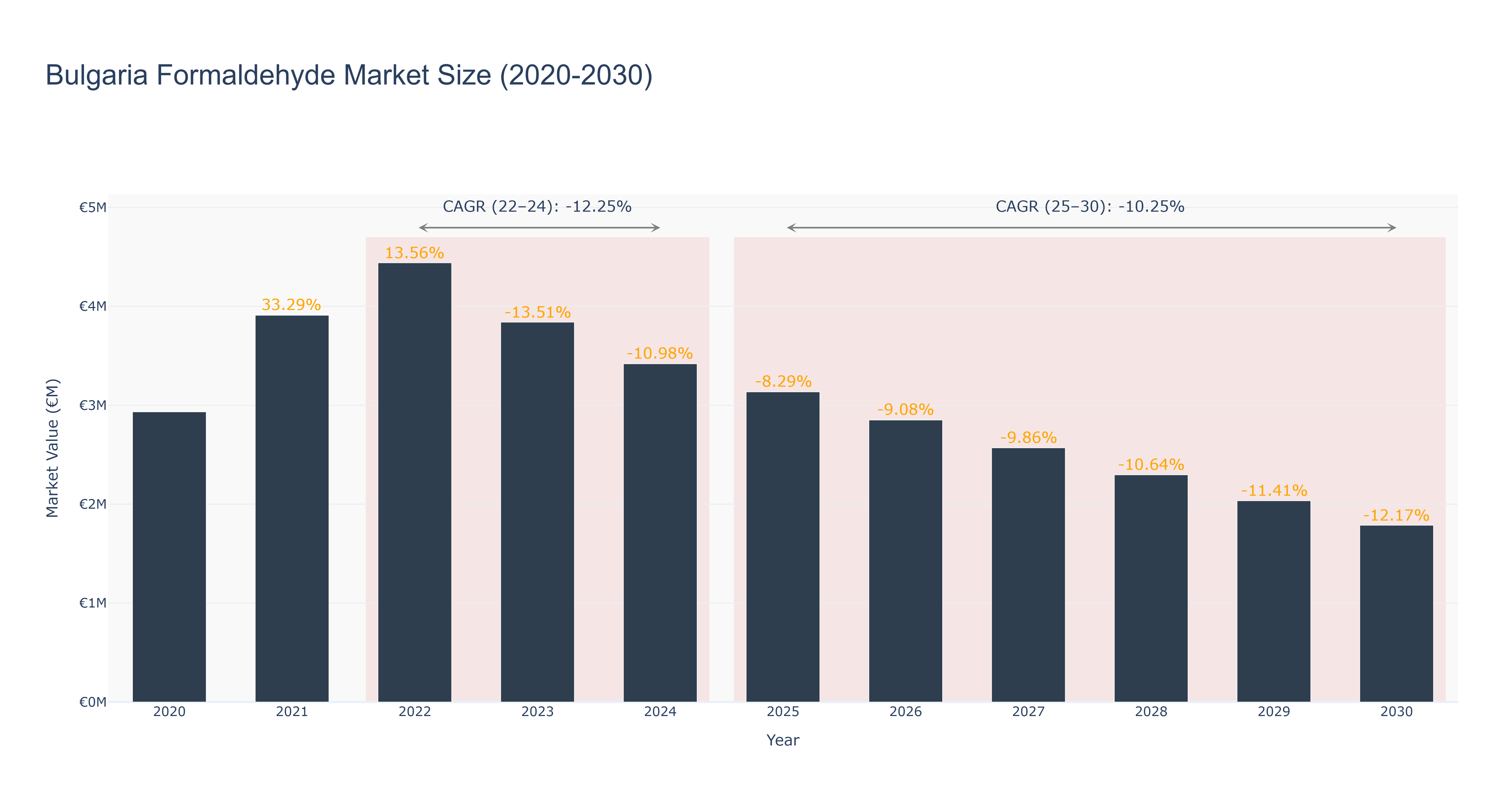
The Bulgaria Formaldehyde Market witnessed a peak market size of €4.44 million in 2022, followed by a gradual decline to €2.85 million in 2026. The market is forecasted to further decrease to €1.79 million by 2030, with a CAGR of -10.25% from 2025 to 2030. The downward trend can be attributed to factors such as increasing environmental regulations, shifting consumer preferences towards eco-friendly products, and the emergence of alternative materials. Despite the current challenges, the market is expected to see potential growth opportunities in the future through increased research and development activities towards sustainable production processes and the development of innovative formaldehyde-based products. One notable upcoming project in Bulgaria's formaldehyde market is the implementation of advanced manufacturing technologies to enhance product quality and efficiency.
Bulgaria Formaldehyde Market: Production & Trade Performance (2019-2025)
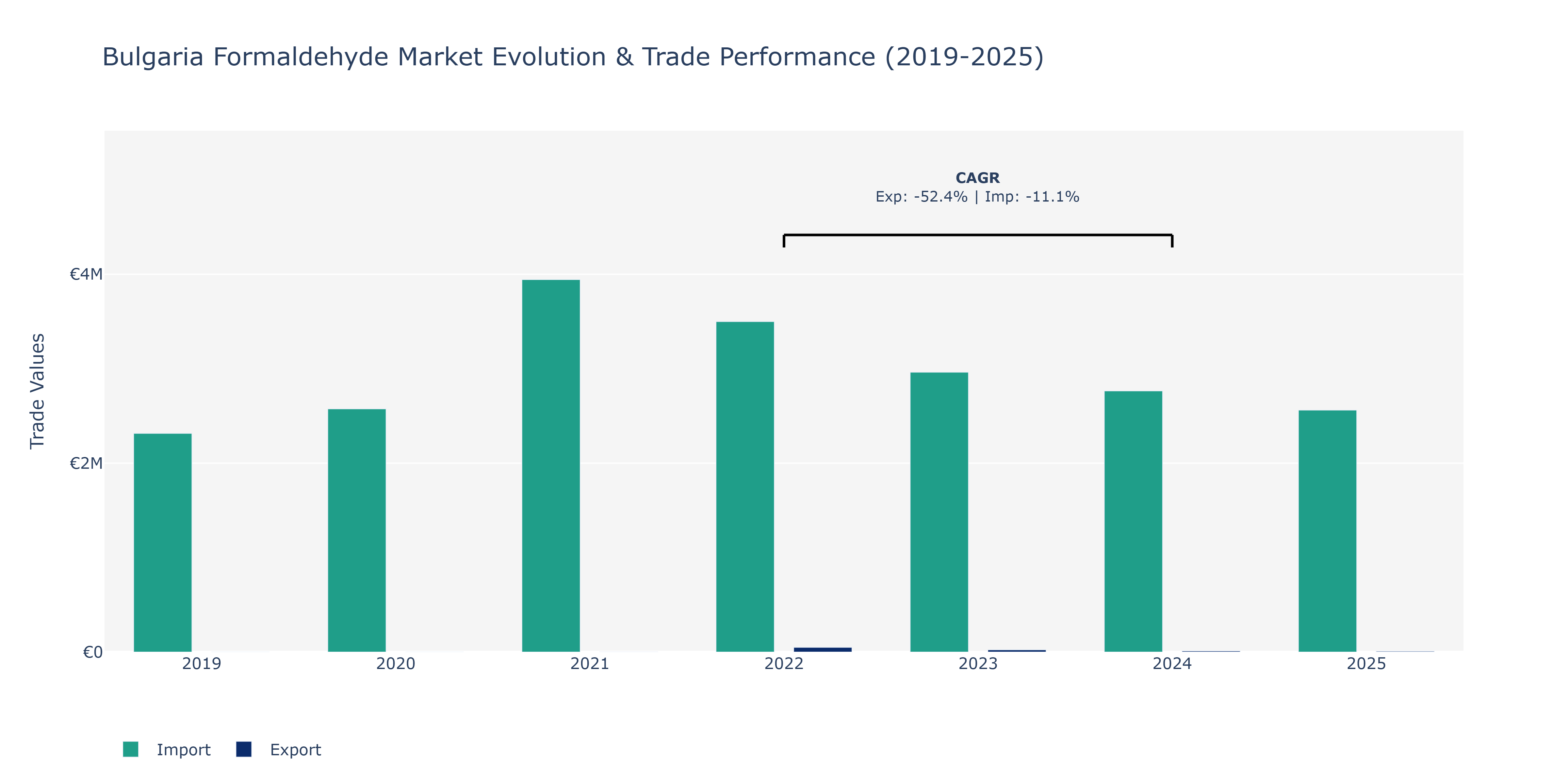
In the Bulgaria Formaldehyde Market, imports showcased a fluctuating trend over the observed years. Starting at €2.31 million in 2019, imports increased to €3.94 million in 2021, marking a substantial rise. However, from 2022 to 2025, the trend reversed, with a consistent decline in Import value, reaching €2.56 million in 2025. Conversely, exports displayed a more stable pattern, with a gradual decrease from €49.25 thousand in 2022 to around €8.37 thousand in 2025. The decline in imports post-2021 can be attributed to factors such as changing consumer preferences towards eco-friendly alternatives and stricter regulations on chemical imports. On the export front, increasing competition from other global markets and shifting demand dynamics may have contributed to the downward trajectory. These market shifts align with the global push for sustainable practices and environmentally friendly products in the chemical industry, influencing Bulgaria's trade flows in formaldehyde.
Bulgaria Formaldehyde Market Overview
The formaldehyde market in Bulgaria is growing due to its widespread use in the production of resins, adhesives, and coatings. Formaldehyde is a key raw material in the manufacture of products such as plywood, particleboard, and textiles. The market growth is driven by increasing industrial activities, advancements in formaldehyde-based technologies, and the expansion of the construction and automotive sectors. However, the market also faces challenges related to environmental and health concerns, which are influencing the development of safer and more sustainable formaldehyde alternatives.
Drivers of the market
The formaldehyde market in Bulgaria is driven by the demand for formaldehyde and its derivatives used in various industrial applications, including the production of resins, textiles, and disinfectants. Formaldehyde provides essential properties such as bonding strength and preservation. The growth of the chemical and manufacturing industries, advancements in formaldehyde production technologies, and the increasing focus on developing high-performance and eco-friendly products contribute to market growth. Additionally, the rise in demand for formaldehyde-based products and the emphasis on improving product performance support the demand for formaldehyde.
Challenges of the market
The Bulgaria Formaldehyde market faces challenges related to the production and supply of formaldehyde used in various industrial applications, including manufacturing and construction. Key issues include managing production costs, addressing environmental and regulatory concerns related to formaldehyde use and emissions, and responding to fluctuations in market demand. The market must also navigate competition from alternative chemical technologies and ensure the quality and performance of formaldehyde products.
Government Policy of the market
The formaldehyde market in Bulgaria is shaped by government policies aimed at regulating chemical use and promoting safety standards. The Bulgarian government supports the use of formaldehyde in various industrial applications, including manufacturing and construction, while ensuring compliance with safety and environmental regulations. Policies emphasize the importance of integrating formaldehyde technologies into industrial processes while managing associated risks. Additionally, the government provides incentives for investments in formaldehyde technologies to support industry growth and ensure safe practices.
Key Highlights of the Report:
- Bulgaria Formaldehyde Market Outlook
- Market Size of Bulgaria Formaldehyde Market, 2024
- Forecast of Bulgaria Formaldehyde Market, 2031
- Historical Data and Forecast of Bulgaria Formaldehyde Revenues & Volume for the Period 2021-2031
- Bulgaria Formaldehyde Market Trend Evolution
- Bulgaria Formaldehyde Market Drivers and Challenges
- Bulgaria Formaldehyde Price Trends
- Bulgaria Formaldehyde Porter`s Five Forces
- Bulgaria Formaldehyde Industry Life Cycle
- Historical Data and Forecast of Bulgaria Formaldehyde Market Revenues & Volume By Application for the Period 2021-2031
- Historical Data and Forecast of Bulgaria Formaldehyde Market Revenues & Volume By Resins for the Period 2021-2031
- Historical Data and Forecast of Bulgaria Formaldehyde Market Revenues & Volume By Fibers for the Period 2021-2031
- Historical Data and Forecast of Bulgaria Formaldehyde Market Revenues & Volume By Solvents for the Period 2021-2031
- Historical Data and Forecast of Bulgaria Formaldehyde Market Revenues & Volume By Plasticizers for the Period 2021-2031
- Historical Data and Forecast of Bulgaria Formaldehyde Market Revenues & Volume By Drying Agents for the Period 2021-2031
- Historical Data and Forecast of Bulgaria Formaldehyde Market Revenues & Volume By Other Chemical Intermediates for the Period 2021-2031
- Historical Data and Forecast of Bulgaria Formaldehyde Market Revenues & Volume By Derivative for the Period 2021-2031
- Historical Data and Forecast of Bulgaria Formaldehyde Market Revenues & Volume By Urea-formaldehyde Resin for the Period 2021-2031
- Historical Data and Forecast of Bulgaria Formaldehyde Market Revenues & Volume By Phenol Formaldehyde Resin for the Period 2021-2031
- Historical Data and Forecast of Bulgaria Formaldehyde Market Revenues & Volume By Polyoxymethylene for the Period 2021-2031
- Historical Data and Forecast of Bulgaria Formaldehyde Market Revenues & Volume By Melamine Formaldehyde Resin for the Period 2021-2031
- Historical Data and Forecast of Bulgaria Formaldehyde Market Revenues & Volume By Pentaerythritol for the Period 2021-2031
- Historical Data and Forecast of Bulgaria Formaldehyde Market Revenues & Volume By Methylene Diphenyl Diisocyanate for the Period 2021-2031
- Historical Data and Forecast of Bulgaria Formaldehyde Market Revenues & Volume By Hexamethylenetetramine for the Period 2021-2031
- Historical Data and Forecast of Bulgaria Formaldehyde Market Revenues & Volume By Others for the Period 2021-2031
- Historical Data and Forecast of Bulgaria Formaldehyde Market Revenues & Volume By End-Use for the Period 2021-2031
- Historical Data and Forecast of Bulgaria Formaldehyde Market Revenues & Volume By Chemicals for the Period 2021-2031
- Historical Data and Forecast of Bulgaria Formaldehyde Market Revenues & Volume By Agriculture for the Period 2021-2031
- Historical Data and Forecast of Bulgaria Formaldehyde Market Revenues & Volume By Building & Construction for the Period 2021-2031
- Historical Data and Forecast of Bulgaria Formaldehyde Market Revenues & Volume By Personal Care & Cosmetics for the Period 2021-2031
- Historical Data and Forecast of Bulgaria Formaldehyde Market Revenues & Volume By Healthcare for the Period 2021-2031
- Historical Data and Forecast of Bulgaria Formaldehyde Market Revenues & Volume By Automotive for the Period 2021-2031
- Historical Data and Forecast of Bulgaria Formaldehyde Market Revenues & Volume By Others for the Period 2021-2031
- Bulgaria Formaldehyde Import Export Trade Statistics
- Market Opportunity Assessment By Application
- Market Opportunity Assessment By Derivative
- Market Opportunity Assessment By End-Use
- Bulgaria Formaldehyde Top Companies Market Share
- Bulgaria Formaldehyde Competitive Benchmarking By Technical and Operational Parameters
- Bulgaria Formaldehyde Company Profiles
- Bulgaria Formaldehyde Key Strategic Recommendations






































