Bulgaria Fruit Pulp Market Top 5 Importing Countries and Market Competition (HHI) Analysis
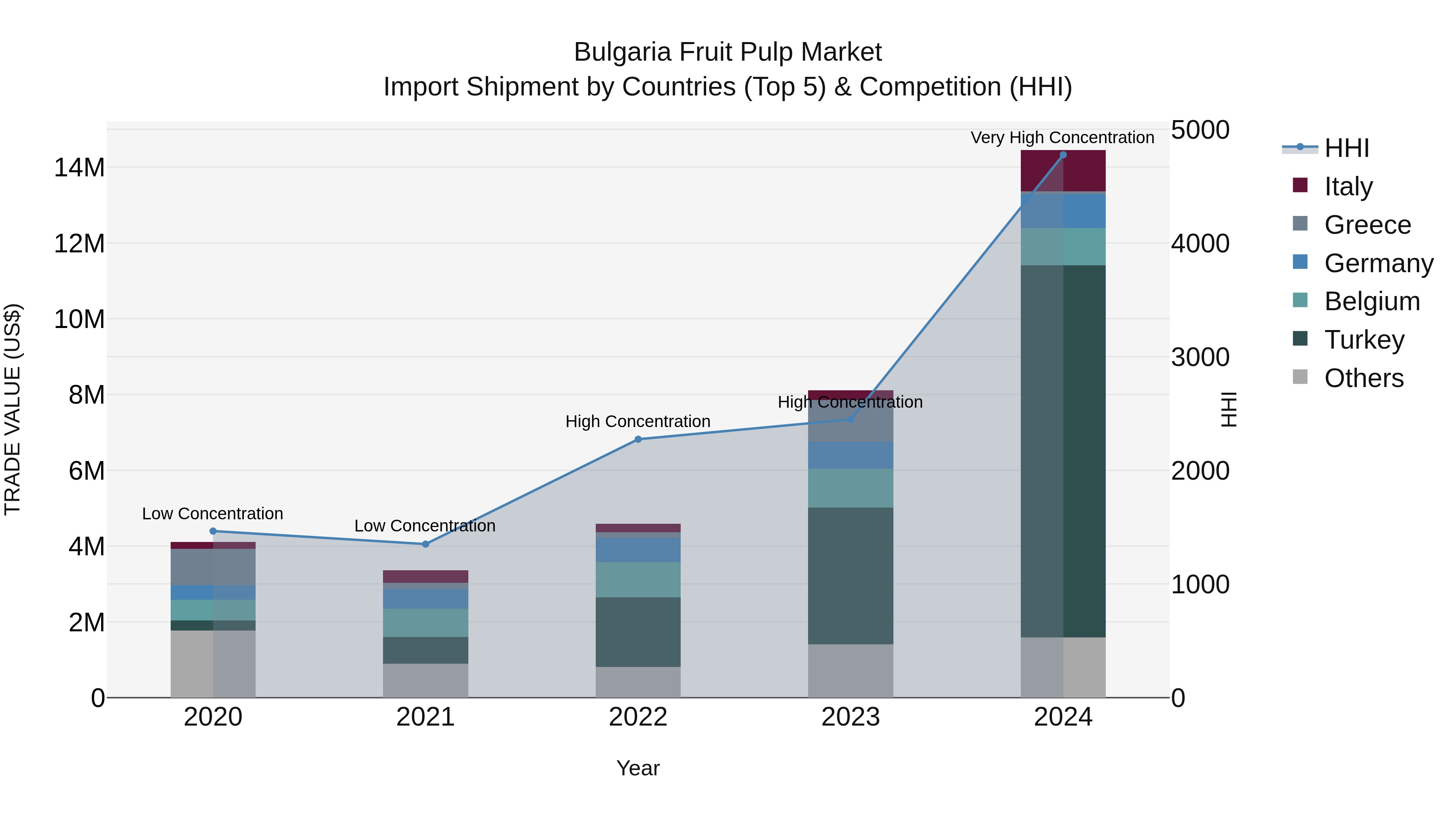
The Bulgaria fruit pulp import Market Top 5 Importing Countries and Market Competition (HHI) Analysis is witnessing significant growth, with a notable increase in concentration levels in 2024. Key exporting countries such as Turkey, Italy, and Germany are playing a crucial role in meeting Bulgaria`s demand. The impressive CAGR of 36.92% from 2020 to 2024 indicates a thriving Market Top 5 Importing Countries and Market Competition (HHI) Analysis , further supported by a remarkable growth rate of 78.07% from 2023 to 2024. As the Market Top 5 Importing Countries and Market Competition (HHI) Analysis continues to expand rapidly, stakeholders should closely monitor these trends to capitalize on emerging opportunities in the fruit pulp import sector.
Bulgaria Fruit Pulp Market Overview
The fruit pulp market in Bulgaria is growing as a result of increasing consumer demand for natural and nutritious fruit-based products. Fruit pulp is used in a variety of applications, including beverages, confectionery, and dairy products, due to its flavor, texture, and nutritional value. The market growth is driven by rising health awareness, the popularity of natural and organic products, and the expansion of the food and beverage industry. Innovations in fruit pulp processing and the development of new fruit-based products contribute to the market`s expansion.
Drivers of the market
The fruit pulp market in Bulgaria is driven by the growing demand for natural and nutritious fruit-based ingredients used in food and beverage products. Fruit pulp provides essential flavors, textures, and nutritional benefits. The growth of the food and beverage industry, advancements in fruit pulp processing technologies, and the increasing focus on developing healthy and natural products contribute to market growth. Additionally, the rise in demand for high-quality and versatile fruit pulps and the emphasis on improving product formulations support the demand for fruit pulp.
Challenges of the market
The fruit pulp market in Bulgaria faces challenges such as seasonal supply variability and competition from imported products. Local fruit production is often subject to weather-related disruptions, affecting the consistency of supply. Additionally, Bulgarian producers must compete with cheaper imports from countries with larger production capabilities, which can undercut prices. There is also a growing need for advanced processing and preservation technologies to maintain product quality.
Government Policy of the market
The fruit pulp market in Bulgaria is shaped by government policies aimed at supporting the fruit processing industry and promoting food safety. The Bulgarian government supports the production and distribution of fruit pulp for various applications, including beverages and food products. Policies emphasize the importance of integrating advanced processing technologies into fruit pulp production. Additionally, the government provides incentives for investments in fruit pulp technologies to support industry growth and ensure product quality.
Key Highlights of the Report:
- Bulgaria Fruit Pulp Market Outlook
- Market Size of Bulgaria Fruit Pulp Market, 2024
- Forecast of Bulgaria Fruit Pulp Market, 2031
- Historical Data and Forecast of Bulgaria Fruit Pulp Revenues & Volume for the Period 2021-2031
- Bulgaria Fruit Pulp Market Trend Evolution
- Bulgaria Fruit Pulp Market Drivers and Challenges
- Bulgaria Fruit Pulp Price Trends
- Bulgaria Fruit Pulp Porter`s Five Forces
- Bulgaria Fruit Pulp Industry Life Cycle
- Historical Data and Forecast of Bulgaria Fruit Pulp Market Revenues & Volume By Fruit Type for the Period 2021-2031
- Historical Data and Forecast of Bulgaria Fruit Pulp Market Revenues & Volume By Mango for the Period 2021-2031
- Historical Data and Forecast of Bulgaria Fruit Pulp Market Revenues & Volume By Strawberry for the Period 2021-2031
- Historical Data and Forecast of Bulgaria Fruit Pulp Market Revenues & Volume By Apple for the Period 2021-2031
- Historical Data and Forecast of Bulgaria Fruit Pulp Market Revenues & Volume By Guava for the Period 2021-2031
- Historical Data and Forecast of Bulgaria Fruit Pulp Market Revenues & Volume By Berries for the Period 2021-2031
- Historical Data and Forecast of Bulgaria Fruit Pulp Market Revenues & Volume By Citrus Fruits for the Period 2021-2031
- Historical Data and Forecast of Bulgaria Fruit Pulp Market Revenues & Volume By Others for the Period 2021-2031
- Historical Data and Forecast of Bulgaria Fruit Pulp Market Revenues & Volume By Form for the Period 2021-2031
- Historical Data and Forecast of Bulgaria Fruit Pulp Market Revenues & Volume By Liquid for the Period 2021-2031
- Historical Data and Forecast of Bulgaria Fruit Pulp Market Revenues & Volume By Powder for the Period 2021-2031
- Historical Data and Forecast of Bulgaria Fruit Pulp Market Revenues & Volume By Application for the Period 2021-2031
- Historical Data and Forecast of Bulgaria Fruit Pulp Market Revenues & Volume By Food and Beverages for the Period 2021-2031
- Historical Data and Forecast of Bulgaria Fruit Pulp Market Revenues & Volume By Distribution for the Period 2021-2031
- Historical Data and Forecast of Bulgaria Fruit Pulp Market Revenues & Volume By E-Commerce for the Period 2021-2031
- Historical Data and Forecast of Bulgaria Fruit Pulp Market Revenues & Volume By Convenience Stores for the Period 2021-2031
- Historical Data and Forecast of Bulgaria Fruit Pulp Market Revenues & Volume By Supermarkets/Hypermarkets for the Period 2021-2031
- Historical Data and Forecast of Bulgaria Fruit Pulp Market Revenues & Volume By Specialty Stores for the Period 2021-2031
- Historical Data and Forecast of Bulgaria Fruit Pulp Market Revenues & Volume By Others for the Period 2021-2031
- Bulgaria Fruit Pulp Import Export Trade Statistics
- Market Opportunity Assessment By Fruit Type
- Market Opportunity Assessment By Form
- Market Opportunity Assessment By Application
- Market Opportunity Assessment By Distribution
- Bulgaria Fruit Pulp Top Companies Market Share
- Bulgaria Fruit Pulp Competitive Benchmarking By Technical and Operational Parameters
- Bulgaria Fruit Pulp Company Profiles
- Bulgaria Fruit Pulp Key Strategic Recommendations






































