Bulgaria Gas Market Top 5 Importing Countries and Market Competition (HHI) Analysis
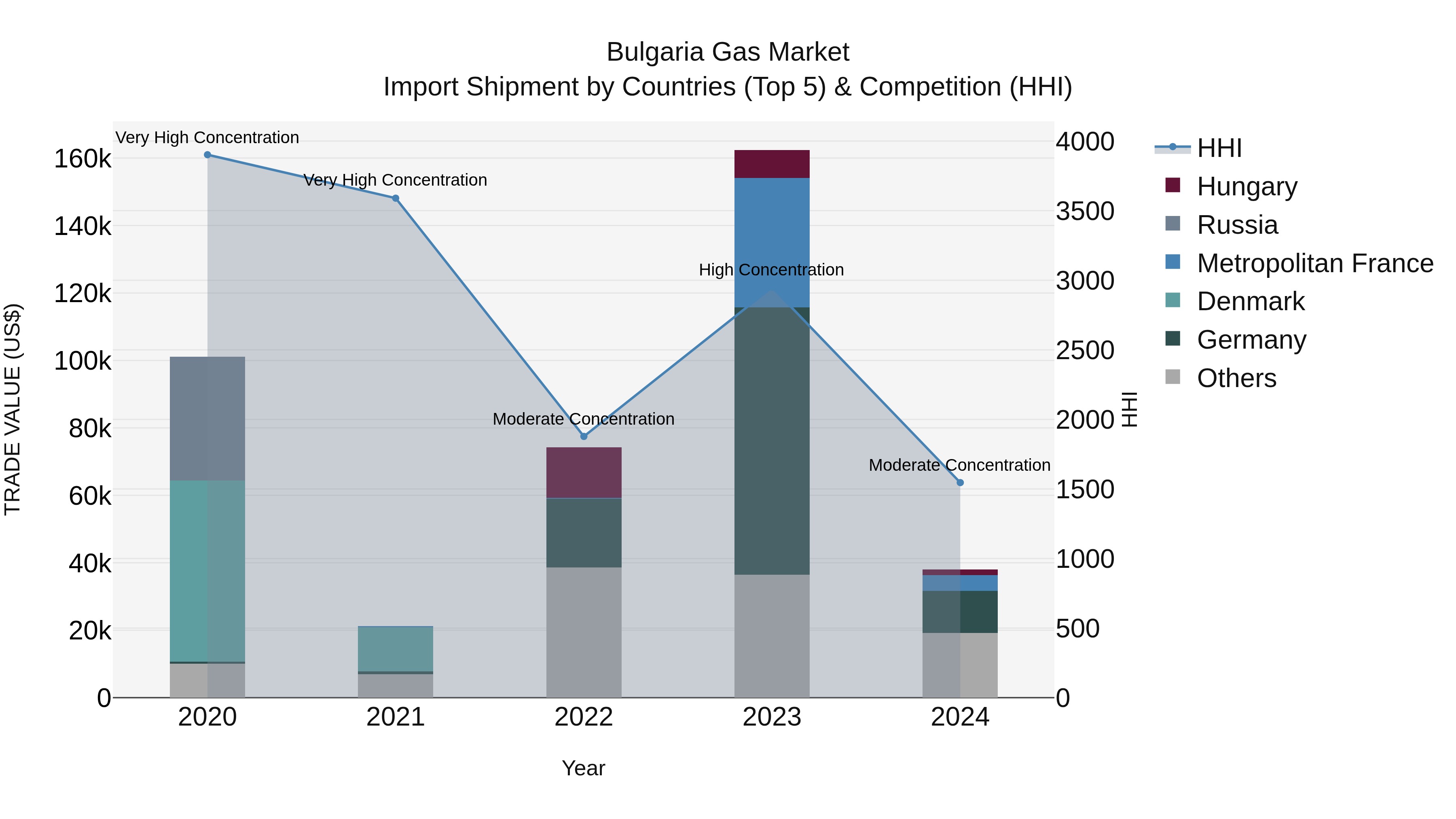
Bulgaria`s gas import shipments in 2024 showed diversification with top exporting countries being Germany, Austria, Metropolitan France, Italy, and Romania. The Herfindahl-Hirschman Index (HHI) indicated a shift from very high concentration in 2023 to a more moderate level in 2024, reflecting a more balanced Market Top 5 Importing Countries and Market Competition (HHI) Analysis . The compound annual growth rate (CAGR) for gas imports from 2020 to 2024 was -21.65%, while the growth rate in 2024 experienced a significant decline of -76.55%. These trends suggest a changing landscape in Bulgaria`s gas import Market Top 5 Importing Countries and Market Competition (HHI) Analysis with implications for future strategies and partnerships.
Bulgaria Gas Market Synopsis
The Bulgaria Gas Market is characterized by a mix of domestic production, imports, and consumption. The country produces natural gas from its own reserves but heavily relies on imports from Russia, with Gazprom being a major supplier. The market is dominated by state-owned companies, with Bulgargaz holding a monopoly on gas imports and distribution. Recent efforts have been made to diversify gas sources and improve infrastructure to enhance security of supply and promote competition. Bulgaria is also investing in interconnectors with neighboring countries to further diversify its gas supply routes. The market is regulated by the State Energy and Water Regulatory Commission (SEWRC) to ensure fair competition and consumer protection. Overall, the Bulgaria Gas Market is in a phase of transition towards a more competitive and secure energy landscape.
Bulgaria Gas Market Trends
The Bulgaria Gas Market is currently experiencing a shift towards greater diversification and integration with the European energy market. The country is investing in infrastructure development to enhance its gas storage capacity and interconnections with neighboring countries, such as Greece and Romania. With the increasing focus on sustainability and renewable energy sources, there are opportunities for the expansion of natural gas as a cleaner alternative to coal in Bulgaria`s energy mix. Furthermore, the liberalization of the gas market is creating opportunities for new players to enter and compete, leading to greater market efficiency and potentially lower prices for consumers. Overall, the Bulgaria Gas Market presents opportunities for investment in infrastructure, innovation in cleaner energy solutions, and increased competition in a maturing market.
Bulgaria Gas Market Challenges
The Bulgaria Gas Market faces several challenges, including dependence on imports from Russia, lack of infrastructure for gas storage and transmission, regulatory uncertainties, and limited competition in the market. The heavy reliance on Russian gas exposes the market to geopolitical risks and pricing fluctuations. The insufficient infrastructure hinders the diversification of gas sources and limits the market`s flexibility to respond to supply disruptions. Regulatory uncertainties create barriers to investment in the sector, while the lack of competition results in higher prices and reduced incentives for innovation. Addressing these challenges will be crucial for the Bulgaria Gas Market to enhance security of supply, promote competition, and achieve sustainability in the long term.
Bulgaria Gas Market Investment Opportunities
The Bulgaria Gas Market is primarily driven by factors such as increasing energy demand, economic growth, government policies promoting gas as a cleaner alternative to coal, and the country`s strategic location as a key transit hub for natural gas in Southeast Europe. Additionally, the diversification of gas supply sources, including the development of liquefied natural gas (LNG) terminals and interconnectors with neighboring countries, plays a significant role in driving market growth. The implementation of infrastructure projects, such as the Balkan Gas Hub and the Greece-Bulgaria Interconnector, further contribute to the expansion and integration of the Bulgaria Gas Market within the broader European gas market landscape. Overall, these drivers are expected to continue shaping the future development and competitiveness of the Bulgarian gas sector.
Bulgaria Gas Market Government Polices
Government policies related to the Bulgaria Gas Market focus on increasing competition, enhancing security of supply, and ensuring regulatory oversight. The government has implemented measures to promote market liberalization, encourage investment in infrastructure, and diversify gas sources to reduce dependency on single suppliers. Bulgaria has committed to aligning its gas market regulations with EU directives to foster a more transparent and efficient market structure. Additionally, the government has adopted initiatives to improve energy efficiency, promote renewable energy sources, and advance towards decarbonization goals. Regulatory bodies such as the Energy and Water Regulatory Commission (EWRC) oversee the implementation and enforcement of these policies to ensure fair competition and consumer protection in the gas market.
Bulgaria Gas Market Future Outlook
The Bulgaria Gas Market is expected to experience steady growth in the coming years, driven by factors such as increasing demand for natural gas in industries, households, and power generation. The country`s strategic location as a key transit hub for gas supplies in Southeast Europe further enhances its position in the market. Investments in infrastructure projects, such as the construction of interconnectors and LNG terminals, will also contribute to the market`s development. Additionally, Bulgaria`s efforts to diversify its gas supply sources and reduce its dependence on a single supplier will play a crucial role in shaping the future of the market. Overall, the Bulgaria Gas Market is forecasted to remain resilient and continue its upward trajectory in terms of consumption, infrastructure development, and market competitiveness.
Key Highlights of the Report:
- Bulgaria Gas Market Outlook
- Market Size of Bulgaria Gas Market, 2024
- Forecast of Bulgaria Gas Market, 2031
- Historical Data and Forecast of Bulgaria Gas Revenues & Volume for the Period 2021- 2031
- Bulgaria Gas Market Trend Evolution
- Bulgaria Gas Market Drivers and Challenges
- Bulgaria Gas Price Trends
- Bulgaria Gas Porter's Five Forces
- Bulgaria Gas Industry Life Cycle
- Historical Data and Forecast of Bulgaria Gas Market Revenues & Volume By Application for the Period 2021- 2031
- Historical Data and Forecast of Bulgaria Gas Market Revenues & Volume By Utilities for the Period 2021- 2031
- Historical Data and Forecast of Bulgaria Gas Market Revenues & Volume By Industrial for the Period 2021- 2031
- Historical Data and Forecast of Bulgaria Gas Market Revenues & Volume By Commercial for the Period 2021- 2031
- Bulgaria Gas Import Export Trade Statistics
- Market Opportunity Assessment By Application
- Bulgaria Gas Top Companies Market Share
- Bulgaria Gas Competitive Benchmarking By Technical and Operational Parameters
- Bulgaria Gas Company Profiles
- Bulgaria Gas Key Strategic Recommendations






































