Portugal Gas Market Top 5 Importing Countries and Market Competition (HHI) Analysis
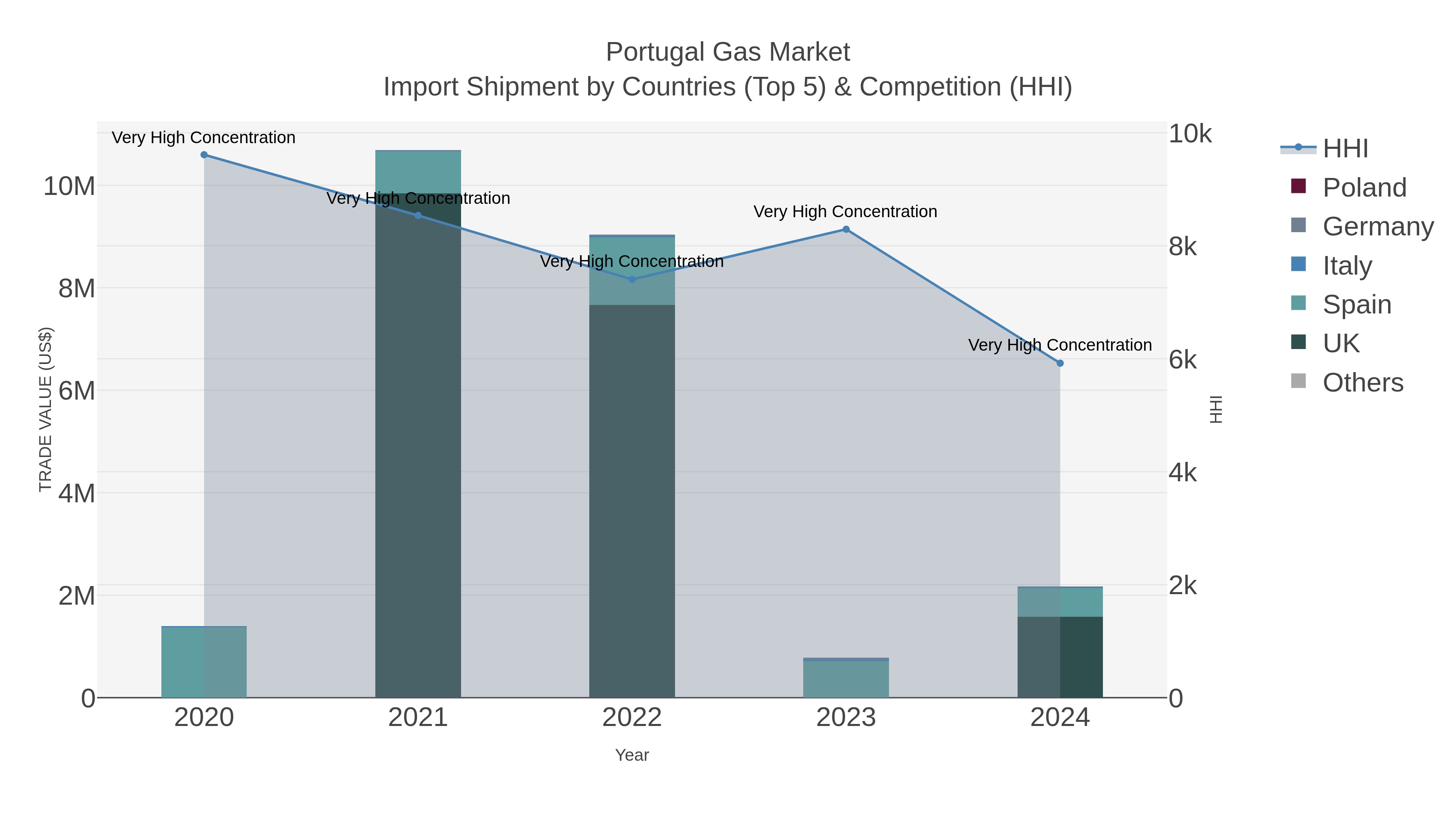
Portugal`s gas import market in 2024 continued to be dominated by key players such as the UK, Spain, Italy, Germany, and Poland. The high Herfindahl-Hirschman Index (HHI) indicates a concentrated market, suggesting potential challenges for new entrants. The impressive compound annual growth rate (CAGR) of 11.59% from 2020 to 2024 reflects a steady expansion of the market. Moreover, the remarkable growth rate of 178.02% from 2023 to 2024 highlights a significant surge in gas import shipments, pointing towards evolving trends and opportunities in the sector.
Portugal Gas Market Synopsis
The Portugal Gas Market is characterized by a strong emphasis on natural gas as a key energy source. The country has a well-developed gas infrastructure, with a network of pipelines and LNG terminals that ensure reliable supply and distribution. The market is dominated by major players such as Galp Energia, which holds a significant market share in gas production, distribution, and retail. Portugal`s gas market is regulated by the Energy Services Regulatory Authority (ERSE), which oversees tariffs, ensures competition, and promotes market transparency. The increasing focus on renewable energy sources and sustainability is driving initiatives to reduce the country`s reliance on gas and promote energy efficiency. Overall, the Portugal Gas Market presents opportunities for investment and growth in the evolving energy landscape.
Portugal Gas Market Trends
The Portugal gas market is experiencing a shift towards renewable energy sources, driven by government initiatives to reduce carbon emissions and increase energy efficiency. Renewable gas, such as biomethane and hydrogen, is gaining traction as a clean alternative to traditional natural gas. Opportunities in the market lie in the development of infrastructure for renewable gas production and distribution, as well as partnerships with other European countries to enhance energy security and promote cross-border trade. Additionally, the increasing demand for cleaner energy solutions presents opportunities for market players to innovate and invest in technologies that support the transition towards a more sustainable energy landscape in Portugal.
Portugal Gas Market Challenges
In the Portugal Gas Market, some key challenges include regulatory uncertainty, limited infrastructure capacity, and dependence on imports. The regulatory landscape in Portugal can be complex and subject to changes, which can create uncertainty for market participants. Additionally, the existing infrastructure for gas transmission and distribution may not be sufficient to meet growing demand, leading to potential supply disruptions. Portugal relies heavily on gas imports, which can make the market vulnerable to fluctuations in global prices and geopolitical factors. Addressing these challenges will require investment in infrastructure, clear and stable regulatory frameworks, and efforts to diversify energy sources to enhance security of supply in the Portugal Gas Market.
Portugal Gas Market Investment Opportunities
The drivers of the Portugal Gas Market include factors such as increasing demand for natural gas for power generation, industrial use, and residential consumption. The country`s efforts to reduce greenhouse gas emissions and transition towards cleaner energy sources have also led to a growing emphasis on natural gas as a more environmentally friendly alternative to coal and oil. Additionally, Portugal`s strategic location as a gateway for gas imports into Europe, particularly from North Africa and the United States, plays a significant role in shaping its gas market dynamics. Government policies promoting energy diversification and security of supply, as well as ongoing investments in infrastructure development, further contribute to the growth and stability of the Portugal Gas Market.
Portugal Gas Market Government Polices
The Portugal Gas Market is regulated by the Energy Services Regulatory Authority (ERSE), which oversees the licensing, pricing, and quality standards of gas suppliers. The government has implemented policies to promote competition and ensure consumer protection in the gas market. This includes measures such as unbundling of gas supply and distribution activities, promoting transparency in pricing, and enforcing regulations to prevent anti-competitive behavior. Additionally, the government has set targets to increase the share of renewable and low-carbon gases in the energy mix, aligning with the country`s commitment to decarbonization and sustainability. Overall, the government`s policies aim to create a more efficient, competitive, and environmentally sustainable gas market in Portugal.
Portugal Gas Market Future Outlook
The future outlook for the Portugal Gas Market looks promising as the country aims to transition towards cleaner energy sources in line with its commitment to reduce carbon emissions. The increasing focus on renewable energy sources, such as solar and wind power, is expected to drive a shift away from traditional gas consumption in the long term. However, natural gas is likely to play a significant role as a transitional fuel in the short to medium term, providing a reliable and flexible energy source to support the integration of intermittent renewables. Investments in infrastructure, such as LNG terminals and pipelines, will be crucial to ensure energy security and meet the growing demand for gas in the industrial, residential, and transportation sectors. Overall, the Portugal Gas Market is poised for evolution towards a more sustainable and diversified energy mix.
Key Highlights of the Report:
- Portugal Gas Market Outlook
- Market Size of Portugal Gas Market, 2025
- Forecast of Portugal Gas Market, 2032
- Historical Data and Forecast of Portugal Gas Revenues & Volume for the Period 2022- 2032
- Portugal Gas Market Trend Evolution
- Portugal Gas Market Drivers and Challenges
- Portugal Gas Price Trends
- Portugal Gas Porter's Five Forces
- Portugal Gas Industry Life Cycle
- Historical Data and Forecast of Portugal Gas Market Revenues & Volume By Application for the Period 2022- 2032
- Historical Data and Forecast of Portugal Gas Market Revenues & Volume By Utilities for the Period 2022- 2032
- Historical Data and Forecast of Portugal Gas Market Revenues & Volume By Industrial for the Period 2022- 2032
- Historical Data and Forecast of Portugal Gas Market Revenues & Volume By Commercial for the Period 2022- 2032
- Portugal Gas Import Export Trade Statistics
- Market Opportunity Assessment By Application
- Portugal Gas Top Companies Market Share
- Portugal Gas Competitive Benchmarking By Technical and Operational Parameters
- Portugal Gas Company Profiles
- Portugal Gas Key Strategic Recommendations






































