Bulgaria Low Voltage Industrial Controls Market Top 5 Importing Countries and Market Competition (HHI) Analysis
Bulgaria`s import shipments of low voltage industrial controls saw significant growth in 2024, with top exporters being China, Germany, Turkey, USA, and Italy. Despite the presence of key players, the Market Top 5 Importing Countries and Market Competition (HHI) Analysis remains relatively competitive with a low concentration level indicated by the Herfindahl-Hirschman Index (HHI). The compound annual growth rate (CAGR) from 2020 to 2024 was an impressive 22.94%, with a continued growth rate of 3.48% from 2023 to 2024. This data suggests a positive outlook for the Bulgarian Market Top 5 Importing Countries and Market Competition (HHI) Analysis for low voltage industrial controls in the coming years.
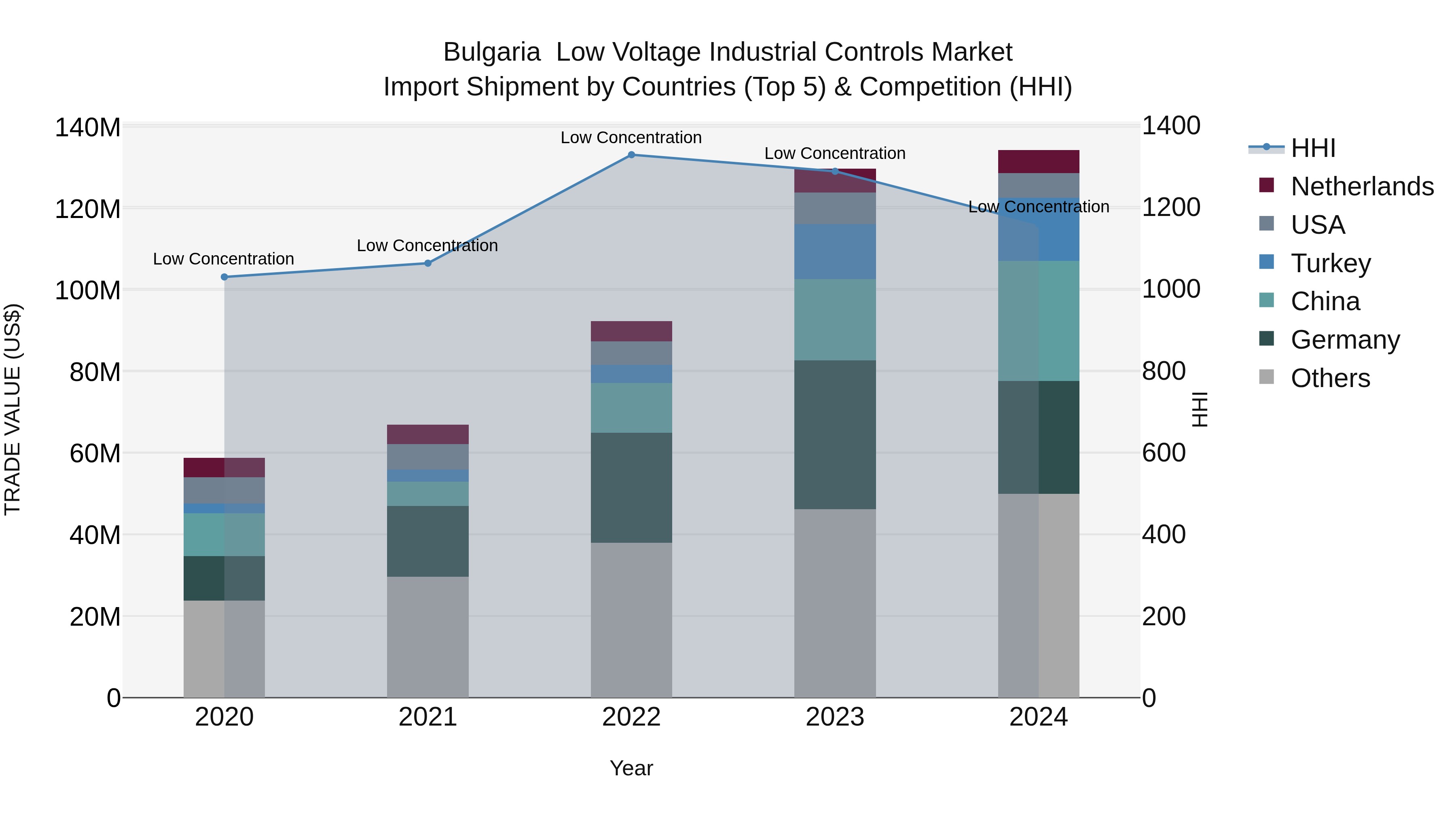
Bulgaria Low Voltage Industrial Controls Market Overview
This market encompasses devices that manage, protect, and control industrial electrical systems operating at low voltage. The market is driven by industrial automation and the need for efficient and safe operation of machinery.
Drivers of the market
The Bulgaria low voltage industrial controls market is growing with the increasing need for efficient and reliable control solutions in industrial automation. Low voltage industrial controls are used to manage and control electrical systems and equipment in various industrial applications. The market is driven by advancements in control technology, increasing automation in industries, and the focus on improving operational efficiency and safety. The emphasis on performance and reliability in industrial controls is contributing to market expansion.
Challenges of the market
In Bulgaria, the Low Voltage Industrial Controls Market is challenged by the need for advanced control systems that can handle the increasing complexity of modern industrial processes. The market is under pressure to develop controls that are not only reliable and efficient but also capable of integrating with digital and automated systems. Additionally, there is a growing demand for controls that can meet the needs of energy-efficient and environmentally friendly operations, which requires significant investment in research and development. The cost of implementing and maintaining these advanced systems is a significant barrier for many businesses.
Government Policy of the market
The low voltage industrial controls market in Bulgaria is shaped by government policies that promote the modernization of industrial automation and manufacturing processes. The governments focus on enhancing energy efficiency, reducing production costs, and improving safety standards drives the demand for low voltage industrial controls. Additionally, compliance with EU regulations on industrial safety and environmental impact plays a significant role in shaping the market. Government incentives for adopting advanced automation technologies and support for the industrial sectors digital transformation further contribute to the growth of the low voltage industrial controls market in Bulgaria.
Key Highlights of the Report:
- Bulgaria Low Voltage Industrial Controls Market Outlook
- Market Size of Bulgaria Low Voltage Industrial Controls Market, 2024
- Forecast of Bulgaria Low Voltage Industrial Controls Market, 2031
- Historical Data and Forecast of Bulgaria Low Voltage Industrial Controls Revenues & Volume for the Period 2021-2031
- Bulgaria Low Voltage Industrial Controls Market Trend Evolution
- Bulgaria Low Voltage Industrial Controls Market Drivers and Challenges
- Bulgaria Low Voltage Industrial Controls Price Trends
- Bulgaria Low Voltage Industrial Controls Porter`s Five Forces
- Bulgaria Low Voltage Industrial Controls Industry Life Cycle
- Historical Data and Forecast of Bulgaria Low Voltage Industrial Controls Market Revenues & Volume By Products for the Period 2021-2031
- Historical Data and Forecast of Bulgaria Low Voltage Industrial Controls Market Revenues & Volume By MCB for the Period 2021-2031
- Historical Data and Forecast of Bulgaria Low Voltage Industrial Controls Market Revenues & Volume By MCCB for the Period 2021-2031
- Historical Data and Forecast of Bulgaria Low Voltage Industrial Controls Market Revenues & Volume By Contactors for the Period 2021-2031
- Historical Data and Forecast of Bulgaria Low Voltage Industrial Controls Market Revenues & Volume By Relays for the Period 2021-2031
- Historical Data and Forecast of Bulgaria Low Voltage Industrial Controls Market Revenues & Volume By Motor starters for the Period 2021-2031
- Historical Data and Forecast of Bulgaria Low Voltage Industrial Controls Market Revenues & Volume By Thermal Overload Relays for the Period 2021-2031
- Historical Data and Forecast of Bulgaria Low Voltage Industrial Controls Market Revenues & Volume By Others for the Period 2021-2031
- Historical Data and Forecast of Bulgaria Low Voltage Industrial Controls Market Revenues & Volume By Applications for the Period 2021-2031
- Historical Data and Forecast of Bulgaria Low Voltage Industrial Controls Market Revenues & Volume By Process Industry for the Period 2021-2031
- Historical Data and Forecast of Bulgaria Low Voltage Industrial Controls Market Revenues & Volume By Manufacturing Industry for the Period 2021-2031
- Historical Data and Forecast of Bulgaria Low Voltage Industrial Controls Market Revenues & Volume By Transportation Railways for the Period 2021-2031
- Bulgaria Low Voltage Industrial Controls Import Export Trade Statistics
- Market Opportunity Assessment By Products
- Market Opportunity Assessment By Applications
- Bulgaria Low Voltage Industrial Controls Top Companies Market Share
- Bulgaria Low Voltage Industrial Controls Competitive Benchmarking By Technical and Operational Parameters
- Bulgaria Low Voltage Industrial Controls Company Profiles
- Bulgaria Low Voltage Industrial Controls Key Strategic Recommendations






































