Bulgaria Lumber Market Top 5 Importing Countries and Market Competition (HHI) Analysis
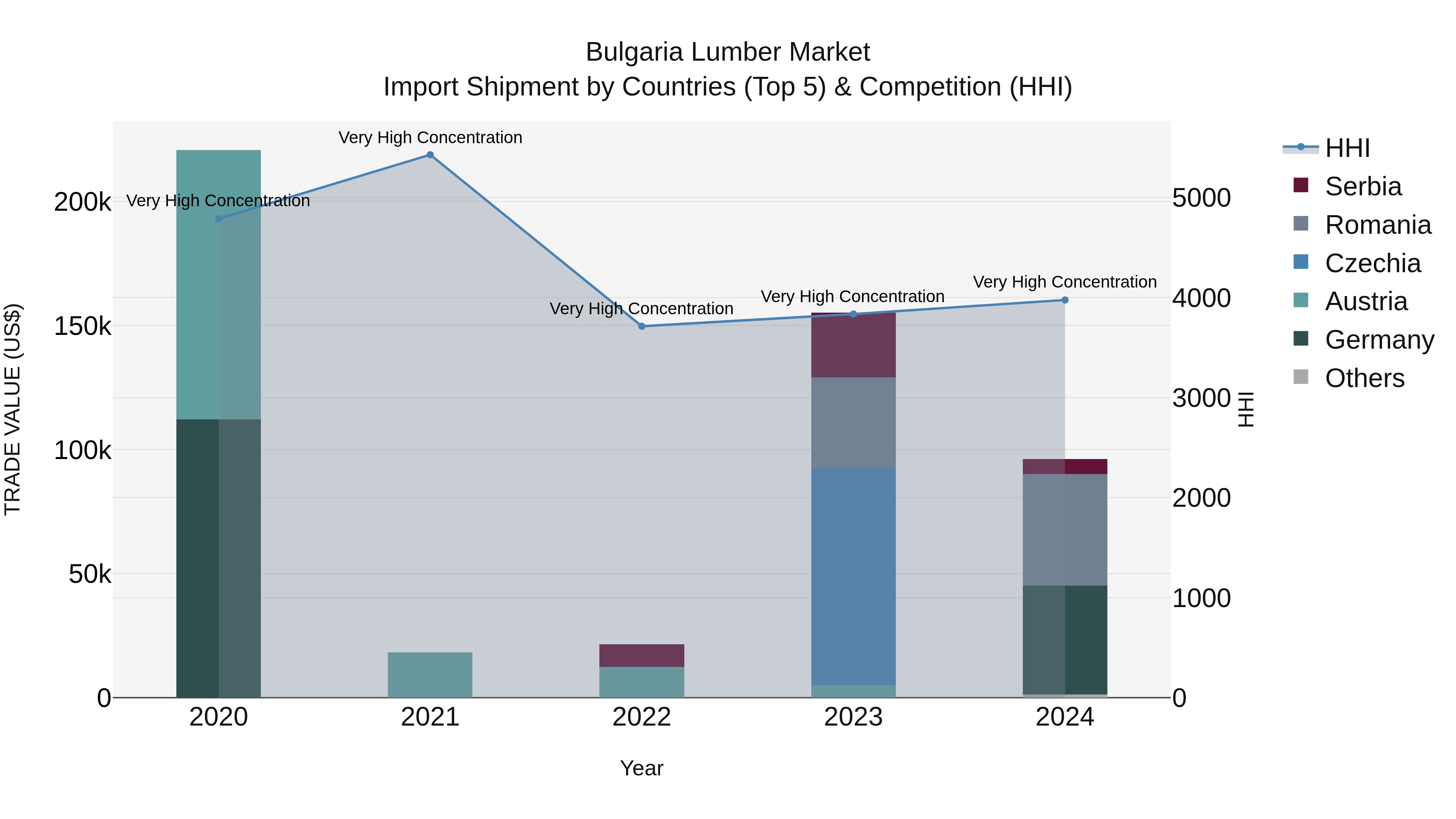
Despite a high concentration of lumber imports from top countries like Romania, Germany, and Serbia, Bulgaria saw a significant decline in import shipments with a CAGR of -18.76% from 2020 to 2024. The negative growth rate of -38.04% from 2023 to 2024 indicates a challenging Market Top 5 Importing Countries and Market Competition (HHI) Analysis environment. It will be crucial for stakeholders in the lumber industry to closely monitor these trends and consider strategies to adapt to the changing dynamics in the Bulgarian Market Top 5 Importing Countries and Market Competition (HHI) Analysis .
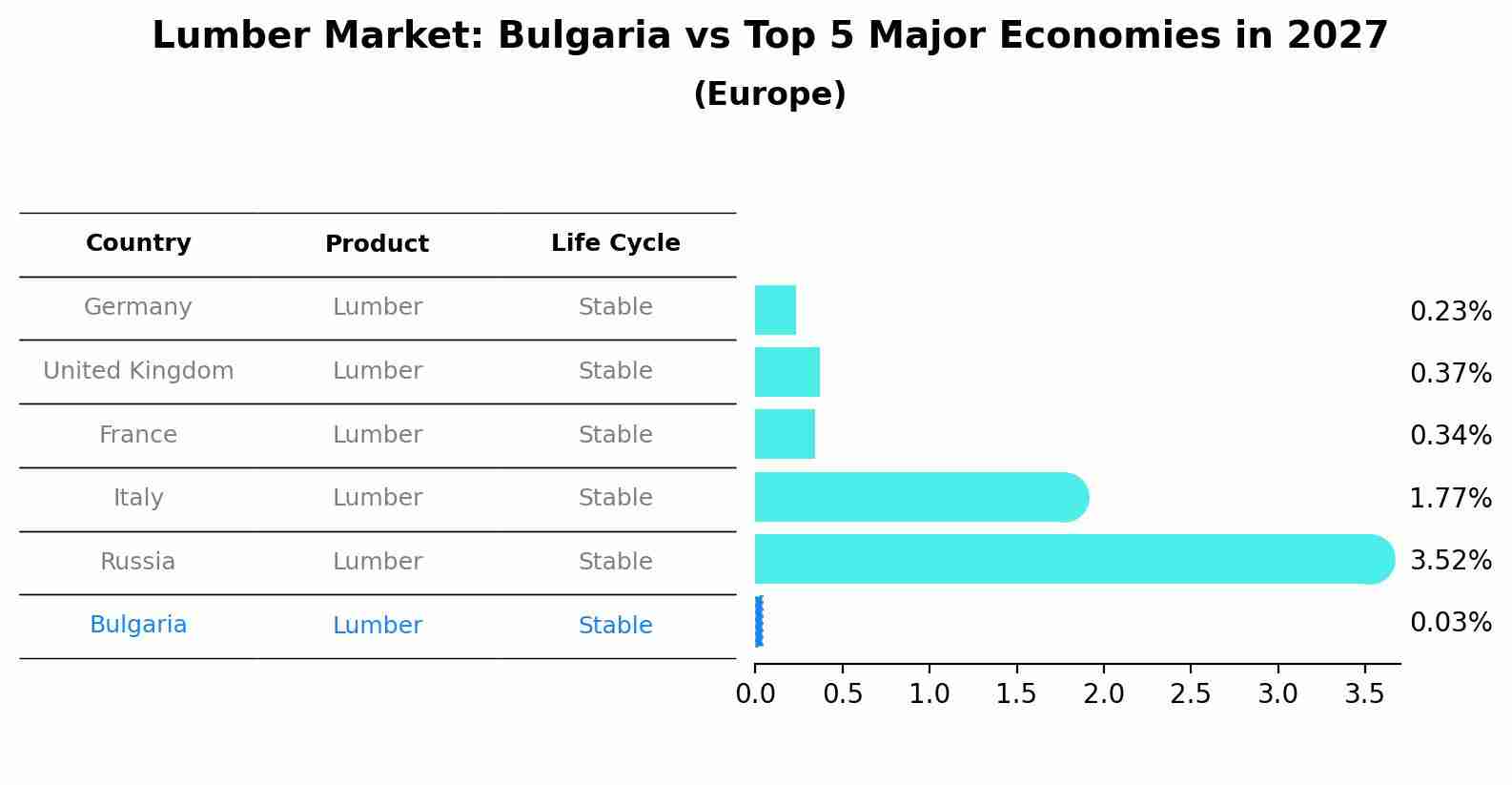
Lumber Market: Bulgaria vs Top 5 Major Economies in 2027 (Europe)
Bulgaria's Lumber market is anticipated to experience a stable growth rate of 0.03% by 2027, reflecting trends observed in the largest economy Germany, followed by United Kingdom, France, Italy and Russia.
Bulgaria Lumber Market Overview
Bulgaria`s lumber market is vital to the construction and furniture industries, supplying essential wood products. The market is influenced by both domestic demand and export opportunities in Europe.
Drivers of the market
The Bulgaria lumber market is growing due to rising demand in construction, furniture manufacturing, and various other applications. Lumber is a vital raw material used in residential and commercial building projects, as well as in the production of wooden products. The market growth is supported by increasing construction activities, the popularity of wooden furniture, and advancements in lumber processing technology. Additionally, the focus on sustainable forestry practices and the growing preference for eco-friendly building materials are contributing to the expansion of the lumber market.
Challenges of the market
Bulgaria`s Lumber Market is confronted with issues related to sustainable forest management and the rising costs of raw materials. There is an increasing demand for lumber products both domestically and for export, but this is balanced by the need to ensure that logging practices do not lead to deforestation or environmental degradation. Furthermore, fluctuating market prices for wood and competition from alternative building materials create additional pressures on the market.
Government Policy of the market
Government policies in Bulgaria aimed at sustainable forest management and environmental conservation significantly impact the lumber market. The Bulgarian government enforces strict regulations on logging activities to ensure the sustainability of forest resources, which influences the supply and pricing of lumber. Additionally, the promotion of eco-friendly construction practices and the adoption of wood as a sustainable building material align with government objectives, driving demand in the lumber market. Government support for the forestry sector, including reforestation initiatives and sustainable forest management practices, also plays a key role in shaping the market.
Key Highlights of the Report:
- Bulgaria Lumber Market Outlook
- Market Size of Bulgaria Lumber Market, 2024
- Forecast of Bulgaria Lumber Market, 2031
- Historical Data and Forecast of Bulgaria Lumber Revenues & Volume for the Period 2021-2031
- Bulgaria Lumber Market Trend Evolution
- Bulgaria Lumber Market Drivers and Challenges
- Bulgaria Lumber Price Trends
- Bulgaria Lumber Porter`s Five Forces
- Bulgaria Lumber Industry Life Cycle
- Historical Data and Forecast of Bulgaria Lumber Market Revenues & Volume By Types for the Period 2021-2031
- Historical Data and Forecast of Bulgaria Lumber Market Revenues & Volume By Hardwood Lumber for the Period 2021-2031
- Historical Data and Forecast of Bulgaria Lumber Market Revenues & Volume By Softwood Lumber for the Period 2021-2031
- Historical Data and Forecast of Bulgaria Lumber Market Revenues & Volume By Application for the Period 2021-2031
- Historical Data and Forecast of Bulgaria Lumber Market Revenues & Volume By Construction for the Period 2021-2031
- Historical Data and Forecast of Bulgaria Lumber Market Revenues & Volume By Furniture for the Period 2021-2031
- Historical Data and Forecast of Bulgaria Lumber Market Revenues & Volume By Flooring for the Period 2021-2031
- Historical Data and Forecast of Bulgaria Lumber Market Revenues & Volume By Moldings for the Period 2021-2031
- Historical Data and Forecast of Bulgaria Lumber Market Revenues & Volume By Others for the Period 2021-2031
- Bulgaria Lumber Import Export Trade Statistics
- Market Opportunity Assessment By Types
- Market Opportunity Assessment By Application
- Bulgaria Lumber Top Companies Market Share
- Bulgaria Lumber Competitive Benchmarking By Technical and Operational Parameters
- Bulgaria Lumber Company Profiles
- Bulgaria Lumber Key Strategic Recommendations






































