Bulgaria Mirrorless Camera Market Top 5 Importing Countries and Market Competition (HHI) Analysis
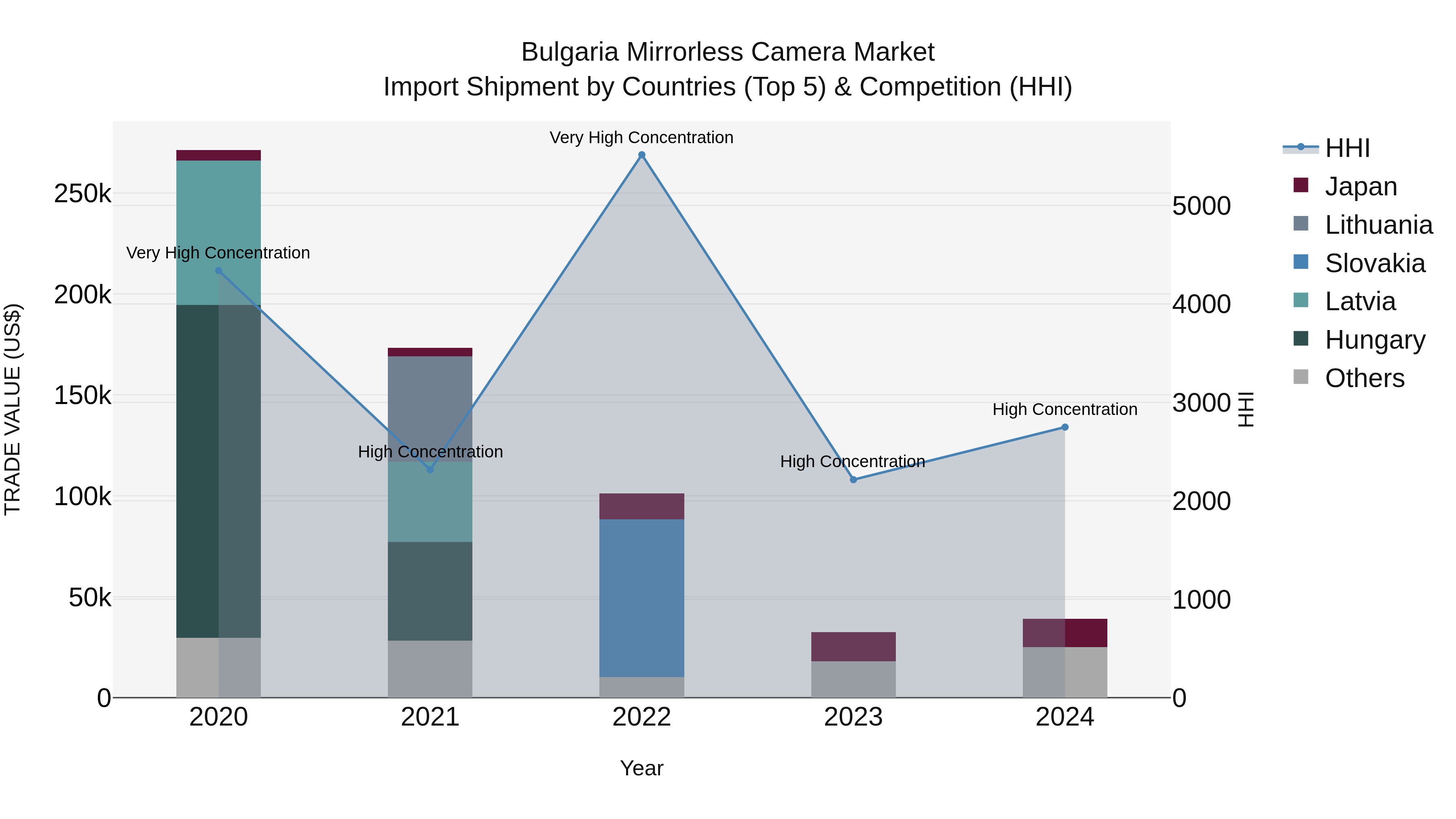
The Bulgaria mirrorless camera import Market Top 5 Importing Countries and Market Competition (HHI) Analysis continues to see a high concentration of shipments from top exporting countries such as China, Japan, USA, Switzerland, and the Philippines. The Market Top 5 Importing Countries and Market Competition (HHI) Analysis concentration increased significantly from 2023 to 2024, indicating a strong presence of these key players. Despite a negative compound annual growth rate from 2020 to 2024, there was a notable growth rate of 20.39% from 2023 to 2024, suggesting a potential rebound in the Market Top 5 Importing Countries and Market Competition (HHI) Analysis . This data highlights the competitive landscape and evolving dynamics within the Bulgaria mirrorless camera import sector.
Bulgaria Mirrorless Camera Market Overview
The Bulgaria mirrorless camera market is experiencing steady growth driven by the increasing demand for lightweight and compact camera options among photography enthusiasts and professionals. Key players in the market, such as Sony, Canon, Nikon, and Fujifilm, are actively introducing new models with advanced features like high-resolution sensors, fast autofocus systems, and 4K video capabilities to cater to the evolving needs of consumers. The mirrorless camera segment in Bulgaria is also benefiting from the rising popularity of social media platforms, where users seek high-quality images for sharing. Additionally, the availability of a wide range of lenses and accessories for mirrorless cameras is further fueling market growth. As consumers in Bulgaria continue to prioritize portability and performance in their camera choices, the mirrorless segment is expected to maintain its upward trajectory in the foreseeable future.
Bulgaria Mirrorless Camera Market Trends and Opportunities
The Bulgaria Mirrorless Camera Market is experiencing growth driven by a rising interest in photography and videography among consumers, as well as advancements in technology leading to more affordable and feature-rich mirrorless cameras. Key trends in the market include a shift towards smaller and lighter camera bodies, improved autofocus systems, and enhanced video capabilities. Opportunities exist for camera manufacturers to target niche segments such as vloggers, content creators, and travel enthusiasts who value portability and versatility in their camera gear. Additionally, the growing popularity of social media platforms and online content creation presents a lucrative avenue for mirrorless camera brands to engage with and attract a younger demographic of tech-savvy users looking to upgrade their gear for better image quality and creative expression.
Bulgaria Mirrorless Camera Market Challenges
In the Bulgaria mirrorless camera market, one of the key challenges is the relatively low awareness and adoption of mirrorless cameras compared to traditional DSLRs. Many consumers in Bulgaria still prefer DSLRs due to their familiarity and perceived superior image quality. Additionally, there is a limited availability of mirrorless camera models and accessories in physical retail stores, which hinders potential customers from experiencing and purchasing these products. Price sensitivity among Bulgarian consumers also poses a challenge, as mirrorless cameras are generally more expensive than entry-level DSLRs. Furthermore, the lack of specialized marketing campaigns and education about the benefits of mirrorless cameras compared to DSLRs contributes to the slow growth of the mirrorless camera market in Bulgaria.
Bulgaria Mirrorless Camera Market Drivers
The Bulgaria Mirrorless Camera Market is primarily being driven by the growing popularity of mirrorless cameras among photography enthusiasts and professionals due to their compact size, lighter weight, and advanced features such as electronic viewfinders and fast autofocus systems. Additionally, the increasing trend of content creation on social media platforms and the rise of vlogging have also contributed to the demand for mirrorless cameras in Bulgaria. The availability of a wide range of mirrorless camera models from leading brands, along with advancements in technology leading to improved image quality and performance, further fuel the market growth. Moreover, the convenience of interchangeable lenses and the versatility of mirrorless cameras for various photography needs are attracting a broader consumer base in the Bulgarian market.
Bulgaria Mirrorless Camera Market Government Policies
The Bulgarian government does not have specific policies targeting the mirrorless camera market. However, general regulations related to import tariffs, value-added tax (VAT), and intellectual property rights protection apply to the industry. In recent years, Bulgaria has been focusing on improving its overall business environment by reducing bureaucracy and streamlining administrative procedures to attract foreign investment. The government also provides various incentives and subsidies to support innovation and technology development, which could indirectly benefit the mirrorless camera market. Overall, while there are no direct policies tailored for the mirrorless camera market in Bulgaria, the government`s efforts to enhance the business climate and support innovation could positively impact the industry.
Bulgaria Mirrorless Camera Market Future Outlook
The future outlook for the Bulgaria Mirrorless Camera Market appears promising, with a projected growth driven by increasing consumer interest in photography and videography, as well as advancements in technology leading to more compact, versatile, and high-performance mirrorless cameras. Additionally, the rising popularity of social media platforms and influencer culture is expected to fuel demand for mirrorless cameras among amateur photographers and content creators. Furthermore, the convenience of mirrorless cameras due to their lightweight design and ability to interchange lenses makes them appealing to a wide range of users. As a result, the Bulgaria Mirrorless Camera Market is anticipated to experience steady growth in the coming years, with opportunities for both established brands and new entrants to capture market share through innovative product offerings and effective marketing strategies.
Key Highlights of the Report:
- Bulgaria Mirrorless Camera Market Outlook
- Market Size of Bulgaria Mirrorless Camera Market, 2024
- Forecast of Bulgaria Mirrorless Camera Market, 2031
- Historical Data and Forecast of Bulgaria Mirrorless Camera Revenues & Volume for the Period 2021- 2031
- Bulgaria Mirrorless Camera Market Trend Evolution
- Bulgaria Mirrorless Camera Market Drivers and Challenges
- Bulgaria Mirrorless Camera Price Trends
- Bulgaria Mirrorless Camera Porter's Five Forces
- Bulgaria Mirrorless Camera Industry Life Cycle
- Historical Data and Forecast of Bulgaria Mirrorless Camera Market Revenues & Volume By Type for the Period 2021- 2031
- Historical Data and Forecast of Bulgaria Mirrorless Camera Market Revenues & Volume By Built-in or Static Lens for the Period 2021- 2031
- Historical Data and Forecast of Bulgaria Mirrorless Camera Market Revenues & Volume By Interchangeable Lens for the Period 2021- 2031
- Bulgaria Mirrorless Camera Import Export Trade Statistics
- Market Opportunity Assessment By Type
- Bulgaria Mirrorless Camera Top Companies Market Share
- Bulgaria Mirrorless Camera Competitive Benchmarking By Technical and Operational Parameters
- Bulgaria Mirrorless Camera Company Profiles
- Bulgaria Mirrorless Camera Key Strategic Recommendations






































