Bulgaria Piano Market Size (2020-2030)
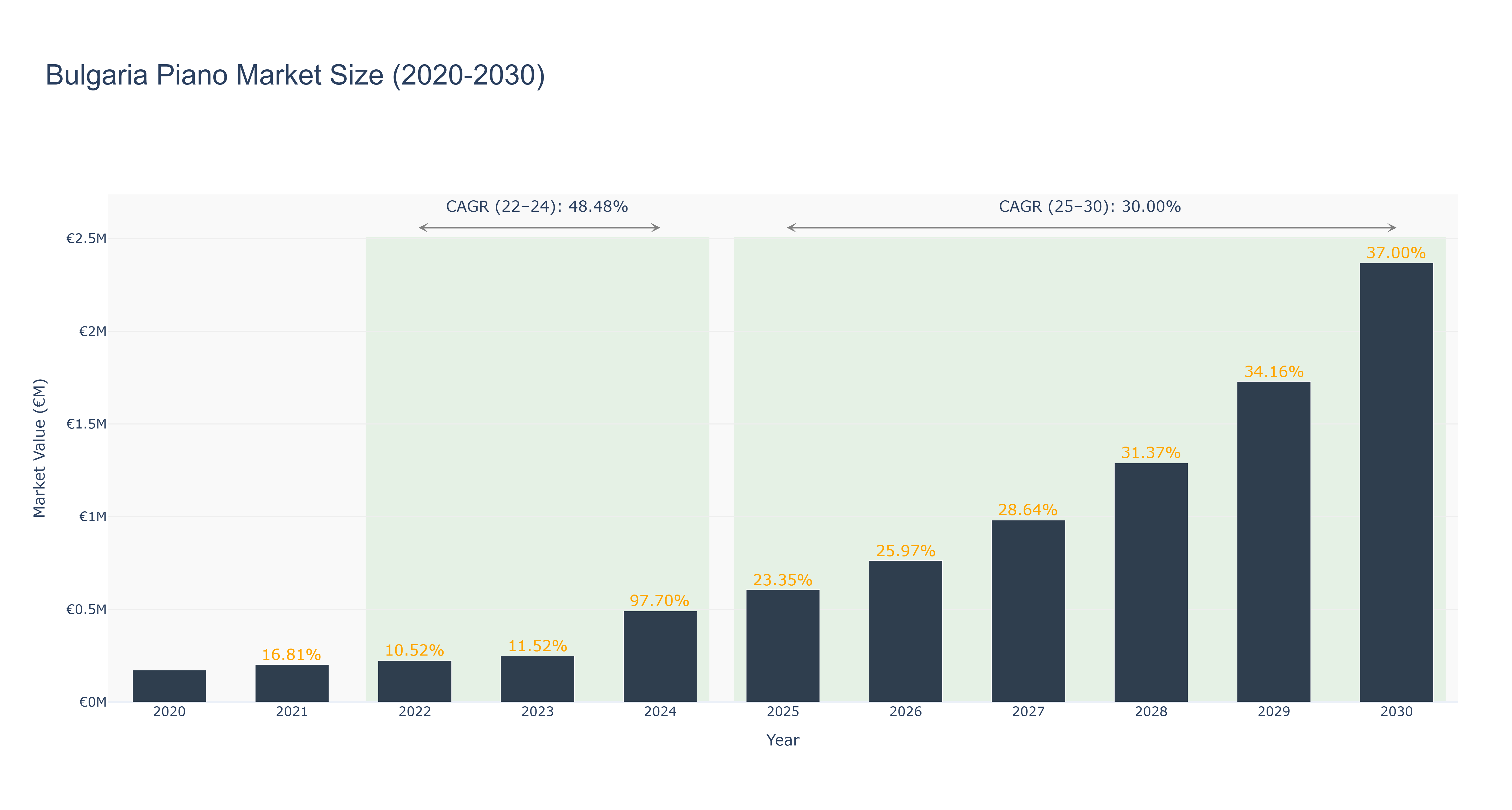
The Bulgaria Piano Market has demonstrated robust growth, particularly between 2022 and 2024, with actual market sizes increasing from €222.63 thousand in 2022 to €490.83 thousand in 2024, reflecting a remarkable compound annual growth rate (CAGR) of 48.48%. This surge can be attributed to rising interest in music education and cultural investments, coupled with a growing middle class willing to invest in musical instruments. Looking ahead, the forecasted period from 2025 to 2030 anticipates continued expansion, with projected market sizes escalating from €605.46 thousand in 2025 to €2.37 million by 2030, corresponding to a CAGR of 30.00%. This growth is expected to be driven by increased disposable income, urbanization, and potential government initiatives to promote the arts. As the market matures, innovation in piano manufacturing and digital integration may further enhance consumer engagement and market penetration.
Bulgaria Piano Market: Production & Trade Performance (2019-2025)
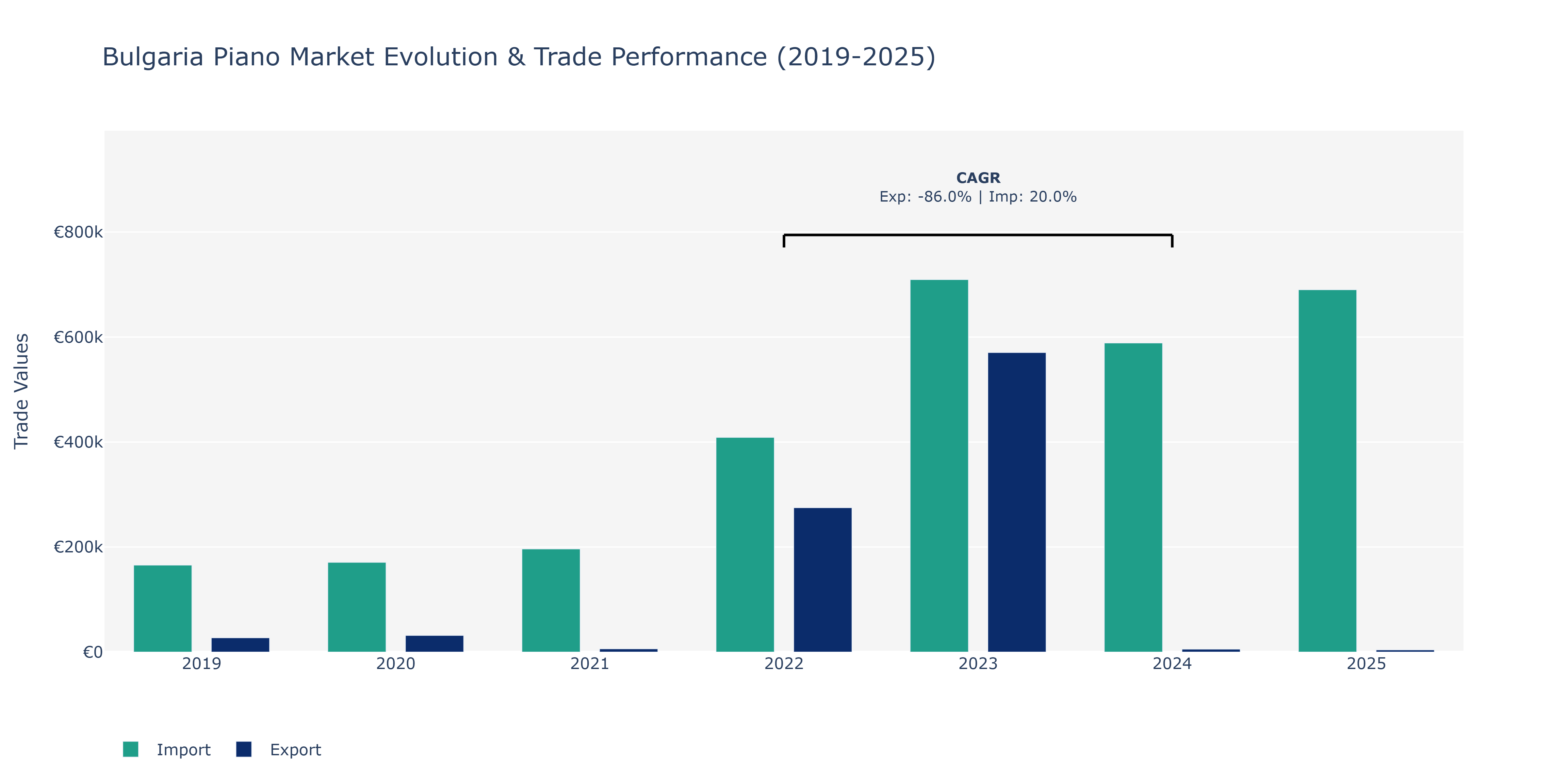
Between 2019 and 2025, Bulgaria's Piano Market saw noteworthy shifts in both exports and imports. In 2019, exports started at €27.12 thousand and showed a slight increase to €31.57 thousand in 2020 before markedly dropping to €6.12 thousand in 2021. However, a remarkable surge occurred in 2022 when exports skyrocketed to €274.82 thousand, peaking at €570.43 thousand in 2023, before decreasing sharply to €5.42 thousand in 2024 and further to €4.08 thousand in 2025. Conversely, imports followed a different trajectory, growing steadily from €165.55 thousand in 2019 to €709.34 thousand in 2023, with a slight dip to €588.59 thousand in 2024, and stabilizing at €690.03 thousand in 2025. This fluctuation can be attributed to various factors, including global economic conditions affecting consumer preferences and demand for pianos, changes in tariffs or trade policies impacting imports, and shifts in domestic production influencing export quantities. The substantial rise in imports from 2019 to 2023 might suggest increased foreign demand for pianos, while the sharp decline in exports post-2023 could reflect changing market dynamics or competitiveness challenges faced by Bulgarian piano manufacturers. To remain competitive, stakeholders in the Bulgaria Piano Market could consider strategic pricing, product innovation, and market diversification strategies to navigate these fluctuations effectively.
Key Highlights of the Report:
- Bulgaria Piano Market Outlook
- Market Size of Bulgaria Piano Market, 2025
- Forecast of Bulgaria Piano Market, 2032
- Historical Data and Forecast of Bulgaria Piano Revenues & Volume for the Period 2022 - 2032F
- Bulgaria Piano Market Trend Evolution
- Bulgaria Piano Market Drivers and Challenges
- Bulgaria Piano Price Trends
- Bulgaria Piano Porter`s Five Forces
- Bulgaria Piano Industry Life Cycle
- Historical Data and Forecast of Bulgaria Piano Market Revenues & Volume By Type for the Period 2022 - 2032F
- Historical Data and Forecast of Bulgaria Piano Market Revenues & Volume By Grand Piano for the Period 2022 - 2032F
- Historical Data and Forecast of Bulgaria Piano Market Revenues & Volume By Upright Piano for the Period 2022 - 2032F
- Historical Data and Forecast of Bulgaria Piano Market Revenues & Volume By Application for the Period 2022 - 2032F
- Historical Data and Forecast of Bulgaria Piano Market Revenues & Volume By Learning and Teaching for the Period 2022 - 2032F
- Historical Data and Forecast of Bulgaria Piano Market Revenues & Volume By Entertainment for the Period 2022 - 2032F
- Historical Data and Forecast of Bulgaria Piano Market Revenues & Volume By Other for the Period 2022 - 2032F
- Bulgaria Piano Import Export Trade Statistics
- Market Opportunity Assessment By Type
- Market Opportunity Assessment By Application
- Bulgaria Piano Top Companies Market Share
- Bulgaria Piano Competitive Benchmarking By Technical and Operational Parameters
- Bulgaria Piano Company Profiles
- Bulgaria Piano Key Strategic Recommendations






































