Bulgaria Wax Market Size (2020-2030)
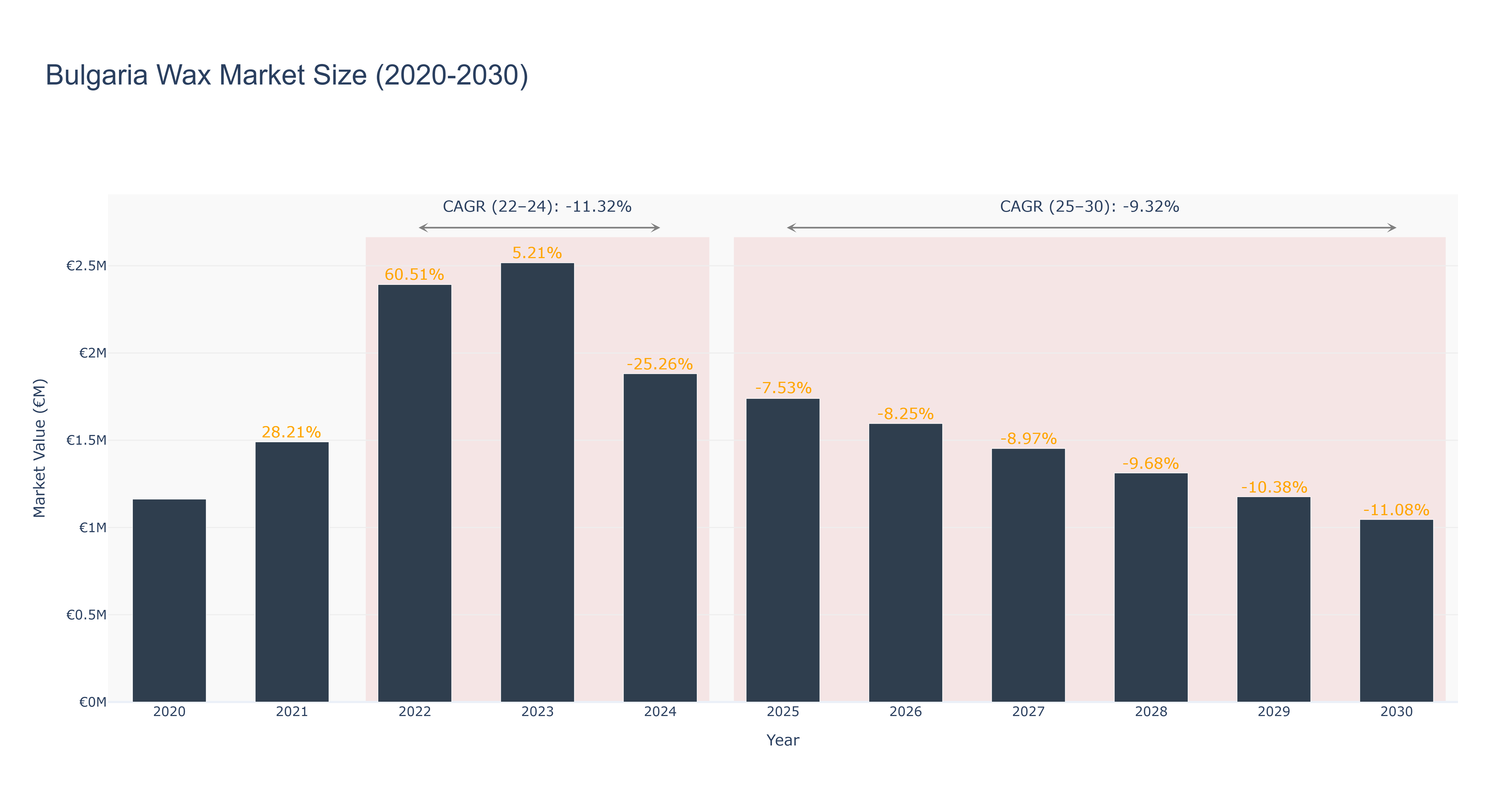
Bulgaria Wax Market has seen fluctuations in market size over the past decade. The peak market size of €2.52 million was observed in 2023, with a subsequent decline to €1.05 million forecasted for 2030. Notably, the market experienced a significant growth rate of 60.51% in 2022, followed by a sharp decline of -25.26% in 2024. The CAGR for the period 2022-24 stands at -11.32%, while for 2025-30, it is projected at -9.32%. These fluctuations can be attributed to various factors such as changes in consumer preferences, economic conditions, and global market dynamics. Looking ahead, the Bulgaria Wax Market is expected to witness further challenges, necessitating strategic adaptations by industry players to navigate the evolving landscape. Recent developments indicate a shift towards sustainable wax production methods, aligning with the growing demand for eco-friendly products in the market.
Bulgaria Wax Market: Production & Trade Performance (2019-2025)
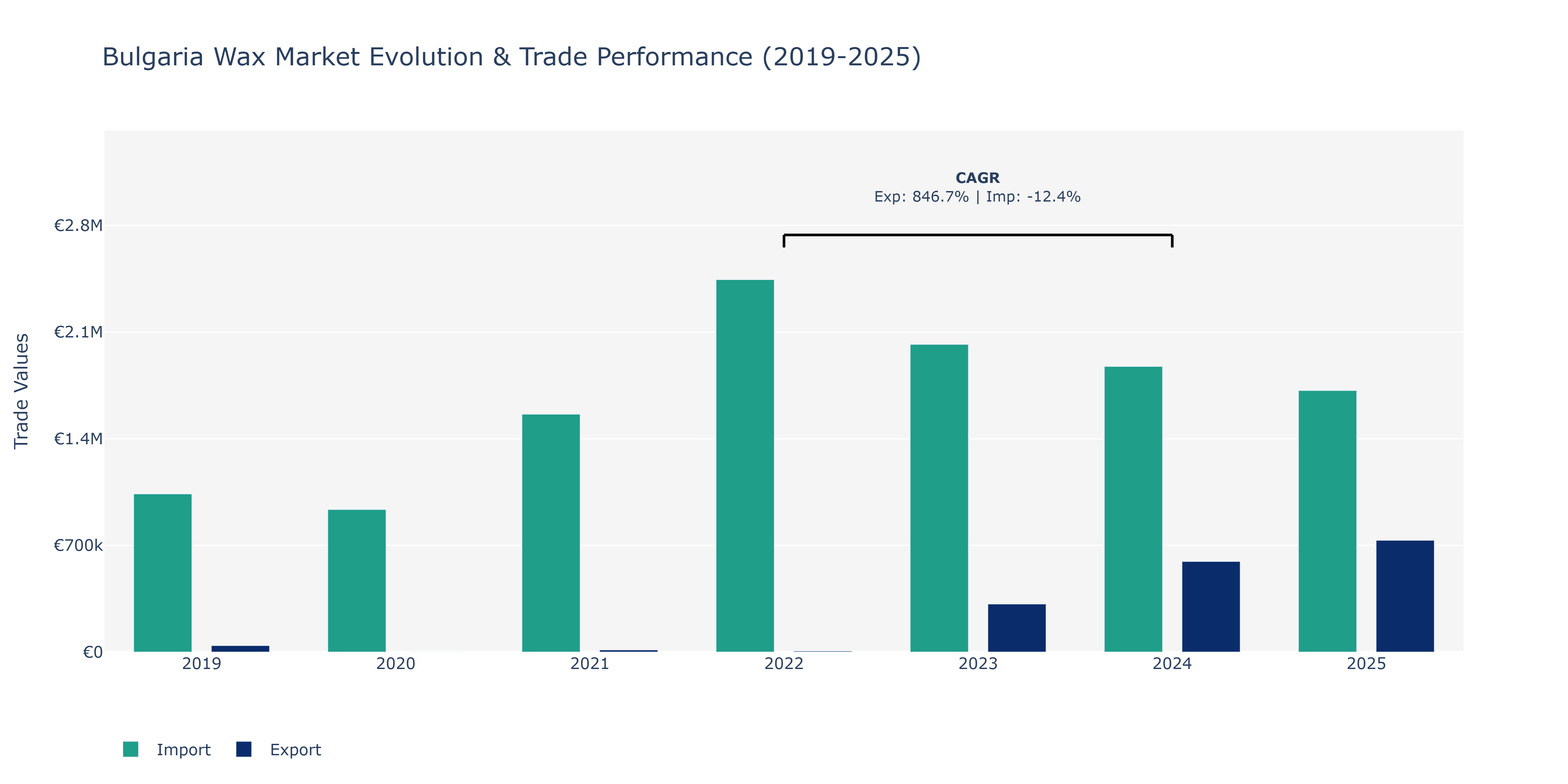
In the Bulgaria Wax Market, exports experienced notable fluctuations over the years. In 2019, exports stood at €42.19 thousand and increased substantially to €315.22 thousand in 2023 before peaking at €733.43 thousand in 2025. The market saw a significant rise in outbound shipments, possibly driven by growing international demand for Bulgarian wax products, improved production processes, and effective marketing strategies. Conversely, imports showcased a different trend, starting at €1.04 million in 2019, decreasing to €935.32 thousand in 2020, and then fluctuating between €1.67 million and €1.88 million from 2022 to 2024. The decline in imports in 2020 might be attributed to global economic uncertainties impacting buying patterns, while the subsequent stability suggests consistent demand for imported raw materials for wax production in Bulgaria. These dynamics reflect a balance between domestic production capabilities and reliance on external sources, indicating a resilient and adaptable market landscape.
Bulgaria Wax Market Overview
The wax market in Bulgaria is witnessing growth, driven by its diverse applications in industries such as cosmetics, packaging, and candles. The demand for high-quality waxes, including paraffin, beeswax, and synthetic waxes, is increasing as manufacturers seek to enhance the quality and performance of their products. The market is expected to grow as consumer preferences for natural and eco-friendly products continue to rise.
Drivers of the market
The Bulgaria Wax market is influenced by demand across various applications, including cosmetics, packaging, and automotive industries. Wax is used for its protective, aesthetic, and functional properties in a wide range of products. The growth in consumer goods, coupled with advancements in wax formulations and production technologies, supports market expansion. Additionally, increasing demand for natural and eco-friendly wax alternatives drives market development.
Challenges of the market
Challenges in the wax market in Bulgaria include fluctuating prices of raw materials and high production costs. The market also faces competition from alternative products and technologies, which can impact demand and pricing. Regulatory requirements related to environmental and safety standards add to operational costs. Additionally, there is a need for continuous innovation to meet evolving customer needs and market trends.
Government Policy of the market
In Bulgaria, the wax market is influenced by regulations related to product safety and environmental impact. Government policies promoting the use of sustainable and non-toxic waxes drive demand in various industries, including cosmetics and packaging.
Key Highlights of the Report:
- Bulgaria Wax Market Outlook
- Market Size of Bulgaria Wax Market, 2024
- Forecast of Bulgaria Wax Market, 2031
- Historical Data and Forecast of Bulgaria Wax Revenues & Volume for the Period 2021-2031
- Bulgaria Wax Market Trend Evolution
- Bulgaria Wax Market Drivers and Challenges
- Bulgaria Wax Price Trends
- Bulgaria Wax Porter`s Five Forces
- Bulgaria Wax Industry Life Cycle
- Historical Data and Forecast of Bulgaria Wax Market Revenues & Volume By Product for the Period 2021-2031
- Historical Data and Forecast of Bulgaria Wax Market Revenues & Volume By Mineral for the Period 2021-2031
- Historical Data and Forecast of Bulgaria Wax Market Revenues & Volume By Synthetic for the Period 2021-2031
- Historical Data and Forecast of Bulgaria Wax Market Revenues & Volume By Natural for the Period 2021-2031
- Historical Data and Forecast of Bulgaria Wax Market Revenues & Volume By Applications for the Period 2021-2031
- Historical Data and Forecast of Bulgaria Wax Market Revenues & Volume By Candles for the Period 2021-2031
- Historical Data and Forecast of Bulgaria Wax Market Revenues & Volume By Packaging for the Period 2021-2031
- Historical Data and Forecast of Bulgaria Wax Market Revenues & Volume By Plastic & Rubber for the Period 2021-2031
- Historical Data and Forecast of Bulgaria Wax Market Revenues & Volume By Cosmetics & Toiletries for the Period 2021-2031
- Historical Data and Forecast of Bulgaria Wax Market Revenues & Volume By Fire Logs for the Period 2021-2031
- Historical Data and Forecast of Bulgaria Wax Market Revenues & Volume By Adhesives for the Period 2021-2031
- Historical Data and Forecast of Bulgaria Wax Market Revenues & Volume By Others for the Period 2021-2031
- Bulgaria Wax Import Export Trade Statistics
- Market Opportunity Assessment By Product
- Market Opportunity Assessment By Applications
- Bulgaria Wax Top Companies Market Share
- Bulgaria Wax Competitive Benchmarking By Technical and Operational Parameters
- Bulgaria Wax Company Profiles
- Bulgaria Wax Key Strategic Recommendations






































